
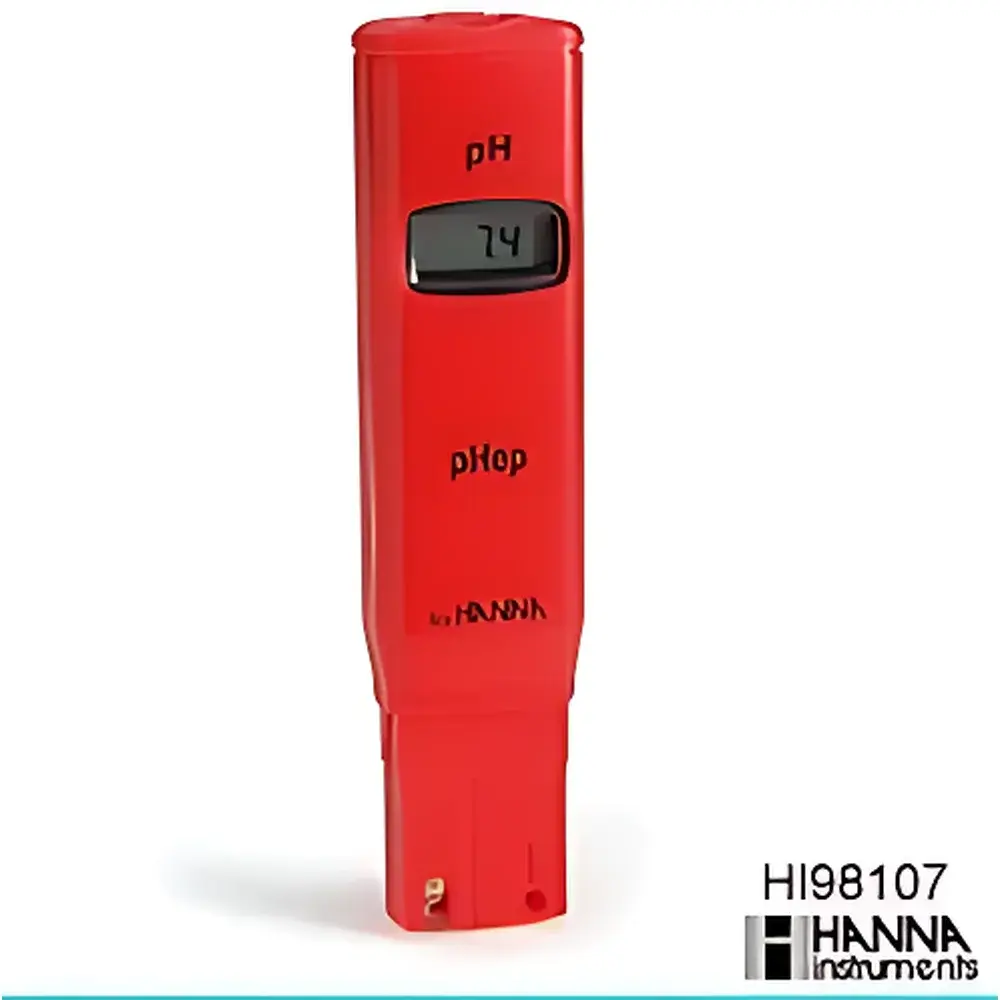
Hanna HI98107 Portable pH Meter
| Brand | Hanna Instruments |
|---|---|
| Origin | Italy |
| Model | HI98107 |
| pH Range | 0.0 to 14.0 |
| Resolution | 0.1 pH |
| Accuracy | ±0.1 pH |
| Calibration | Manual 2-point |
| Electrode | HI73106 replaceable pH electrode |
| Power | 4 × 1.5 V AAA batteries |
| Operating Environment | 0 to 50 °C, ≤95% RH |
| Dimensions | 175 × 41 × 23 mm |
| Weight | 95 g |
Overview
The Hanna HI98107 Portable pH Meter is a compact, handheld electrochemical instrument engineered for rapid, field-ready pH measurement across laboratory, educational, aquaculture, hydroponic, food safety, and environmental monitoring applications. It operates on the potentiometric principle: measuring the potential difference between a glass pH-sensing membrane and a stable reference electrode (Ag/AgCl) immersed in aqueous solution, converted into pH units via the Nernst equation. Its robust, pen-style architecture integrates a sealed, replaceable HI73106 combination pH electrode with a built-in temperature sensor for automatic temperature compensation (ATC), ensuring consistent readings across varying ambient conditions without requiring external thermometers or manual input.
Key Features
- Compact ergonomic design optimized for one-handed operation and portability—ideal for spot-checking in tanks, reservoirs, processing lines, or classroom demonstrations.
- Large, high-contrast LCD display with wide viewing angle enables clear readability under diverse lighting conditions, including outdoor or low-illumination environments.
- Durable, replaceable HI73106 electrode featuring a specialized hydrated gel electrolyte and porous ceramic junction—designed for stability in low-ionic-strength samples and resistance to clogging in turbid or particulate-laden solutions.
- Manual two-point calibration using standard pH 4.01 and pH 7.01 (or pH 10.01) buffers—supports traceable calibration protocols compliant with ISO 8655-5 and ASTM D1293 for routine water quality testing.
- Integrated ATC functionality (0 to 50 °C) eliminates manual temperature entry errors and improves measurement reproducibility across seasonal or process-induced thermal variations.
- Low-power consumption architecture powered by four standard AAA batteries—provides extended operational life (>1,000 hours) and facilitates battery replacement in remote or resource-constrained settings.
Sample Compatibility & Compliance
The HI98107 is validated for use with aqueous solutions having total dissolved solids (TDS) 50 µS/cm. It is not intended for non-aqueous solvents, highly viscous fluids, or strong oxidizing agents (e.g., concentrated hypochlorite or peroxide). The instrument complies with CE marking requirements (2014/30/EU EMC Directive and 2011/65/EU RoHS Directive) and meets IEC 61010-1 safety standards for electrical equipment used in laboratory environments. While not certified for GMP/GLP-regulated production environments, its calibration traceability, documented electrode performance, and stable baseline drift (<0.02 pH/hour after stabilization) support use in QC/QA workflows aligned with ISO/IEC 17025 pre-analytical verification requirements.
Software & Data Management
The HI98107 is a standalone, non-data-logging instrument—designed for immediate readout and operator interpretation rather than automated data capture. This architecture minimizes firmware complexity, enhances long-term reliability, and avoids regulatory burdens associated with electronic records under FDA 21 CFR Part 11. Users are expected to manually record measurements alongside buffer lot numbers, calibration dates, and environmental notes in bound laboratory notebooks or LIMS-integrated forms. For laboratories requiring digital audit trails, Hanna recommends pairing the HI98107 with the HI98107-01 calibration kit (including certified pH standards and electrode storage solution) and documenting procedures per internal SOPs referencing ISO 17025 Clause 7.7 (Ensuring Validity of Results).
Applications
- Water quality assessment in municipal distribution systems, swimming pools, and wastewater treatment effluent streams.
- Routine pH verification during hydroponic nutrient solution preparation and recirculation monitoring.
- Quick-check validation of cleaning-in-place (CIP) rinse water neutrality prior to equipment reuse in food and beverage facilities.
- Classroom instruction in general chemistry and environmental science labs—supporting student understanding of acid-base equilibria and electrode response dynamics.
- Field-based soil slurry analysis (1:1 or 1:5 water extraction) per EPA Method 9045D guidelines.
- Pre-screening of fermentation broth pH in small-scale bioprocessing or craft brewing operations.
FAQ
Is the HI98107 suitable for measuring pH in non-aqueous solutions such as ethanol or oil?
No. The HI73106 electrode requires aqueous hydration to maintain stable junction potential and glass membrane response. Non-aqueous media cause rapid dehydration and irreversible electrode drift.
Can the HI98107 be calibrated with only one buffer solution?
While single-point calibration is possible for approximate checks, Hanna specifies two-point calibration (pH 4.01 and 7.01) to verify both slope and offset—essential for maintaining ±0.1 pH accuracy across the full 0.0–14.0 range.
How often should the HI73106 electrode be replaced?
Electrode lifespan depends on usage frequency and sample matrix. Under typical field conditions, replacement is recommended every 6–12 months—or immediately upon observing sluggish response (>30 sec to stabilize), unstable readings, or failure to calibrate within specification.
Does the HI98107 meet GLP documentation requirements?
It does not generate electronic audit trails or user authentication logs. However, when used with written calibration records, dated buffer certificates, and defined SOPs, it supports GLP-aligned data integrity practices for non-critical applications.
What is the function of the dialysis membrane visible at the electrode tip?
That is the junction sleeve—a porous PTFE membrane that controls electrolyte outflow. Extending it ~1–2 mm renews the junction surface area, restoring stable liquid junction potential in cases of minor clogging or drying.




