
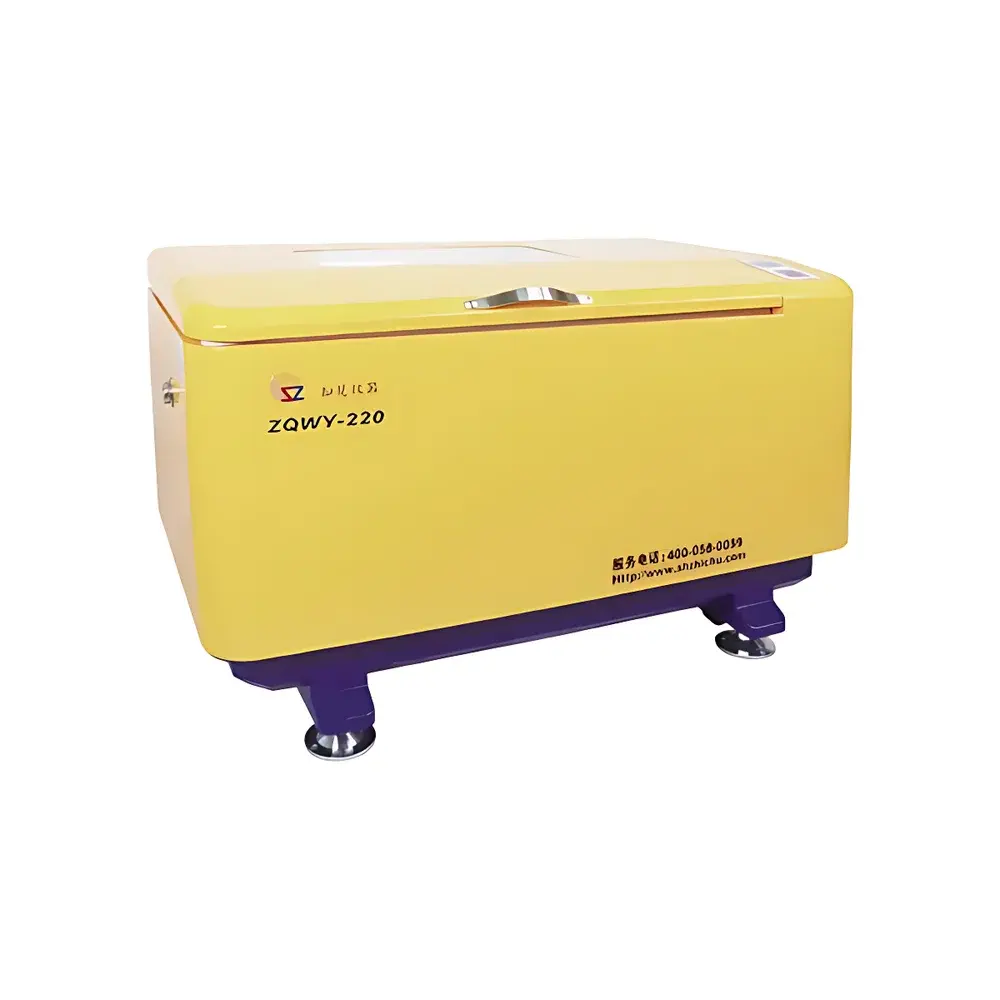
Zhichu ZQWY-220 Horizontal High-Capacity Full-Temperature Orbital Shaker Incubator
| Brand | Zhichu |
|---|---|
| Origin | Guangdong, China |
| Manufacturer Type | Authorized Distributor |
| Product Category | Domestic |
| Model | ZQWY-220 |
| Instrument Type | Full-Temperature Orbital Shaker Incubator |
| Timer Range | 0–999.9 h |
| Oscillation Frequency | 10–300 rpm (Φ26 mm), 10–250 rpm (Φ50 mm) |
| Oscillation Amplitude | Φ26 mm (standard), Φ50 mm (optional) |
| Temperature Range | 4–60 °C (ambient 23–25 °C) |
| Shelf Quantity | 3 |
| Frequency Accuracy | ±1 rpm |
| Temperature Control Accuracy | ±0.1 °C |
| Temperature Uniformity | ±1 °C (at 37 °C) |
| Max Capacity (stainless steel clamps) | 250 mL × 70, 500 mL × 48, 1000 mL × 24, 2000 mL × 15, or 15,000 mL × 4 |
| Max Capacity (plastic clamps) | same as above |
| Shelf Dimensions (L×W) | 905 mm × 630 mm |
| External Dimensions (L×W×H) | 1340 mm × 880 mm × 990 mm |
| Net Weight | ~314 kg |
| Noise Level | <55 dB(A) |
| Clearance from Shelf to Chamber Top | 645 mm |
| Display | LCD with backlight |
| Control Algorithm | PID microcomputer |
| Air Circulation | Forced convection with silent fan |
| Refrigeration System | Imported compressor + eco-friendly non-CFC refrigerant |
| Safety Features | Over-temperature alarm, auto power-off on fault, power-loss recovery, UV sterilization, door-open pause, EMI filter ring |
| Optional Upgrades | Touchscreen interface, bidirectional rotation control, encrypted operation lock |
Overview
The Zhichu ZQWY-220 is a horizontally configured, high-capacity full-temperature orbital shaker incubator engineered for demanding microbiological, cell culture, and fermentation applications requiring simultaneous precise temperature control and uniform agitation across large sample volumes. Unlike vertical or compact benchtop shakers, its horizontal architecture maximizes usable chamber volume while maintaining mechanical stability at high rotational speeds—critical for oxygen-sensitive cultures, suspension-based bioprocesses, and long-duration kinetic studies. The system operates on the principle of orbital shaking (typically 20–25 mm nominal amplitude), generating gentle yet effective mixing via eccentric motion driven by a high-torque servo motor and a three-dimensional offset triple-crank mechanism. This design ensures low-vibration transmission, minimal shear stress on sensitive cells, and exceptional long-term mechanical reproducibility—validated by ±1 rpm frequency accuracy and ±0.1 °C temperature regulation across the full 4–60 °C operating range.
Key Features
- Triple-crank eccentric drive system delivering smooth, low-noise orbital motion (<55 dB[A]) with enhanced durability and load-balancing capacity up to 314 kg gross weight
- PID-controlled forced-air convection with silent axial fans and optimized side ventilation ports—ensuring rapid thermal equilibration and uniformity (±1 °C at 37 °C) across all three independently accessible shelves
- High-efficiency refrigeration module featuring an imported hermetic compressor and R134a/R600a blended non-ozone-depleting refrigerant, enabling stable sub-ambient operation down to 4 °C for cold-adapted strain cultivation or enzyme kinetics
- UV-C germicidal lamp integrated into the chamber ceiling, activated automatically during idle cycles or manually via control panel, reducing microbial contamination risk between runs
- Intelligent safety architecture including over-temperature cutoff, real-time fault diagnostics, automatic restart after power interruption (with timestamped resume), and door-open immediate stop functionality compliant with IEC 61010-1 mechanical safety requirements
- Ergonomic front-access design with tempered double-glazed observation window, adjustable leveling feet, and integrated casters—facilitating safe relocation and routine maintenance without disassembly
Sample Compatibility & Compliance
The ZQWY-220 accommodates diverse vessel formats via interchangeable clamp systems: standard injection-molded polypropylene universal clamps (for single-handed vial insertion/removal) and optional stainless-steel fixtures rated for autoclaving. Maximum configurations include 70 × 250 mL Erlenmeyer flasks, 48 × 500 mL bottles, or 4 × 15 L carboys—supporting scalable process development from lab-scale screening to pilot-batch preparation. All internal surfaces feature electropolished 304 stainless steel with R-corner geometry, meeting ISO 14644-1 Class 7 cleanroom-compatible surface finish standards for ease of decontamination and biofilm resistance. The unit complies with GB/T 23792–2009 (Chinese national standard for incubator shakers), and its electrical safety design conforms to IEC 61010-1 Ed.3. While not FDA 21 CFR Part 11–certified out-of-box, audit-ready data logging (via optional RS485/Modbus RTU or USB export) supports GLP/GMP-aligned workflows when paired with validated third-party LIMS integration.
Software & Data Management
The base model employs a backlit monochrome LCD interface with encrypted parameter locking—preventing unauthorized changes to critical setpoints (temperature, speed, duration) during unattended operation. Optional touchscreen upgrade enables dual-display visualization: real-time values (actual temp/speed/remaining time) and user-defined targets appear simultaneously without mode switching. All operational events—including start/stop timestamps, temperature deviations >0.5 °C, speed fluctuations >2 rpm, and UV cycle logs—are stored in non-volatile memory with configurable retention (up to 30 days). Data export is supported via USB flash drive (CSV format) or serial communication (ASCII protocol), facilitating traceability for quality records per ISO/IEC 17025 clause 7.7. Firmware updates are performed offline using signed binary files to maintain integrity—no cloud connectivity or remote access is implemented, preserving network isolation per ITAR and institutional cybersecurity policies.
Applications
- Mammalian and insect cell suspension culture under controlled hypoxia or normoxia (leveraging side air-intake ports for O2 exchange modulation)
- Recombinant protein expression in E. coli BL21(DE3) strains requiring tight temperature ramping (e.g., 37 °C induction → 16 °C post-induction folding)
- Soil microbiome enrichment assays involving multi-liter mixed-culture fermentations with periodic sampling
- Antibiotic susceptibility testing (AST) using broth microdilution protocols compliant with CLSI M07-A11 guidelines
- Enzyme activity profiling across thermal gradients (e.g., thermostable polymerases from 4–60 °C)
- Algal biomass production trials requiring photoperiod-synchronized agitation and cooling
FAQ
What is the maximum flask size supported on the standard shelf configuration?
The ZQWY-220 accommodates up to four 15 L carboys or twenty-four 1 L flasks per shelf—totaling 72 × 1 L vessels across three shelves. Load distribution must remain symmetrical to maintain rotational balance.
Does the unit support programmable temperature ramps or multi-step protocols?
No—this model implements single-setpoint PID control only. For gradient-based experiments, external programmable chillers or auxiliary controllers are required.
Can the UV sterilization cycle be scheduled independently of shaker operation?
Yes. UV activation is decoupled from agitation and temperature control; users may initiate timed cycles (1–60 min) manually or configure automatic daily sanitation at system startup.
Is the refrigeration system serviceable on-site by authorized technicians?
Yes. Compressor, capillary tube, and evaporator assemblies are modular and accessible without chamber disassembly. Refrigerant charging requires certified HVAC-R personnel per local environmental regulations.
What documentation is provided for IQ/OQ validation?
Factory calibration certificates (temperature uniformity, speed accuracy, timer linearity) and electrical safety test reports are included. Customized 21 CFR Part 11–compliant validation packages are available upon request with additional lead time.





