
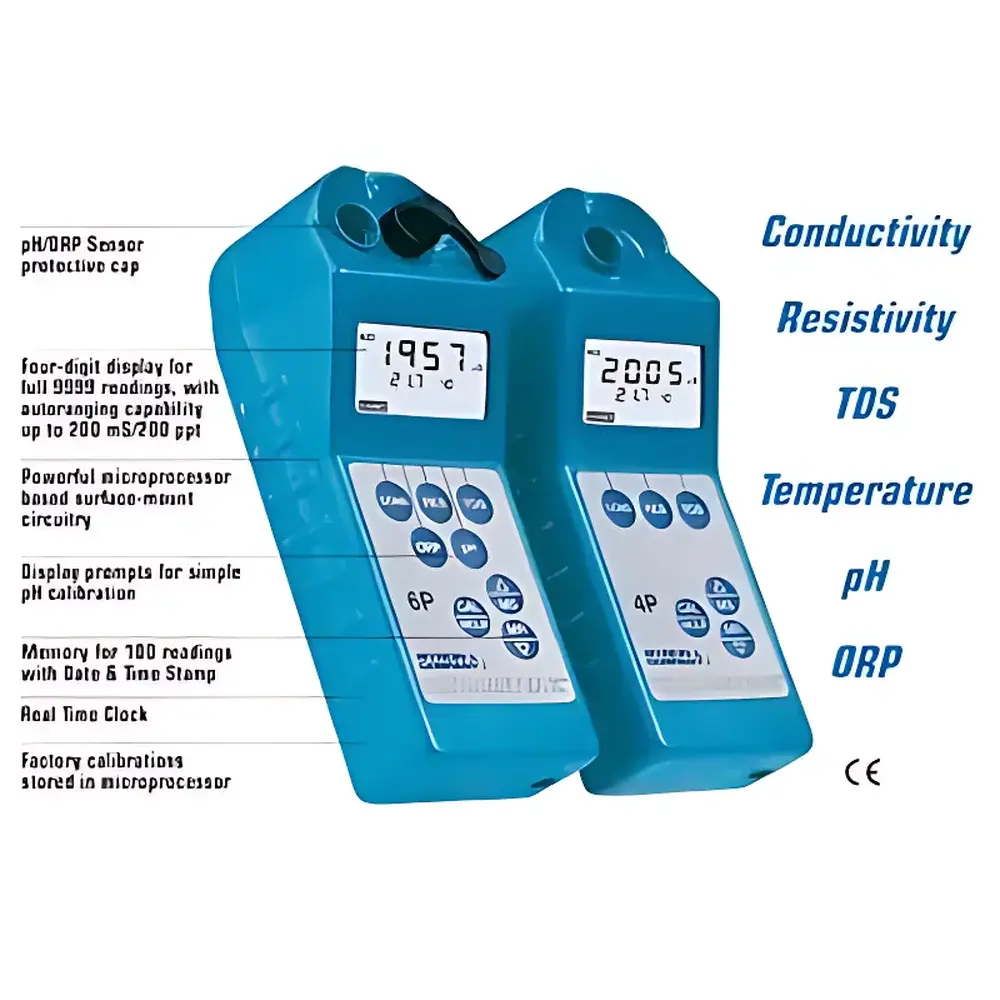
MYRON L Ultrameter 6P Portable 6-Parameter pH/Conductivity Meter
| Brand | MYRON L |
|---|---|
| Origin | USA |
| Model | Ultrameter 6P |
| Instrument Type | Portable |
| Parameter Count | 6 |
| Measurement Accuracy | ±0.01 pH |
| pH Range | 0–14 |
| pH Resolution | 0.01 |
| pH Accuracy | ±0.01 pH |
| Calibration Solution | pH 7 buffer |
| Conductivity Range | Auto-ranging 0–9999 µS/cm, 10–200 mS/cm |
| TDS Range | 0–9999 ppm, 10–200 ppt |
| Resistivity Range | 10 kΩ·cm – 30 MΩ·cm |
| ORP Range | ±999 mV |
| Temperature Range | 0–71 °C |
| Temperature Resolution | 0.1 °C |
| Temperature Accuracy | ±0.1 °C |
| Auto Temperature Compensation | Yes (0–71 °C) |
| IP Rating | IP67 (NEMA 6) |
| Data Storage | 20 points with timestamp |
| Enclosure | Fully sealed, buoyant, submersible to 1 m |
Overview
The MYRON L Ultrameter 6P is a field-deployable, six-parameter electrochemical analyzer engineered for high-reliability in-situ water quality assessment. It operates on potentiometric and conductometric principles: pH and ORP are measured via ion-selective glass and noble-metal electrodes using Nernstian response; conductivity, TDS, and resistivity are derived from four-pole AC conductivity measurement to minimize polarization errors and electrode fouling; temperature is acquired via a precision thermistor with automatic compensation applied across all parameters. Designed for demanding environments—from semiconductor ultrapure water loops and pharmaceutical WFI systems to wastewater treatment effluents and environmental surface monitoring—the Ultrameter 6P delivers laboratory-grade traceability in a ruggedized handheld platform compliant with ASTM D1125 (Standard Test Methods for Electrical Conductivity and Resistivity of Water) and ISO 7888 (Water Quality — Determination of Electrical Conductivity).
Key Features
- True six-parameter capability: simultaneous real-time measurement of pH, ORP, conductivity, TDS, resistivity, and temperature—no mode switching or sensor swapping required
- IP67-rated enclosure with fully sealed membrane keypad and buoyant ABS/PC housing; certified submersible to 1 meter for 30 minutes (IEC 60529)
- Integrated sample cup eliminates external beakers and minimizes cross-contamination—enables stable measurements in ultra-low-conductivity water (150 mS/cm) using the same probe assembly
- Auto-ranging conductivity circuit with dual-range excitation (low-current for high-resistivity, high-current for low-resistivity), eliminating manual range selection errors
- Onboard calibration verification: built-in diagnostic routines confirm electrode slope, asymmetry potential, and cell constant integrity prior to each measurement sequence
- 20-point non-volatile memory with embedded UTC timestamp (YYYY-MM-DD HH:MM), exportable via optional IR interface or analog output (0–5 V)
Sample Compatibility & Compliance
The Ultrameter 6P accommodates aqueous samples across the full industrial spectrum: deionized water (0.055 µS/cm), reverse osmosis permeate, boiler feedwater, cooling tower recirculation, municipal drinking water, activated sludge supernatant, and seawater (53 mS/cm). Its single-probe architecture avoids inter-sensor alignment drift common in multi-electrode arrays. All measurements adhere to GLP data integrity requirements: audit trail metadata (operator ID, calibration history, ambient temperature, probe serial number) is retained with each stored reading. The device meets FDA 21 CFR Part 11 readiness when paired with validated third-party data logging software, supporting electronic signatures and change control protocols required in pharmaceutical and biotech manufacturing.
Software & Data Management
While the Ultrameter 6P operates autonomously without PC connectivity, its data structure follows ASTM E1382-compliant ASCII format for seamless integration into LIMS and SCADA systems. Optional infrared (IR) communication enables wireless transfer of timestamped datasets to Windows-based desktop utilities, generating CSV reports with calculated parameters (e.g., NaCl-equivalent TDS, theoretical resistivity at 25 °C). Firmware updates preserve calibration coefficients and user-defined units (µS/cm vs. mS/cm, ppm vs. ppt) across revisions. No proprietary drivers or cloud dependencies are required—data remains under full user control per ISO/IEC 27001-aligned information governance policies.
Applications
- Pharmaceutical water systems: routine verification of Purified Water (PW) and Water for Injection (WFI) per USP and EP 2.2.38
- Semiconductor fab monitoring: real-time detection of trace alkali/acid contamination in UPW rinse baths
- Power generation: condensate polisher outlet resistivity trending and cation conductivity estimation
- Environmental fieldwork: EPA Method 120.1 (pH) and Method 120.2 (conductivity) compliance in stream, lake, and groundwater surveys
- Food & beverage QA: post-CIP rinse verification, brine concentration validation, and cleaning solution titration support
- Academic research: kinetic studies of corrosion inhibitors where simultaneous pH/ORP/conductivity capture dynamic interfacial reactions
FAQ
Does the Ultrameter 6P require separate electrodes for pH and conductivity?
No. It uses a single, integrated 4-pole conductivity/pH/ORP sensor cartridge with patented dual-reference junction design—eliminating inter-electrode spacing errors and enabling stable ultra-pure water measurement.
Can it measure resistivity below 1 MΩ·cm with accuracy?
Yes. The instrument applies low-frequency AC excitation and adaptive current sourcing to maintain ±1% reading accuracy down to 10 kΩ·cm, verified per ASTM D1125 Annex A3.
Is calibration traceable to NIST standards?
All factory calibrations are performed against NIST-traceable reference solutions (pH 4.01, 7.00, 10.01; KCl 1413 µS/cm); certificate of conformance includes uncertainty budgets per ISO/IEC 17025.
How is temperature compensation implemented across parameters?
A calibrated thermistor embedded in the sensor body provides continuous 0.1 °C resolution. Conductivity compensation follows the DIN EN 27888 algorithm; pH uses the standard Nernst temperature coefficient (−0.198 mV/°C per pH unit).
What maintenance is required beyond routine calibration?
Annual verification of cell constant and electrode slope is recommended. The sensor cartridge is replaceable as a single unit—no field disassembly or electrolyte refills needed.
Related Products




