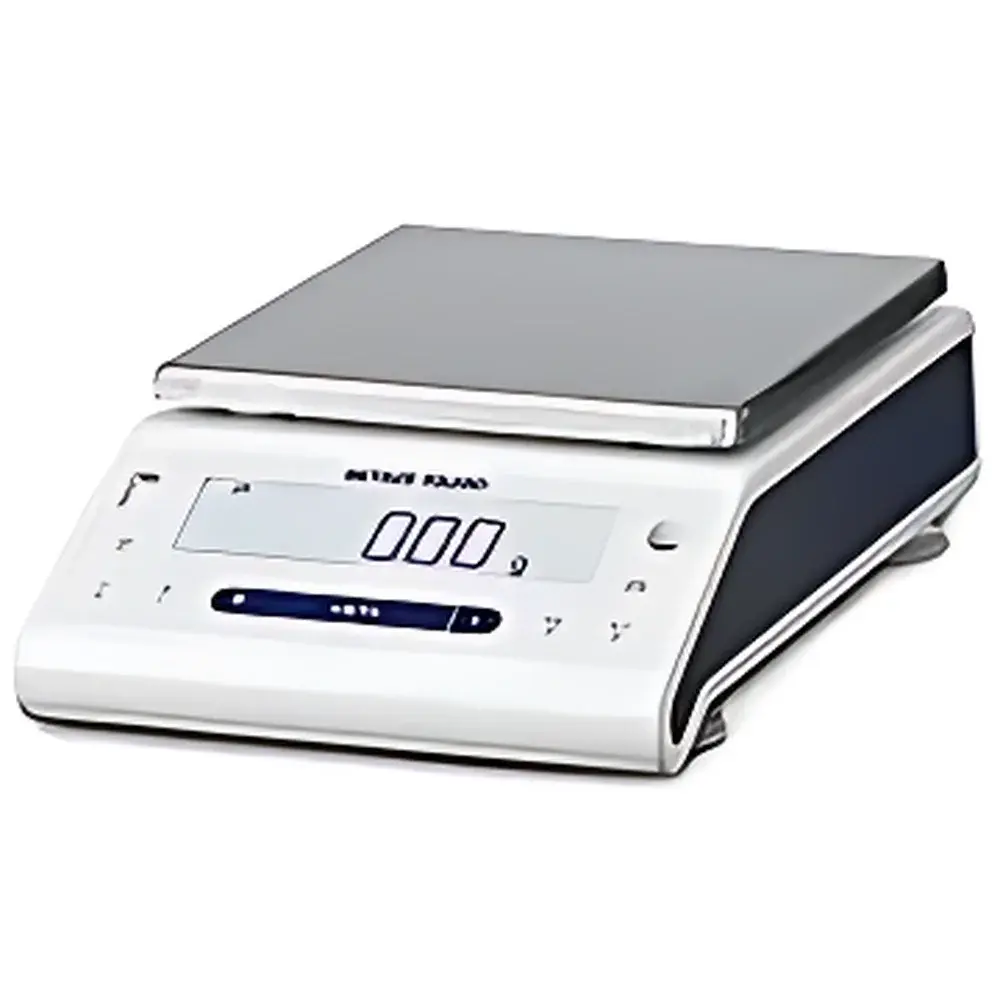
METTLER TOLEDO NewClassic ML Series Precision Balance
| Brand | METTLER TOLEDO |
|---|---|
| Origin | Switzerland |
| Model | ML Series |
| Readability | 0.01 g |
| Max Capacity | 820 g to 4200 g (model-dependent) |
| Calibration | Internal motorized calibration with built-in weights |
| Sensor Technology | MonoBloc single-module electromagnetic force compensation sensor |
| Display | Backlit LCD with ergonomic viewing angle |
| Compliance | ISO/IEC 17025, GLP/GMP-ready, USP Chapter 41 & 1251 compliant |
| Application Modes | Weighing, Percent Weighing, Density Determination, Checkweighing, Counting, Formulation, Statistics |
Overview
The METTLER TOLEDO NewClassic ML Series Precision Balance is an entry-level yet rigorously engineered analytical balance platform designed for routine laboratory weighing tasks requiring high repeatability, long-term stability, and regulatory traceability. Built upon METTLER TOLEDO’s proprietary MonoBloc electromagnetic force compensation (EMFC) sensor architecture, the ML Series eliminates mechanical levers and load-transmission components—minimizing hysteresis, thermal drift, and mechanical wear. This monolithic sensor design ensures consistent sensitivity across the full weighing range and delivers exceptional linearity and reproducibility under varying ambient conditions. The balance operates on the principle of restoring force measurement: when a sample is placed on the pan, the system applies a precisely controlled electromagnetic current to counteract gravitational force; the magnitude of this current is directly proportional to mass and digitally converted into a stable, high-resolution readout. With readability fixed at 0.01 g across all models—from the compact ML802 (820 g capacity) to the high-capacity ML4002E (4200 g)—the series bridges the performance gap between basic top-loading balances and higher-tier analytical instruments while maintaining cost-efficiency and operational simplicity.
Key Features
- Internal motorized calibration: Fully automated, user-initiated calibration using built-in reference weights—eliminates manual handling of external standards and reduces calibration-induced errors.
- MonoBloc single-module sensor: Integrated electromagnetic force compensation transducer with temperature-compensated coil and optimized magnetic circuit—ensures <0.002% linearity error and <0.003% repeatability (standard deviation) over 24-hour operation.
- Ergonomic backlit LCD display: 128 × 64 pixel high-contrast screen with wide viewing angle and adjustable brightness—optimized for prolonged use in variable lighting environments including fume hoods and cleanrooms.
- GLP/GMP-compliant functionality: Automatic timestamping, operator ID prompts (via optional keyboard), audit trail logging, and print-ready data export—fully compatible with 21 CFR Part 11 requirements when paired with METTLER TOLEDO LabX software.
- Dedicated application modes: Pre-installed workflows include piece counting (with statistical averaging), percentage weighing (relative to reference mass), density determination (using auxiliary sinker kit), checkweighing with configurable tolerance zones, formulation by incremental addition, and statistical process reporting (mean, SD, CV%, min/max).
- Robust mechanical architecture: Die-cast aluminum base with reinforced stainless-steel weighing pan and draft shield compatibility (optional ML-DSC kit)—designed for durability in shared lab environments with frequent repositioning.
Sample Compatibility & Compliance
The ML Series accommodates a broad spectrum of solid and granular samples—from pharmaceutical powders and chemical reagents to metal parts and polymer pellets—within its defined capacity and readability envelope. Its low-profile pan geometry and minimal air displacement characteristics reduce convective interference during dynamic weighing, supporting reliable measurements even with low-density or static-prone materials. All models comply with international metrological standards including OIML R76 (Class II), EN 45501, and ISO 9001 quality management system requirements. For regulated industries, the balances support full traceability per ISO/IEC 17025:2017 clause 6.4.10 (equipment verification), USP “Balances” and “Weighing on an Analytical Balance”, and are validated-ready for GxP environments when deployed with documented IQ/OQ protocols and periodic performance verification (e.g., repeatability, eccentricity, sensitivity, and linearity tests).
Software & Data Management
While the ML Series operates as a standalone instrument with intuitive front-panel navigation, it integrates seamlessly with METTLER TOLEDO’s LabX™ PC-based software suite for advanced data governance. LabX enables centralized method management, automated report generation (PDF/CSV), electronic signature capture, and real-time data archiving with full 21 CFR Part 11 compliance—including role-based access control, immutable audit trails, and secure electronic records retention. For labs without LabX, the balance supports direct RS232 or USB-to-serial output to LIMS or Excel via standard ASCII protocol (including ST command set), with configurable print formats for balance logs, calibration certificates, and statistical summaries.
Applications
- Quality control laboratories: Routine raw material verification, batch release testing, and finished product weight checks per pharmacopeial monographs.
- Academic teaching labs: Foundational mass measurement training, stoichiometric calculations, and physical chemistry experiments requiring sub-10 mg resolution.
- Environmental testing facilities: Soil sample preparation, filter weighing pre/post-gravimetric analysis (e.g., TSP, PM10), and reagent dispensing for EPA Method 1664B.
- Food & beverage R&D: Ingredient proportioning, nutritional labeling compliance, and shelf-life stability studies involving moisture loss/gain quantification.
- Materials science: Powder blending uniformity assessment, catalyst loading verification, and composite formulation consistency monitoring.
FAQ
What is the difference between ML and ML-E model variants?
The “E” suffix denotes enhanced connectivity: ML-E models include both RS232 and USB Device ports as standard, whereas non-E variants feature RS232 only. Both share identical weighing performance, calibration logic, and firmware capabilities.
Is external calibration required after internal calibration?
Internal calibration satisfies routine daily verification. However, periodic external calibration using certified reference weights (traceable to NIST or equivalent NMIs) is mandated by ISO/IEC 17025 and internal QA policies—typically every 3–6 months depending on usage frequency and criticality.
Can the ML balance be used in a fume hood?
Yes—provided the unit is mounted on a vibration-isolated surface, draft shields are installed (ML-DSC kit recommended), and airflow velocity near the pan remains below 0.2 m/s per USP . Temperature gradients inside the hood must be stabilized prior to operation.
Does the MonoBloc sensor require recalibration after relocation?
No. The MonoBloc design is inherently insensitive to minor leveling deviations and mechanical shock. However, the balance must be re-leveled and zeroed after transport; internal calibration should then be executed to confirm metrological integrity.
How is compliance with USP verified on the ML Series?
The balance meets USP criteria through factory-validated repeatability (<0.002% RSD at 5% and 100% capacity), minimum weight determination (calculated automatically via built-in MW function), and documented uncertainty budgets available in the instrument’s calibration certificate.