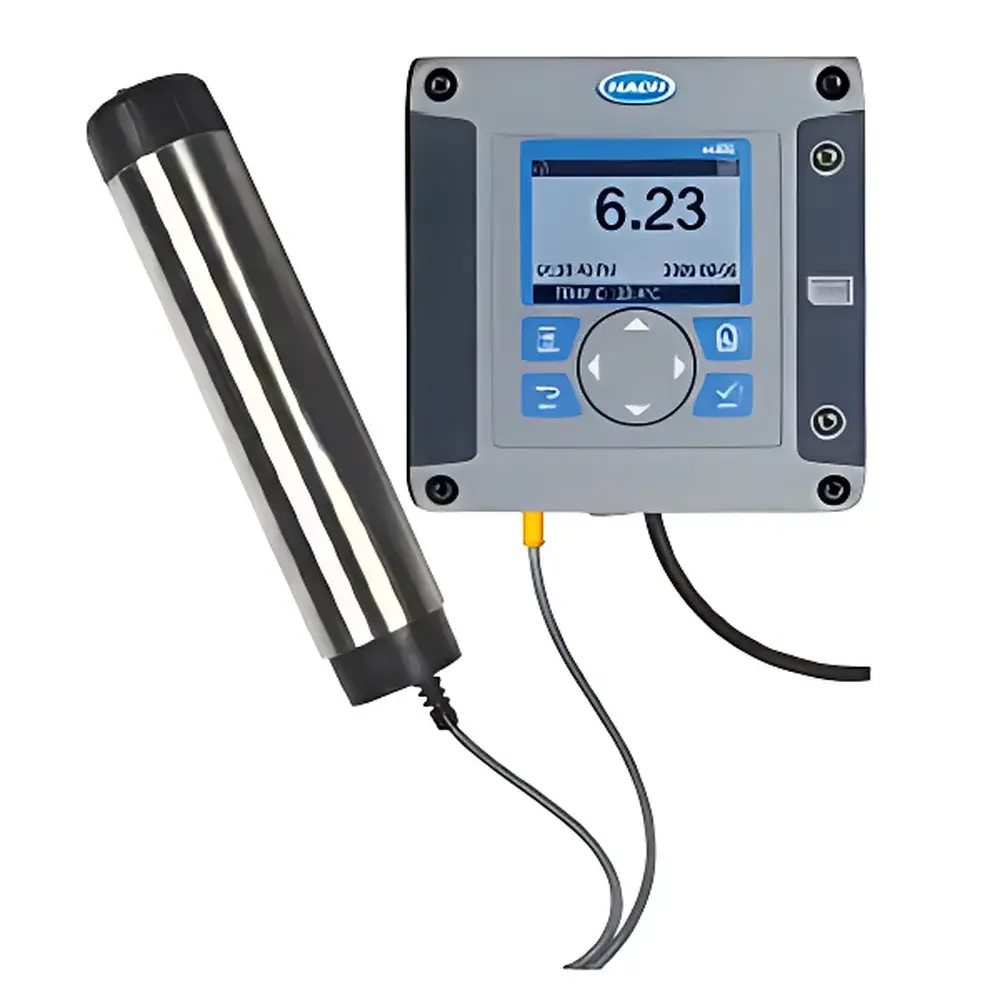
Hach LDO II Fluorescence-Based Online Dissolved Oxygen Analyzer
| Brand | Hach |
|---|---|
| Origin | USA |
| Model | LDO II |
| Measurement Principle | Fluorescence Quenching (Dynamic Luminescence Lifetime Detection) |
| Range | 0.00–20.00 mg/L (ppm) |
| Accuracy | ±0.1 mg/L (<1 mg/L), ±0.2 mg/L (≥1 mg/L) |
| Repeatability | ±0.05 mg/L |
| Response Time (t₉₀) | <60 s, (t₉₅): <90 s at 20°C |
| Temperature Compensation | Automatic, NTC 30 kΩ |
| Sensor Materials | Noryl housing, 316 stainless steel body, polybutadiene rubber sensing cap |
| Operating Temp. | 0.0–50.0°C (sensor), 0.0–100.0°C (sample) |
| Max. Cable Length | 300 m |
| Interference Resistance | Immune to H₂S, heavy metals (Pb²⁺, Cd²⁺, Cu²⁺, etc.), hydrocarbons, Cl₂, CN⁻, S²⁻, and common ions (Na⁺, Ca²⁺, NH₄⁺, NO₃⁻, SO₄²⁻, Cl⁻, etc.) |
| Analog Outputs | Dual 4–20 mA or 0–20 mA, isolated |
| Environmental Rating | IP66, -20–60°C operating, -30–70°C storage, 0–95% RH non-condensing |
| Warranty | 12 months on sensor module |
Overview
The Hach LDO II Fluorescence-Based Online Dissolved Oxygen Analyzer is an industrial-grade, maintenance-optimized process instrument engineered for continuous, high-reliability dissolved oxygen (DO) monitoring in wastewater treatment plants, drinking water distribution systems, and surface water quality networks. Unlike traditional electrochemical (Clark-type) sensors, the LDO II employs optical fluorescence quenching technology—specifically, dynamic luminescence lifetime detection—to quantify molecular oxygen concentration. This principle relies on the oxygen-dependent reduction in the excited-state lifetime of a ruthenium-based luminophore embedded in a gas-permeable polymer matrix. As dissolved O₂ molecules collide with the excited complex, they non-radiatively deactivate it; the resulting decay time is measured precisely via phase-shift analysis, eliminating drift associated with photobleaching or signal intensity variation. The absence of membranes, electrolytes, or polarizing voltages ensures zero polarization time, no zero-current drift, and immunity to fouling from sulfides, oils, chlorine residuals, or transition metal ions—critical advantages in biologically active or chemically aggressive process streams.
Key Features
- Zero-calibration operation for up to 12 months under typical municipal wastewater conditions, validated per ASTM D888 and ISO 5814 protocols
- Optical sensing architecture eliminates membrane replacement, electrolyte refills, and electrode polishing—reducing scheduled maintenance intervals by >80% versus amperometric DO analyzers
- Full-scale response time (t90) ≤60 seconds at 20°C; t95 ≤90 seconds—enabling real-time feedback control for aeration basins and denitrification zones
- Proven accuracy: ±0.1 mg/L below 1.0 mg/L and ±0.2 mg/L above 1.0 mg/L, traceable to NIST-certified standards
- Robust mechanical design: sensor body constructed from 316 stainless steel and Noryl® thermoplastic, with a polybutadiene rubber sensing cap rated for abrasion and biofilm resistance
- Dual isolated 4–20 mA analog outputs support redundant data routing to DCS/SCADA systems while maintaining intrinsic safety compliance (IEC 61000-6-2/4)
Sample Compatibility & Compliance
The LDO II is validated for use across heterogeneous aqueous matrices including activated sludge, anaerobic digester supernatant, tertiary effluent, raw surface water, and clarified potable water. Its immunity to >25 common interferents—including H₂S, Fe²⁺/Fe³⁺, Cu²⁺, Zn²⁺, CN⁻, Cl₂, crude oil, and all major anions and cations defined in EPA Method 360.1—is confirmed through interlaboratory testing per ISO/IEC 17025-accredited procedures. The analyzer complies with EN 61326-1 (EMC), EN 61010-1 (safety), and meets functional safety requirements for SIL 2 applications per IEC 61508 when integrated into certified control loops. It supports GLP/GMP data integrity workflows via optional Hach SC1000 platform integration, enabling audit-trail logging, user access controls, and electronic signature capability compliant with FDA 21 CFR Part 11.
Software & Data Management
When deployed with Hach’s SC1000 Multi-Parameter Controller or integrated into PlantWeb® digital ecosystems via Modbus TCP or HART 7, the LDO II delivers timestamped DO values with embedded temperature compensation metadata. Firmware v3.2+ enables automatic sensor health diagnostics—including luminophore degradation rate estimation, LED output stability tracking, and signal-to-noise ratio trending—accessible via secure HTTPS web interface or Hach Link™ desktop software. All configuration changes, calibration events (if performed), and fault logs are stored with UTC timestamps and operator ID, supporting regulatory reporting under ISO 9001, ISO 14001, and EU Water Framework Directive Annex V requirements.
Applications
- Real-time aeration control in activated sludge and MBR systems to optimize energy consumption while meeting NH₄⁺-N and COD removal targets
- Monitoring dissolved oxygen gradients across sequential batch reactors (SBRs) and oxidation ditches for process stability assessment
- Effluent compliance verification against discharge permits (e.g., EPA NPDES limits, EU Urban Wastewater Treatment Directive)
- Early detection of septicity onset in wet wells and force mains via rapid DO depletion trends
- Long-term ecological monitoring of rivers, lakes, and estuaries where sensor longevity and interference rejection are critical
FAQ
Does the LDO II require daily or weekly calibration?
No. Under stable operational conditions (pH 6–9, TSS < 150 mg/L, no abrasive solids), the factory-calibrated sensor maintains metrological validity for ≥12 months without adjustment—verified by periodic check with Winkler titration or certified air-saturated water standards.
Can the sensor be installed in submerged or pressurized piping?
Yes. The sensor is rated for continuous submersion up to 10 bar (145 psi) and compatible with insertion-style flow cells, retractable housings, and direct-threaded pipe mounts per ANSI B16.5 Class 150 flange specifications.
Is temperature compensation automatic and traceable?
Yes. An integrated NTC 30 kΩ thermistor provides real-time thermal correction across 0.0–50.0°C, with compensation algorithm coefficients certified per NIST SRM 1910b and documented in the instrument’s calibration certificate.
What is the maximum allowable cable distance between transmitter and sensor?
The standard configuration supports 10 m; using Hach-approved junction boxes and shielded twisted-pair cable (Belden 8761), total loop length extends to 300 m without signal degradation or noise susceptibility.
How does the LDO II handle hydrogen sulfide exposure in anaerobic zones?
H₂S has no measurable effect on the ruthenium-luminophore chemistry or optical window clarity—unlike Clark electrodes, which suffer irreversible poisoning and signal hysteresis upon H₂S contact. Field data from over 1,200 installations confirm stable performance in digester supernatant and septage lift stations.