
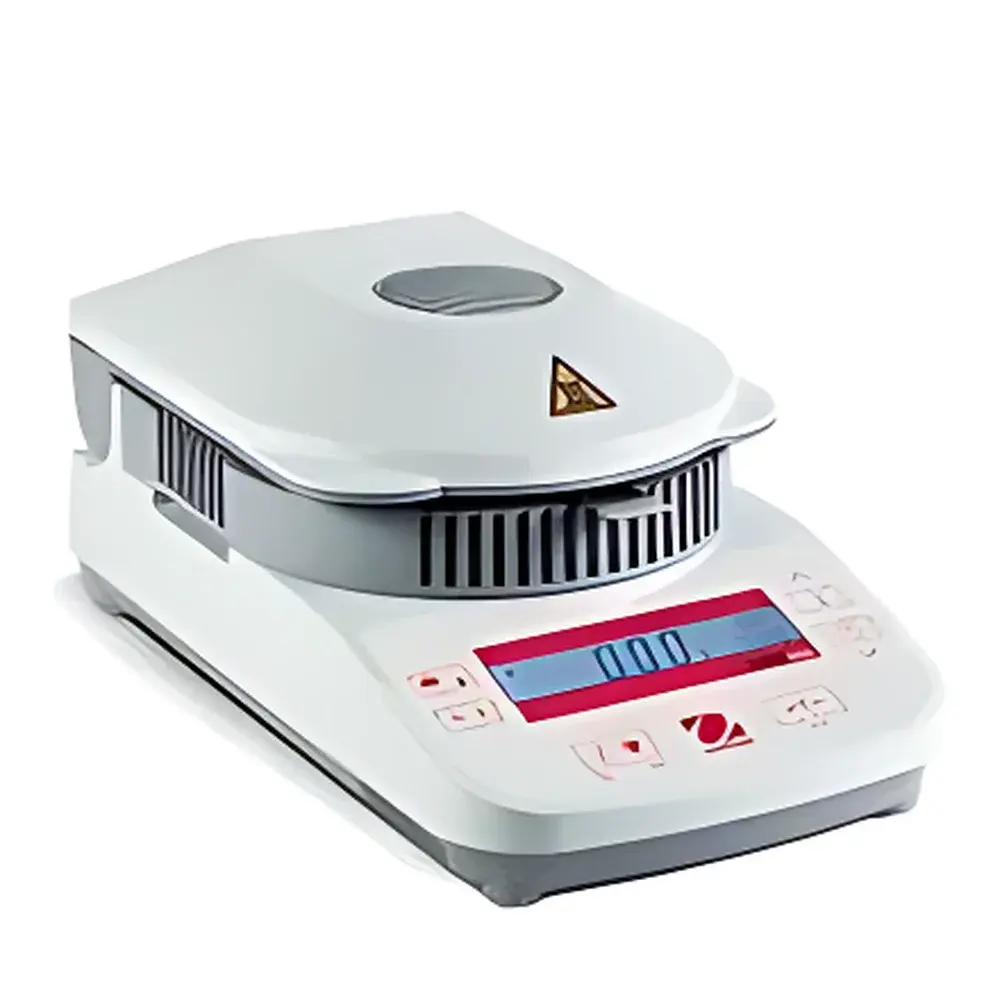
OHAUS MB25 Halogen Moisture Analyzer
| Brand | OHAUS |
|---|---|
| Origin | USA |
| Model | MB25 |
| Capacity | 110 g / 99 g (moisture mode) |
| Readability | 0.01 g / 0.005 g |
| Moisture Readability (>10 g sample) | 0.05% |
| Repeatability (3 g sample) | 0.2% |
| Repeatability (10 g sample) | 0.05% |
| Minimum Sample Mass | 0.5 g |
| Recommended Sample Mass | 3–20 g |
| Pan Diameter | Ø90 mm |
| Heating Source | Halogen lamp |
| Temperature Range | 50–160 °C (in 5 °C increments) |
| Heating Time | 1–60 min (30 s increments), 60–90 min (1 min increments) |
| End Point Modes | Timed, Automatic |
| Display | Backlit LCD showing moisture %, solids %, weight, time, temperature |
| Interface | Bidirectional RS232 |
| Operating Environment | 10–30 °C |
| Dimensions (W×H×D) | 165 × 127 × 280 mm |
| Net Weight | 2.1 kg |
| Gross Weight | 4.2 kg |
| Sample Pan Handle | Standard |
Overview
The OHAUS MB25 Halogen Moisture Analyzer is a precision thermal gravimetric instrument engineered for rapid, reliable moisture content determination in solid and semi-solid samples. It operates on the principle of loss-on-drying (LOD), where sample mass is continuously monitored during controlled halogen lamp heating. Unlike conventional infrared or convection ovens, the MB25 employs a high-intensity, focused halogen heating source that delivers uniform thermal energy with fast ramp rates—up to 40% faster than the MB23 model—enabling consistent drying kinetics across diverse matrices. Its integrated analytical balance utilizes an isolated load cell architecture, thermally decoupled from the heating chamber to eliminate thermal drift and ensure measurement integrity throughout the entire drying cycle. Designed for routine QC laboratories and production environments, the MB25 meets foundational requirements for method validation under ISO 5530-1, AOAC 952.08, and USP , supporting traceable, auditable moisture analysis in regulated and non-regulated settings.
Key Features
- Backlit monochrome LCD display delivering real-time visibility of moisture %, solids %, net weight, elapsed time, and current temperature—optimized for ambient lab lighting conditions.
- Six-button intuitive interface with no nested menus; all core functions—including start/stop, tare, method selection, and parameter adjustment—are accessible within one layer of operation.
- Thermally isolated weighing mechanism using proprietary isolation technology to suppress heat-induced signal interference, maintaining ±0.005 g readability even at 160 °C.
- Halogen lamp heating system with precise 5 °C adjustable setpoints (50–160 °C), enabling method-specific optimization for heat-sensitive (e.g., pharmaceutical actives) or refractory (e.g., animal feed, starches) materials.
- Bidirectional RS232 serial interface compliant with standard laboratory peripheral protocols—supports direct connection to thermal printers, LIMS workstations, and data acquisition PCs without additional drivers.
- Standard ergonomic sample pan handle and Ø90 mm stainless-steel weighing pan, compatible with optional glass fiber filters and ceramic crucibles for volatile or particulate-prone samples.
Sample Compatibility & Compliance
The MB25 accommodates a broad spectrum of industrial and research-grade materials, including hygroscopic powders (e.g., lactose, excipients), granular agrochemicals, roasted tea leaves, pet food kibble, polymer pellets, and ground spices. Its 0.5 g minimum sample mass and 3–20 g recommended range allow flexibility across low-mass R&D screening and high-throughput batch verification. The instrument complies with general-purpose metrological requirements per OIML R76-1 and supports GLP/GMP documentation workflows via timestamped, non-editable result export. While not natively 21 CFR Part 11–certified, its RS232 output enables integration with validated third-party data management systems that provide electronic signatures, audit trails, and user access controls required for FDA-regulated environments.
Software & Data Management
Data output is structured as ASCII text over RS232, formatted for seamless ingestion into spreadsheet applications (e.g., Microsoft Excel), statistical process control (SPC) platforms, or enterprise LIMS. Each record includes date/time stamp, operator ID (manually entered), method name, initial/final mass, moisture %, solids %, drying duration, and endpoint mode (timed vs. automatic). No proprietary software is bundled; however, OHAUS provides configuration guidelines for common terminal emulators (e.g., Tera Term) and offers firmware update utilities via USB-to-serial adapters. For laboratories requiring full traceability, the MB25’s deterministic endpoint logic—based on mass change rate thresholds—ensures method reproducibility across operators and shifts, forming a defensible basis for SOP development aligned with ISO/IEC 17025 clause 7.2.2.
Applications
- Food & Beverage: Quantification of moisture in flour, coffee beans, dried fruits, and snack foods per AOAC 937.01 and ICC 113/1.
- Pharmaceuticals: Residual solvent and water content verification in APIs and tablet granules prior to compression, supporting ICH Q5C stability guidance.
- Agriculture & Feed: Rapid assessment of grain moisture for storage compliance (e.g., USDA FGIS standards) and compound feed formulation consistency.
- Chemicals & Polymers: Monitoring drying efficiency of resins, catalysts, and pigment dispersions where over-heating degrades performance attributes.
- Tea & Botanicals: Batch release testing of processed leaves to prevent mold growth during warehousing while preserving volatile aroma compounds.
FAQ
What is the difference between halogen and infrared heating in moisture analyzers?
Halogen lamps emit broadband near-infrared radiation with higher power density and faster thermal response than traditional IR emitters, enabling tighter temperature control and reduced drying time—especially critical for heterogeneous or layered samples.
Can the MB25 be used for volatile organic compound (VOC) analysis?
No. The MB25 measures total volatile loss as “moisture” by mass reduction; it does not distinguish between water and other volatiles. For VOC-specific quantification, gas chromatography (GC) or Karl Fischer titration is required.
Is calibration traceable to NIST standards?
Yes. External calibration using certified weights (e.g., Class M2 or better) and reference moisture standards (e.g., sodium tartrate dihydrate) ensures traceability to SI units per ISO/IEC 17025 requirements.
Does the MB25 support multiple user-defined drying methods?
It stores one active method at a time; however, users can manually reconfigure parameters (temperature, time, endpoint) between runs without firmware modification.
How often should the halogen lamp be replaced?
Typical service life exceeds 5,000 hours under standard operating conditions; replacement is indicated by inconsistent heating profiles or failure to reach setpoint temperature within specification.




