
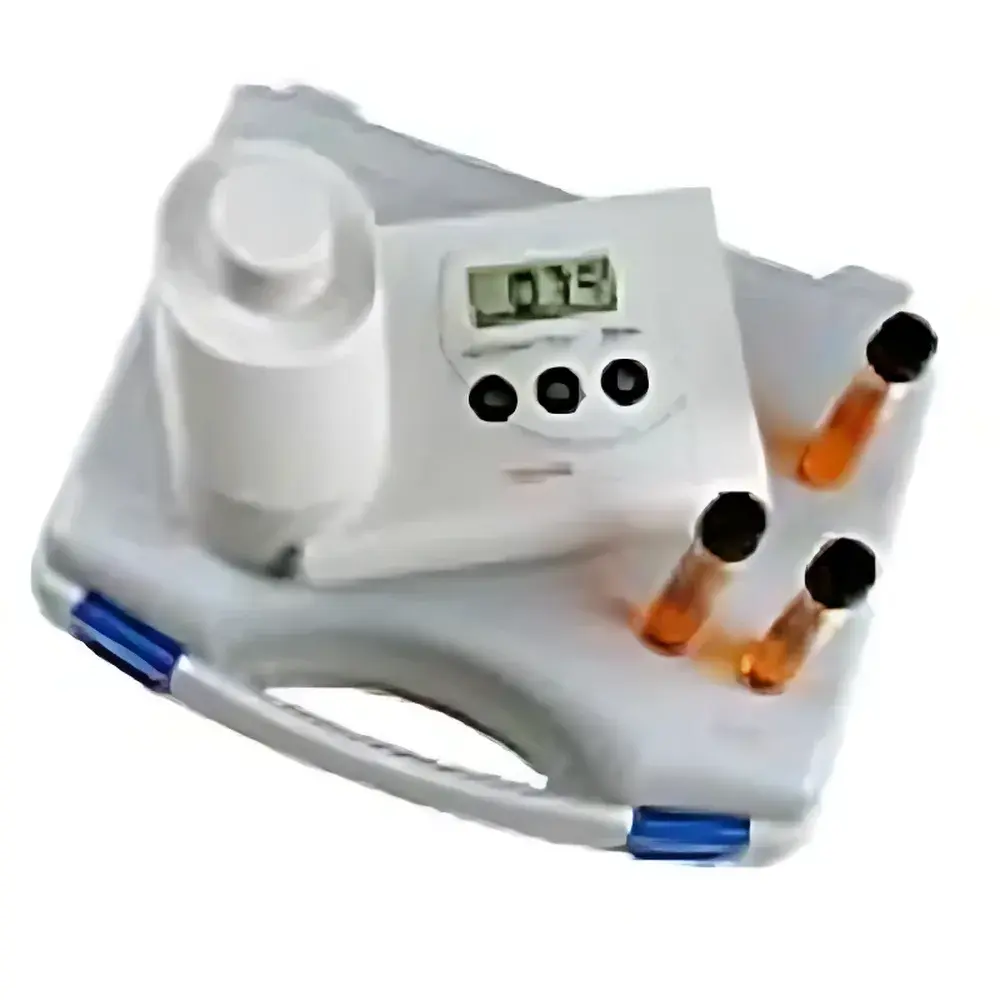
Merck Spectroquant® Picco COD Portable Chemical Oxygen Demand Analyzer
| Brand | Merck |
|---|---|
| Origin | Germany |
| Model | Picco COD |
| Instrument Type | Portable |
| Wavelength | 610 ± 20 nm |
| Measurement Range | 0–10000 mg/L (multi-range, segmented) |
| Accuracy | ≤ ±10% |
| Repeatability | ≤ ±5% |
| LOD | 0.1 mg/L |
| Measurement Time | < 5 seconds (post-digestion) |
| Batch Capacity | 12 or 24 samples (digestion-dependent) |
| Power Supply | 9-V alkaline battery (≈600 measurements) |
| Operating Temperature | 5–40 °C |
| Relative Humidity | 30–90% RH (non-condensing) |
| Compliance | CE marked per DIN EN 55022, EN 61000-4-2, EN 61000-4-8, EN 50082-2, EN 50081-1, DIN V ENV 50140, EN 50204 |
Overview
The Merck Spectroquant® Picco COD is a dedicated, portable photometric analyzer engineered for rapid, field-deployable determination of Chemical Oxygen Demand (COD) in water and wastewater samples. It operates on the principle of colorimetric analysis following dichromate-based open-reflux digestion—a standardized oxidation method defined in ISO 6060 and EPA Method 410.1. Unlike benchtop spectrophotometers, the Picco COD integrates a fixed-wavelength LED-optical system centered at 610 ± 20 nm—optimized for detecting the Cr(III) reduction product formed during digestion. Its design prioritizes operational simplicity and analytical robustness for users requiring reliable, single-parameter COD data without laboratory infrastructure. The instrument functions exclusively with Merck’s pre-calibrated, factory-prepared Spectroquant® COD cell tests, eliminating manual curve generation and minimizing inter-operator variability. As a true “plug-and-read” system, it delivers quantitative results in under five seconds after sample digestion—making it suitable for routine monitoring at municipal treatment plants, industrial effluent points, and environmental field surveys.
Key Features
- Dedicated optical architecture: High-stability LED light source paired with narrow-band interference filter ensures consistent photometric performance across extended field use.
- Pre-programmed, lot-specific calibration curves embedded in each Spectroquant® COD test vial—no user calibration required; traceability to Merck’s certified reference materials (CRM) is maintained per batch.
- Portable, all-in-one configuration: Includes instrument, rugged carrying case, 16-mm round cell adapter, 9-V battery, and operator manual—ready for immediate deployment without external power or PC interface.
- Low-power electronics: Engineered for >600 measurements per battery; automatic shutdown after 5 minutes of inactivity conserves energy and extends operational readiness.
- Robust environmental tolerance: Validated for continuous operation between 5–40 °C and 30–90% relative humidity (non-condensing), meeting typical ambient conditions encountered during outdoor sampling campaigns.
- CE-compliant electromagnetic compatibility: Certified to EN 61000-4-2 (ESD), EN 61000-4-8 (power-frequency magnetic fields), and EN 55022 (radiated/conducted emissions), ensuring stable function near pumps, radios, or other industrial equipment.
Sample Compatibility & Compliance
The Picco COD is validated for use with freshwater, wastewater, surface water, and treated effluent matrices—provided samples are digested using Merck’s approved Spectroquant® COD Cell Test kits (e.g., 1.14540.0001, 1.14541.0001, 1.14691.0001, 1.14555.0001). Each kit covers a distinct concentration range (10–150 mg/L to 500–10,000 mg/L) and includes pre-dosed reagents, digestion vials, and barcoded labels for unambiguous lot tracking. All test kits comply with ISO 6060:1989 and are manufactured under Merck’s ISO 9001-certified quality system. While the Picco itself does not perform digestion, its measurement protocol aligns with GLP-aligned workflows when paired with a certified block heater (e.g., Merck TR 320) and documented SOPs. Data generated supports regulatory reporting under EU Water Framework Directive (WFD) Annex V monitoring requirements and U.S. Clean Water Act discharge compliance when used within validated method scope.
Software & Data Management
The Picco COD operates as a standalone, firmware-controlled device with no onboard data storage or USB/Bluetooth connectivity. Results are displayed numerically on the LCD screen and must be manually recorded. For traceable documentation, users integrate the instrument into paper-based or LIMS-linked workflows: each test vial’s barcode corresponds to a unique Merck lot number, enabling full reagent traceability. When deployed in regulated environments (e.g., ISO/IEC 17025-accredited labs), the system supports audit readiness through procedural controls—including documented instrument verification (using supplied blank and standard checks), daily recalibration verification via control samples, and adherence to Merck’s Certificate of Analysis (CoA) for each reagent lot. While not 21 CFR Part 11 compliant out-of-the-box, the Picco COD can be incorporated into Part 11–compliant processes via complementary electronic lab notebooks (ELNs) that capture instrument ID, operator, date/time, sample ID, and result—provided metadata is entered contemporaneously.
Applications
- Routine effluent monitoring at small- to medium-sized wastewater treatment facilities where multi-parameter instrumentation is cost-prohibitive.
- Field validation of online COD sensors—used as a reference method during commissioning or periodic verification per ISO 15839.
- Educational laboratories teaching fundamental water quality principles, including redox chemistry and spectrophotometric quantification.
- Industrial pretreatment compliance checks for food processing, textile, and pharmaceutical manufacturing sites subject to local discharge limits.
- Emergency response scenarios—rapid assessment of organic loading after spills or process upsets, leveraging portability and minimal setup time.
- Research-grade screening in limnology or watershed studies where spatial sampling density outweighs the need for ultra-low detection limits.
FAQ
Does the Picco COD include a digestion unit?
No—the Picco COD is a photometer only. Sample digestion must be performed separately using a certified heating block (e.g., Merck TR 320) and Spectroquant® COD Cell Tests.
Can I use third-party COD reagents with this instrument?
No. The Picco COD relies on proprietary, pre-calibrated vials with embedded lot-specific calibration curves. Non-Merck reagents invalidate accuracy claims and void warranty support.
What is the lowest measurable COD concentration?
The practical limit of detection is 0.1 mg/L, achieved using the 10–150 mg/L test range (Cat. No. 1.14540.0001) and strict adherence to digestion protocol and blank correction.
Is the instrument suitable for saline or high-chloride samples?
Standard COD tests are susceptible to chloride interference above 1000 mg/L Cl⁻. For such matrices, Merck recommends using the chloride-compensated Spectroquant® COD Cell Test (Cat. No. 1.14553.0001) in conjunction with the Picco COD.
How often should I verify instrument performance?
Perform a blank and mid-range standard check before each analytical session. Full verification against NIST-traceable standards is recommended weekly or per organizational QA/QC policy.







