
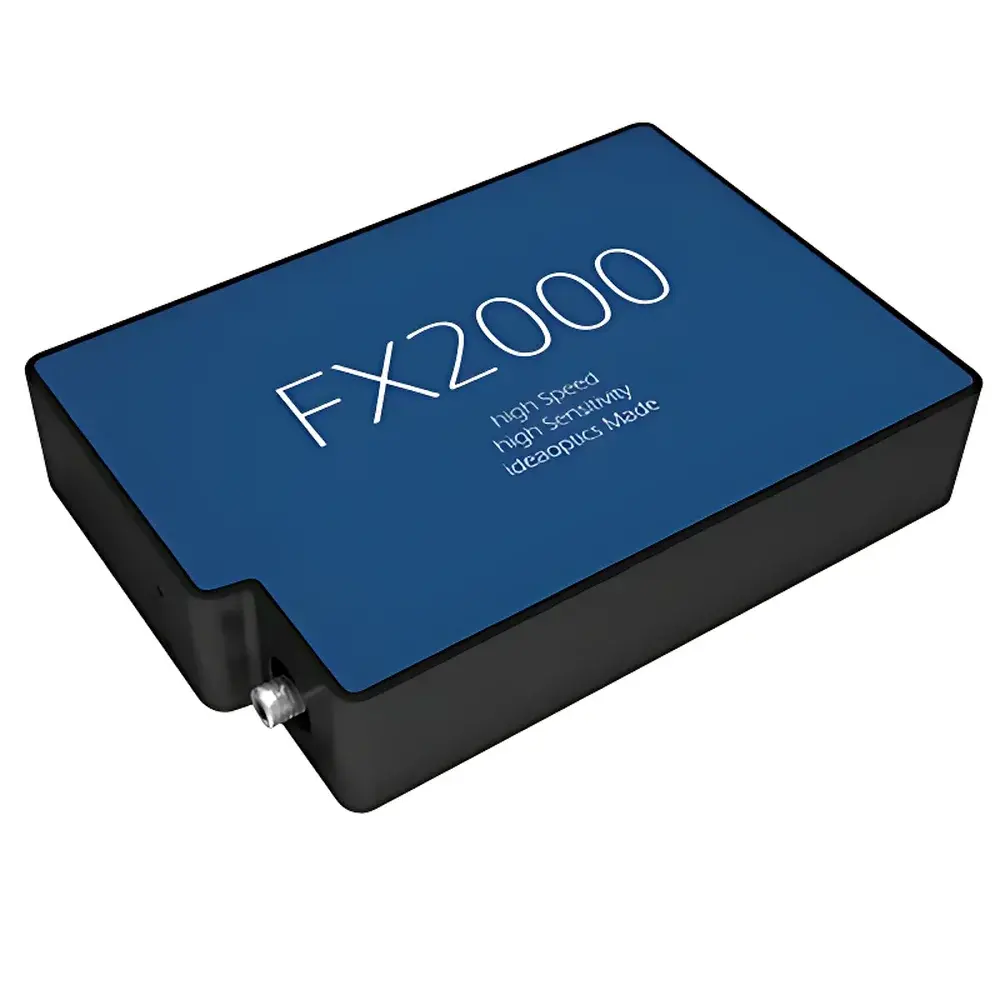
IdeaOptics FX2000 High-Speed Fiber Optic Spectrometer
| Brand | IdeaOptics |
|---|---|
| Origin | Shanghai, China |
| Manufacturer Type | Original Equipment Manufacturer (OEM) |
| Product Origin | Domestic (China) |
| Model | FX2000 |
| Spectral Range | 200–1100 nm |
| Detector Type | UV-enhanced CCD |
| Optical Resolution | 0.22–7.67 nm (FWHM, configurable via slit and grating selection) |
| Sensitivity | 130 photons/count @ 400 nm |
| Signal-to-Noise Ratio (SNR) | 400:1 (full well, 1 s integration) |
| Dynamic Range | 3000:1 (typical, single acquisition) |
| Stray Light | ≤0.2% @ 600 nm |
| Optical Design | Symmetric, non-crossed Czerny-Turner with 72.5 mm focal length |
| Grating | Imported Richardson double-blazed holographic grating |
Overview
The IdeaOptics FX2000 is a high-performance, OEM-grade fiber optic spectrometer engineered for demanding spectroscopic applications requiring broad spectral coverage, high-speed data acquisition, and robust quantitative fidelity. Based on a symmetric, non-crossed Czerny-Turner optical architecture with a 72.5 mm focal length, the FX2000 integrates a custom double-blazed Richardson holographic grating and a UV-sensitized back-thinned CCD detector to deliver uniform quantum efficiency across the full 200–1100 nm range. Its optical design suppresses higher-order diffraction and minimizes stray light (≤0.2% @ 600 nm), while the UV-enhanced detector achieves 130 photons/count sensitivity at 400 nm—critical for low-light UV absorption measurements such as NO and SO2 differential optical absorption spectroscopy (DOAS). The instrument operates on a principle of wavelength-dispersive detection: incident light, delivered via standard SMA905 fiber, is collimated, diffracted by the grating, and focused onto the linear CCD array, where photon counts are digitized with 16-bit resolution and calibrated against NIST-traceable standards.
Key Features
- Double-Blazed Holographic Grating: Imported Richardson grating optimized for dual blaze peaks—enhancing responsivity in both UV (200–350 nm) and NIR (750–1100 nm) regions, ensuring flat spectral response without gain switching or software correction.
- UV-Sensitized Back-Thinned CCD: German-fabricated sensor with quantum efficiency >50% at 254 nm and extended lifetime (>5 years under continuous operation), enabling stable long-term monitoring in UV gas analysis and fluorescence applications.
- High Dynamic Range Architecture: 3000:1 dynamic range achieved through low-noise analog front-end design, correlated double sampling (CDS), and programmable integration time (1 ms to 65 s), supporting simultaneous detection of weak and intense spectral features—essential for LED binning and reflectance ratio measurements.
- Dual-Patented High-Speed Acquisition: Incorporates proprietary Fast Mode Switching (sub-10 ms reconfiguration between integration/gain settings) and Flag Bit Synchronization, enabling deterministic trigger alignment with external hardware (e.g., pulsed lasers, motorized stages) for time-resolved or process-control deployments.
- Thermally Stabilized Optomechanics: All optical components mounted on low-expansion aluminum alloy housing; internal temperature monitored and compensated in real time to maintain wavelength calibration stability (<±0.02 nm/°C drift).
Sample Compatibility & Compliance
The FX2000 interfaces seamlessly with standard 200 µm or 400 µm core silica optical fibers (SMA905 connector), supporting liquid cuvettes, integrating spheres, reflection probes, and gas cells. It complies with IEC 61326-1 (EMC for laboratory equipment) and meets CE safety requirements. While not intrinsically rated, it is routinely deployed in industrial emission monitoring systems certified to EN 15267 (performance testing of automated measuring systems for air quality) and supports traceable calibration protocols aligned with ISO/IEC 17025. Firmware and driver architecture support audit-ready metadata logging—including timestamp, integration time, temperature, and detector gain—for GLP/GMP environments requiring 21 CFR Part 11–compliant data integrity.
Software & Data Management
The FX2000 ships with IdeaOptics’ SDK (C/C++, Python, MATLAB, LabVIEW) and SpectraWiz® desktop application, which provides real-time spectral visualization, multi-curve overlay, peak identification (with customizable threshold and FWHM filters), and export to CSV, HDF5, or JCAMP-DX formats. Raw data includes dark reference subtraction, pixel-wise nonlinearity correction, and optional Savitzky-Golay smoothing. The SDK supports asynchronous acquisition queues, memory-mapped buffers for high-throughput streaming (>1 kHz sustained), and hardware-triggered burst mode—enabling integration into automated QC lines or OEM embedded systems. All calibration files (wavelength, intensity, linearity) are stored onboard and digitally signed to prevent tampering.
Applications
- UV-Visible Gas Monitoring: Quantitative DOAS analysis of NO, NO2, SO2, and O3 in stack emissions and ambient air, leveraging high UV sensitivity and low stray light for sub-ppm detection limits.
- LED and Laser Characterization: Radiometric measurement of spectral power distribution (SPD), dominant wavelength, CCT, and CRI—enabled by >3000:1 dynamic range and <0.05 nm wavelength repeatability over 8-hour runs.
- Thin-Film & Coating Metrology: In-line reflectance/transmittance analysis for thickness and refractive index extraction using interference fringe modeling (e.g., Cauchy or Tauc-Lorentz models).
- Fluorescence Lifetime Pre-screening: Time-gated spectral acquisition (via external TTL sync) for distinguishing short- and long-lived fluorophores in biological or material samples.
- Educational & Research Spectroscopy: Modular platform for teaching optical design principles, detector physics, and chemometric modeling—supported by open API and documented calibration methodology.
FAQ
What spectral calibration options are available for the FX2000?
The FX2000 includes factory-applied NIST-traceable wavelength and radiometric calibration. Users may perform field recalibration using optional HG-CD/Ne lamps or custom reference sources via the SpectraWiz® Calibration Wizard.
Can the FX2000 operate in triggered or gated acquisition modes?
Yes—it supports hardware-level TTL triggering (rising/falling edge), external gate synchronization, and internal software-defined gating with microsecond timing resolution.
Is the detector cooled, and what is its dark current specification?
The CCD operates at ambient temperature (no active cooling); dark current is specified at <0.005 e⁻/pixel/s @ 25°C, with CDS effectively suppressing thermal noise during typical integration times (<5 s).
How is stray light performance validated?
Stray light is measured per ASTM E275-20 using a 600 nm bandpass filter and broadband source; reported value (≤0.2%) reflects worst-case out-of-band rejection at the detector’s most sensitive region.
Does the FX2000 support OEM integration into custom enclosures or industrial housings?
Yes—mechanical drawings, thermal profiles, and electrical interface specifications (5 V DC input, USB 2.0/3.0, GPIO pins) are provided under NDA for seamless mechanical and firmware integration.
Related Products





