
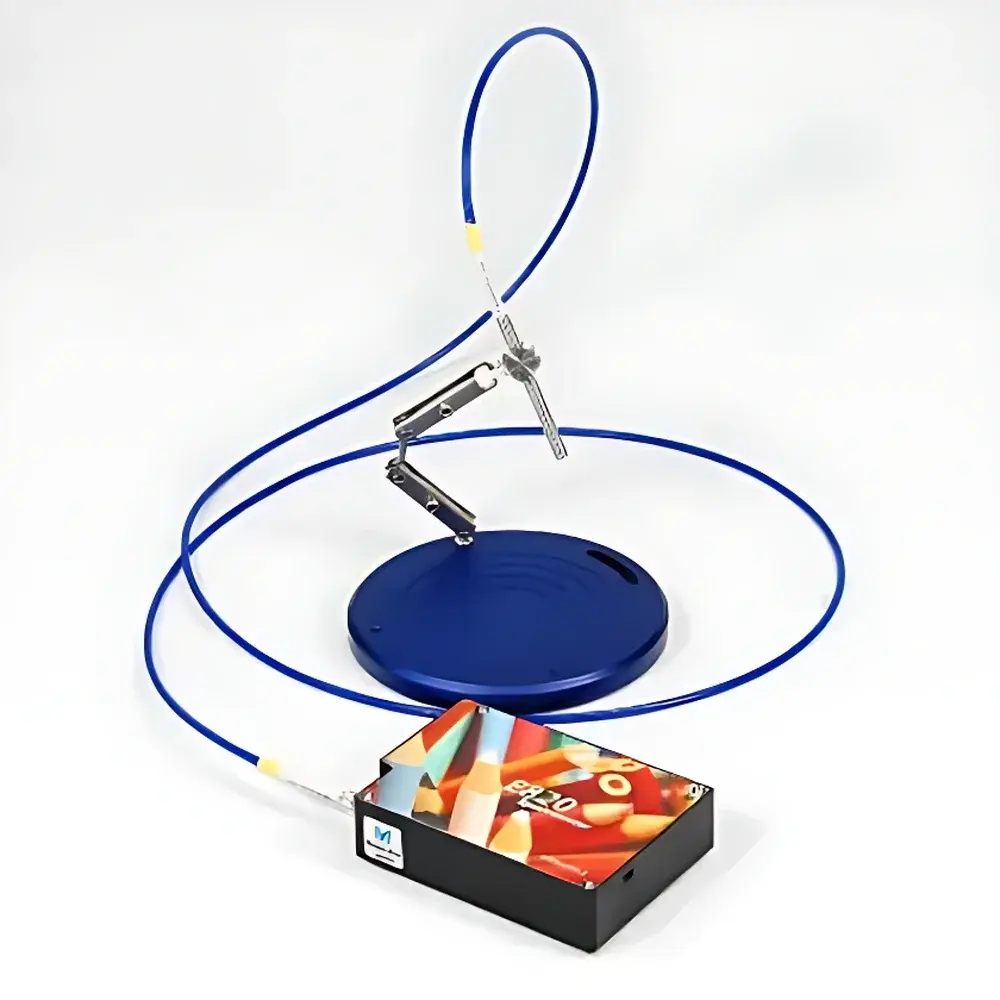
IdeaOptics E820 Fiber Optic Spectrometer for Educational Laboratories
| Brand | IdeaOptics |
|---|---|
| Origin | Shanghai, China |
| Manufacturer Type | Direct Manufacturer |
| Regional Classification | Domestic (China) |
| Model | E820 |
| Pricing | Available Upon Request |
| Spectral Range | 365–960 nm |
| Detector Type | CCD |
| Resolution | High Resolution |
| Sensitivity | 130 photons/count at 400 nm |
| Signal-to-Noise Ratio | 400:1 (at saturation) |
| Dynamic Range | 2 × 10⁸ (system) |
| 3000 | 1 (single acquisition) |
| Stray Light | 0.2% @ 600 nm |
Overview
The IdeaOptics E820 Fiber Optic Spectrometer is a compact, robust, and education-optimized spectroscopic instrument engineered for undergraduate and graduate-level teaching laboratories. Based on the principle of Czerny-Turner optical architecture coupled with a linear CCD detector, the E820 delivers stable spectral acquisition across the UV-Vis-NIR range (365–960 nm). Its modular design supports direct integration with fiber-coupled light sources, emission samples, and optical accessories—enabling hands-on instruction in fundamental spectroscopic concepts including atomic line spectra, blackbody radiation, spectral calibration, and Beer-Lambert law validation. Unlike research-grade spectrometers optimized for ultimate resolution or throughput, the E820 prioritizes operational simplicity, repeatable signal response, and pedagogical transparency—making spectral data interpretation accessible to students with minimal prior instrumentation experience.
Key Features
- Compact benchtop form factor (125 × 80 × 45 mm) designed for shared lab workstations and portable demonstration setups.
- Pre-aligned Czerny-Turner optical path with fixed grating (600 lines/mm), ensuring long-term wavelength stability without user recalibration.
- High quantum efficiency CCD detector with thermoelectric stabilization (−5 °C nominal operating temperature) to suppress dark current drift during extended acquisitions.
- Digital trigger interface (TTL-compatible) for synchronized measurements with pulsed light sources or external event markers.
- USB 2.0 interface with vendor-provided SDK (C/C++, Python, MATLAB APIs) supporting custom experiment scripting and real-time spectral streaming.
- Factory-calibrated wavelength scale traceable to NIST-traceable Hg/Ar emission lines, delivered with full calibration certificate.
Sample Compatibility & Compliance
The E820 accepts standard SMA-905 fiber inputs (core diameters 50–400 µm), enabling compatibility with gas discharge lamps (e.g., Hg, Na, He), LED arrays, plasma jets, fluorescence cuvettes, and reflective/diffuse solid samples via integrating spheres or collimating optics. All firmware and hardware meet CE electromagnetic compatibility (EMC) Directive 2014/30/EU and RoHS 2011/65/EU requirements. While not certified for GMP or FDA-regulated environments, its deterministic acquisition behavior and reproducible dark/bias correction routines support GLP-aligned educational documentation practices—including timestamped spectral logs and metadata tagging per measurement session.
Software & Data Management
IdeaOptics provides SpectraView Lite—a cross-platform application (Windows/macOS/Linux) that enables real-time spectral display, peak identification, baseline subtraction, and export in CSV, TXT, and JCAMP-DX formats. The software enforces audit-ready data handling: each saved spectrum includes embedded metadata (acquisition time, integration time, detector temperature, lamp status, user ID if configured), satisfying basic traceability requirements for academic lab reports and accreditation reviews (e.g., ABET program criteria). Raw frame buffers are accessible via SDK for advanced processing pipelines, including FFT-based noise reduction, Savitzky-Golay smoothing, and multivariate regression training—facilitating capstone projects in chemometrics and optical sensing.
Applications
- Atomic emission spectroscopy: quantitative analysis of hydrogen Balmer series, sodium D-line splitting, and mercury spectral line identification.
- Plasma diagnostics: spectral monitoring of argon/oxygen afterglow emissions to infer electron temperature trends in low-pressure glow discharges.
- Colorimetry and CIE chromaticity mapping using built-in tristimulus function convolution.
- UV-Vis absorbance kinetics: time-resolved monitoring of dye degradation under LED irradiation using external shutter control.
- Optical filter characterization: transmission profiling of interference filters and dichroic mirrors across visible wavelengths.
- Environmental science labs: turbidity-correlated scattering intensity measurements in colloidal suspensions using 405 nm excitation.
FAQ
Is the E820 suitable for quantitative concentration analysis?
Yes—when paired with calibrated reference standards and controlled optical pathlengths, the E820 supports absorbance-based quantification per ISO 6425 and ASTM E275 for routine teaching applications.
Can I replace the grating or detector myself?
No—the optical module is factory-sealed and not field-serviceable; detector and grating selection is fixed per model variant to ensure calibration integrity.
Does the system comply with FDA 21 CFR Part 11?
No—SpectraView Lite does not implement electronic signatures or audit trail encryption; however, raw spectral files are immutable and timestamped for manual verification.
What is the minimum integration time supported?
2 ms (hardware-limited), with 10 µs increments up to 65 s, enabling both fast transient capture and high-SNR averaging.
Is OEM integration supported?
Yes—full SDK documentation, DLL libraries, and example code are provided under non-exclusive license for curriculum development and embedded lab system integration.
Related Products





