
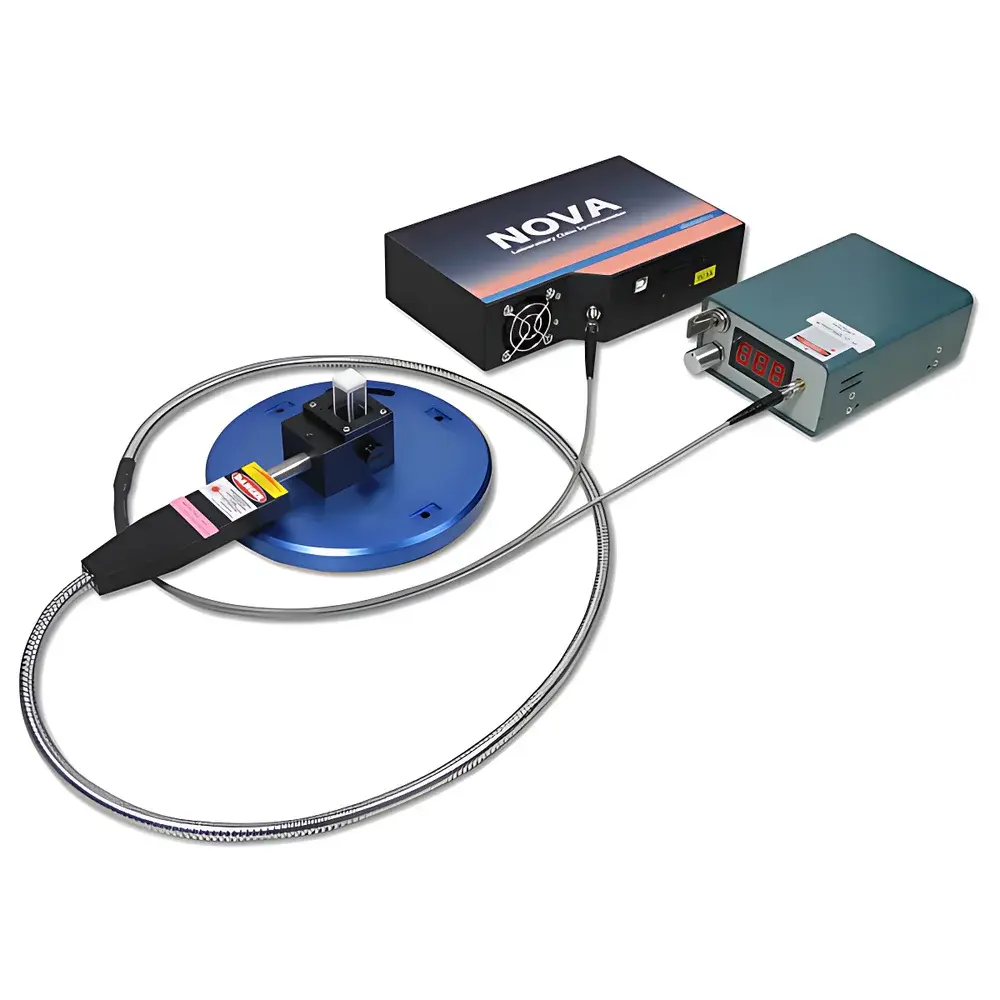
IdeaOptics K-Sens Portable Raman Spectrometer
| Brand | IdeaOptics |
|---|---|
| Origin | Shanghai, China |
| Manufacturer Type | Original Equipment Manufacturer (OEM) |
| Product Category | Domestic |
| Model | K-Sens |
| Instrument Type | Portable / Handheld Raman Spectrometer |
| Spectral Range | 150–4000 cm⁻¹ |
| Spectral Resolution | 10 cm⁻¹ |
| Spatial Resolution | 0.1 mm (lateral), 0.1 mm (axial) |
| Minimum Wavenumber | 150 cm⁻¹ |
| Spectral Repeatability | ≤ ±0.1 cm⁻¹ |
Overview
The IdeaOptics K-Sens Portable Raman Spectrometer is an engineered solution for high-fidelity, field-deployable molecular fingerprinting based on inelastic light scattering (Raman effect). Designed around a back-thinned, thermoelectrically cooled CCD detector, the system delivers enhanced quantum efficiency and low-noise performance essential for trace-level identification across solid, liquid, and powdered samples. Its compact architecture supports direct integration with commercial upright or inverted microscopes via the DPS parallel-light coupler—enabling rapid configuration of a confocal micro-Raman platform without optical realignment. The instrument operates across a broad spectral window (150–4000 cm⁻¹), optimized for detection of low-frequency lattice modes (e.g., graphene G’/2D bands, interlayer shear modes) and high-wavenumber functional group vibrations (e.g., C=O, N–H, S–S), with spectral repeatability maintained within ±0.1 cm⁻¹—critical for quantitative batch-to-batch comparison and long-term stability monitoring.
Key Features
- Back-thinned CCD detector with on-chip thermoelectric cooling (ΔT = −40°C vs. ambient), reducing dark current by >80% and enabling extended integration times up to 300 seconds without saturation.
- Peak quantum efficiency of 95% at 532 nm excitation, achieved through optimized anti-reflection coating and deep depletion architecture—maximizing photon capture for weak Raman signals.
- Confocal capability down to 1 μm lateral resolution using optional K-Sens Confocal Probe, compatible with standard microscope nosepieces (e.g., Nikon CFI60, Olympus UIS2).
- Modular optical path design: DPS parallel-light input interface ensures minimal aberration when coupled to external optics; no recalibration required after microscope attachment.
- Integrated Rayleigh rejection filter with OD6 suppression at laser line (532 nm or 785 nm variants available), minimizing stray light interference in SERS and resonance Raman measurements.
Sample Compatibility & Compliance
The K-Sens accommodates diverse sample geometries—including bulk solids, thin films, biological tissues, colloidal suspensions, and pharmaceutical powders—without requirement for vacuum or cryogenic environments. Its open optical architecture allows direct placement of Petri dishes, glass slides, vials, or custom holders into the measurement zone. All optical components comply with ISO 10110-7 (surface quality) and IEC 61000-6-3 (EMC emissions). Software workflows support audit trails, electronic signatures, and data integrity protocols aligned with FDA 21 CFR Part 11 and EU Annex 11 requirements when deployed in regulated QC/QA laboratories. Optional calibration validation kits include NIST-traceable polystyrene and silicon standards for routine wavenumber and intensity verification per ASTM E1840 and ISO 8655-6.
Software & Data Management
Control and analysis are performed via RamanStudio™—a modular, Python-extendable platform supporting real-time spectral acquisition, baseline correction (Asymmetric Least Squares), peak deconvolution (Voigt fitting), and multivariate analysis (PCA, PLS-DA). Raw spectra are stored in HDF5 format with embedded metadata (excitation wavelength, integration time, grating position, temperature log). Export options include CSV, JCAMP-DX, and vendor-neutral .spc for interoperability with third-party chemometric tools (e.g., Unscrambler X, MATLAB). Data security features include role-based access control, encrypted local storage, and configurable auto-backup to network-attached storage (NAS) or cloud repositories compliant with GDPR and HIPAA.
Applications
- 2D Materials Characterization: Layer-counting of graphene, MoS₂, and h-BN via G/2D intensity ratio mapping and interlayer breathing mode analysis below 100 cm⁻¹ (with optional low-wavenumber upgrade).
- Biomedical Tissue Diagnostics: Label-free discrimination of cancerous vs. normal epithelial tissue based on collagen cross-linking shifts and lipid/protein ratio changes—validated in peer-reviewed histopathology studies.
- SERS Quantification: Detection of sub-picomolar analytes (e.g., pesticides, explosives, neurotransmitters) using Au/Ag nanostructured substrates, leveraging ultra-low noise floor and OD6 laser line rejection.
- Pharmaceutical Solid-State Analysis: Polymorph identification, crystallinity assessment, and API-excipient interaction screening in tablets and lyophilized powders.
- Forensic & Cultural Heritage: Non-destructive pigment identification in paintings, ink analysis in questioned documents, and polymer degradation profiling in historical artifacts.
FAQ
What excitation wavelengths are supported?
Standard configurations use 532 nm or 785 nm diode lasers; custom modules for 633 nm and 1064 nm are available upon request.
Is the K-Sens suitable for GLP-compliant environments?
Yes—when configured with RamanStudio™ in Audit Mode, it provides full electronic record retention, user authentication, and change history tracking meeting OECD GLP Principles and FDA 21 CFR Part 11 criteria.
Can the spectral resolution be improved beyond 10 cm⁻¹?
Resolution enhancement is achievable via optional high-density holographic gratings (e.g., 2400 g/mm) and slit width optimization, delivering ≤4 cm⁻¹ resolution at the expense of throughput—discussed during pre-delivery technical consultation.
Does the system support automated mapping?
Yes—integrated XYZ motorized stage control (optional) enables point-and-shoot or raster-scan chemical imaging with sub-micron step precision and synchronized spectral acquisition.
How is calibration verified over time?
Built-in self-check routines perform daily wavelength calibration using internal reference LEDs; annual verification with NIST SRM 2241 (polystyrene) or SRM 2242 (silicon) is recommended per ISO/IEC 17025 accreditation requirements.






