
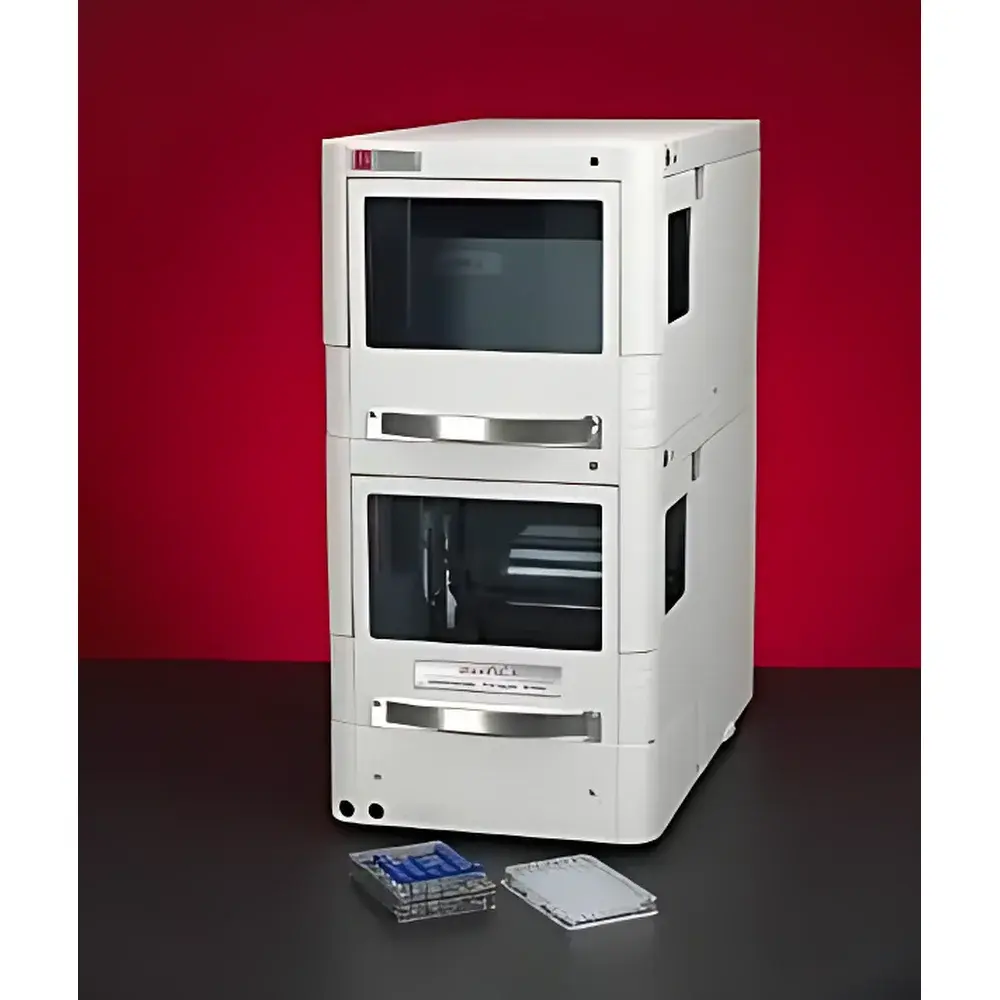
Brookhaven BioDLS High-Throughput Dynamic Light Scattering Analyzer
| Brand | Brookhaven Instruments |
|---|---|
| Origin | USA |
| Model | BioDLS |
| Dispersion Method | Dry & Wet Dispersion |
| Instrument Type | Online Laser Particle Size Analyzer |
| Particle Size Range | 0.5 nm – 3 µm (sample-dependent) |
| Molecular Weight Range | 4 × 10² – 2 × 10⁷ Da (sample-dependent) |
| Concentration Range | 0.1 – 100 mg/mL (sample-dependent) |
| Sample Volume | 2 µL |
| Throughput | Up to 768 samples per run (2 × 384-well plates) |
| Temperature Control | Sample cell: 5–90 °C |
| Storage plate | Ambient to 4 °C |
| Laser Source | 35 mW, 635 nm solid-state laser (optional 30 mW, 850 nm) |
| Scattering Angle | 90° |
| Detector | Avalanche Photodiode (APD) |
| Correlator | 522 physical channels, 10¹⁰ linear channels, dynamic sampling/delay range: 25 ns – 1310 s |
| Interface | USB 2.0 & 1.1 |
| Software | Windows XP/Vista compatible |
| Dimensions (w/d/h) | 300 × 510 × 630 mm (28 kg, no storage cooler) |
| Operating Environment | 10–75 °C, 0–95% RH (non-condensing) |
Overview
The Brookhaven BioDLS High-Throughput Dynamic Light Scattering Analyzer is an engineered solution for rapid, automated characterization of nanoparticle and macromolecular size distributions in pharmaceutical, biopharmaceutical, and materials science laboratories. It operates on the principle of dynamic light scattering (DLS), where Brownian motion of particles in suspension induces time-dependent fluctuations in scattered laser intensity. These fluctuations are captured by a high-sensitivity avalanche photodiode (APD) detector at a fixed 90° scattering angle and processed via a high-resolution digital correlator (522 physical channels, 10¹⁰ linear channels) to generate autocorrelation functions. Using the Stokes–Einstein equation, the system computes hydrodynamic diameter distributions with sub-nanometer resolution—enabling precise assessment of colloidal stability, aggregation onset, and conformational changes under controlled thermal conditions.
Key Features
- True high-throughput operation: Supports standard 12-, 48-, 96-, and 384-well microplates or HPLC vials—enabling up to 768 samples per unattended run.
- Ultra-low sample consumption: Requires only 2 µL per measurement, minimizing precious material usage during early-stage formulation screening.
- Integrated thermal management: Independent temperature control for both sample cells (5–90 °C) and storage plates (ambient to 4 °C) ensures reproducible kinetics and cold-chain integrity for thermally sensitive biologics.
- Automated fluidic handling: Fully programmable sample aspiration, rinsing, waste disposal, and inert gas purging (e.g., nitrogen) to prevent oxidation of labile proteins or lipids.
- High-fidelity optical architecture: 35 mW, 635 nm solid-state laser (with optional 850 nm configuration) coupled to a low-noise APD detector delivers robust signal-to-noise ratios across the full 0.5 nm–3 µm size range.
- Compliance-ready design: Hardware and software architecture support audit trails, user access controls, and electronic signature capabilities aligned with FDA 21 CFR Part 11 and GLP/GMP documentation requirements when configured with validated software modules.
Sample Compatibility & Compliance
The BioDLS accommodates aqueous and organic dispersions, protein solutions, liposomes, polymeric nanoparticles, micelles, and virus-like particles. Its compatibility with standard microplate formats eliminates dependency on proprietary consumables—reducing cost-per-sample and accelerating method transfer. The system meets essential performance criteria outlined in ISO 22412:2017 (DLS particle sizing) and supports method validation per ICH Q5A(R2) and USP for subvisible particle analysis in parenteral formulations. Optional IQ/OQ documentation packages are available for regulated environments requiring installation and operational qualification.
Software & Data Management
BioDLS is operated via Windows-compatible software featuring intuitive workflow scripting, real-time correlation curve visualization, and batch processing of multi-plate datasets. Raw intensity autocorrelation data are stored in vendor-neutral binary format with embedded metadata (timestamp, temperature, laser power, cell ID). Export options include CSV, Excel, and PDF reports containing intensity-, volume-, and number-weighted size distributions; polydispersity index (PdI); Z-average diameter; and multimodal deconvolution plots. Audit trail logs record all user actions, parameter changes, and calibration events—ensuring traceability for regulatory submissions.
Applications
- Accelerated pre-formulation screening of monoclonal antibodies, mRNA-LNPs, and peptide therapeutics.
- Stability assessment under stress conditions (temperature ramping, pH variation, excipient screening).
- Aggregation kinetics monitoring during forced degradation studies.
- Batch release testing of nanomedicines and colloidal drug carriers.
- Quality-by-Design (QbD) development of robust manufacturing processes.
- Support for comparability studies following process changes or site transfers.
FAQ
What sample volume is required per measurement?
Each measurement consumes only 2 µL of sample—optimized for scarce or expensive biologics.
Can the BioDLS measure molecular weight directly?
No—it derives hydrodynamic size from diffusion coefficient; molecular weight estimation requires calibration with standards of known Mw and conformation.
Is the system compliant with 21 CFR Part 11?
Yes—when deployed with validated software and appropriate administrative controls (e.g., role-based access, electronic signatures, audit trail review).
What is the minimum detectable concentration?
Typical lower limit is ~0.1 mg/mL for globular proteins; sensitivity varies with particle scattering cross-section and refractive index contrast.
Does the instrument support kinetic measurements over time?
Yes—programmable time-series acquisition enables real-time monitoring of aggregation or dissociation events at user-defined intervals.
How is carryover minimized between samples?
Automated wash cycles using configurable solvents, combined with inert gas drying and disposable capillary paths, reduce carryover to <0.01%.



