
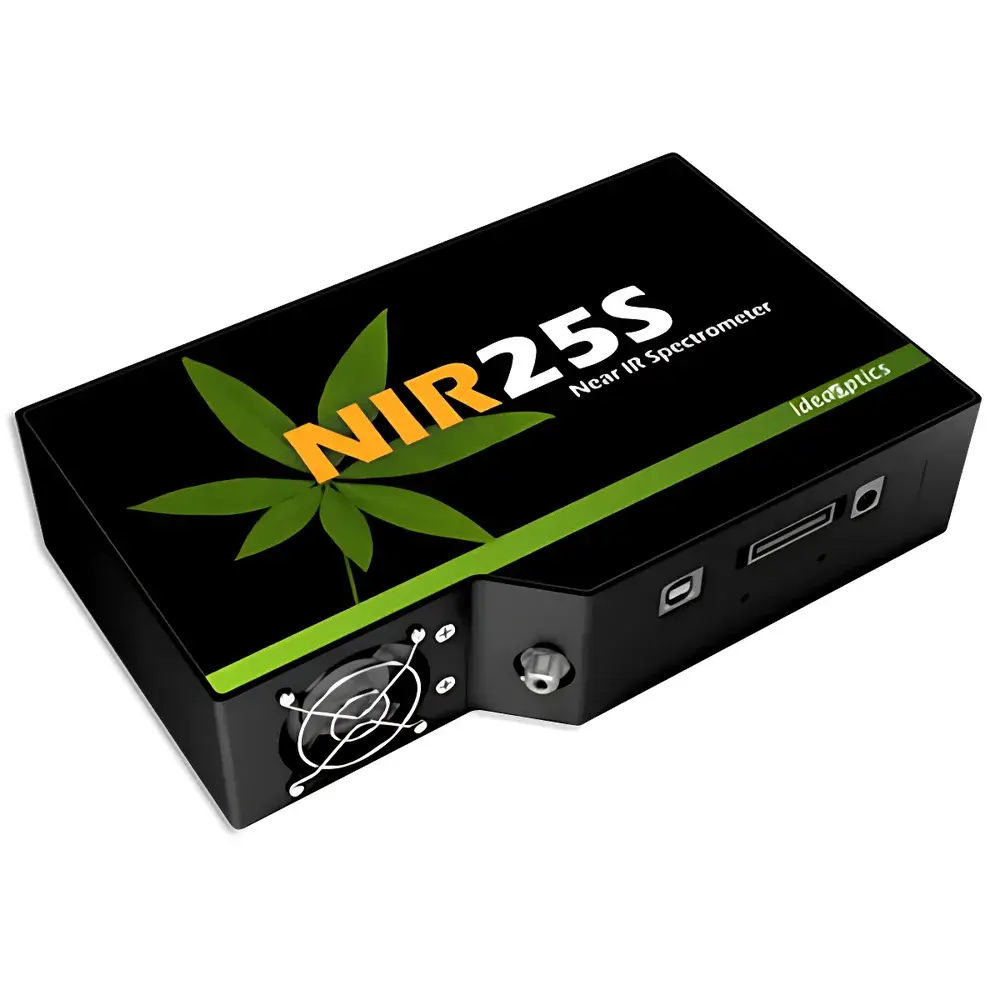
IdeaOptics NIR Series Deep-Cooled Fiber Optic Spectrometer
| Brand | IdeaOptics |
|---|---|
| Model | NIR Series |
| Detector | Hamamatsu InGaAs linear array |
| Spectral Range | 900–2500 nm |
| Spectral Resolution | 3.2 nm (FWHM) |
| Wavelength Accuracy | ±0.5 nm |
| Pixel Count | 512 |
| Dynamic Range | 7500:1 (typ.) |
| SNR | 15,000:1 (with deep TEC cooling) |
| Integration Time | 1 ms to 60 s |
| Cooling | Two-stage thermoelectric (TEC) to –25 °C |
| Optical Interface | SMA 905 fiber coupling |
| Compliance | CE, RoHS, ISO 9001 manufacturing environment |
Overview
The IdeaOptics NIR Series Deep-Cooled Fiber Optic Spectrometer is a high-performance, benchtop-grade near-infrared (NIR) analytical instrument engineered for precision spectroscopic measurements across the 900–2500 nm spectral window. It operates on the principle of fixed-grating optical dispersion coupled with a linear InGaAs photodiode array detector, enabling non-scanning, snapshot spectral acquisition. Unlike traditional scanning monochromators or Fourier-transform systems, this spectrometer delivers full-spectrum capture in as little as 1 millisecond—making it suitable for time-resolved process monitoring, real-time reaction kinetics, and dynamic sample characterization. Its core architecture integrates a two-stage thermoelectric cooler (TEC) directly bonded to the Hamamatsu InGaAs detector chip, suppressing dark current and thermal noise to achieve a measured signal-to-noise ratio (SNR) of up to 15,000:1. The system is optimized for fiber-coupled operation using standard SMA 905 connectors, supporting flexible integration into custom optical paths, flow cells, probe-based measurement setups, and industrial process lines.
Key Features
- Sub-millisecond spectral acquisition: Full 512-pixel spectrum captured in ≤1 ms, enabling high-speed transient analysis and synchronization with external triggers (TTL-compatible).
- Extended NIR coverage: Simultaneous detection from 900 nm to 2500 nm, segmented into configurable spectral bands (e.g., 900–1700 nm, 2050 nm, 2200 nm, 2500 nm) via integrated order-sorting step filters to eliminate higher-order diffraction artifacts.
- Deep TEC cooling: Dual-stage Peltier cooling stabilizes detector temperature to –25 °C, mitigating condensation risk through hermetic internal design and active dew-point management—critical for long-term stability in ambient-humidity environments.
- High optical resolution: 3.2 nm spectral resolution (FWHM) supported by 512-pixel InGaAs array and optimized collimation/focusing optics; wavelength calibration traceable to NIST-traceable emission lines (e.g., Ar, Ne).
- Rugged OEM-ready platform: Aluminum alloy housing with EMI-shielded electronics, fanless thermal management, and industrial-grade power input (12 V DC ±10%).
Sample Compatibility & Compliance
The NIR Series spectrometer is compatible with transmission, reflectance, diffuse reflectance, and attenuated total reflectance (ATR) sampling configurations via interchangeable fiber-optic probes and cuvette holders. It supports liquid, solid, and semi-solid samples—including powders, granules, pastes, and biological tissues—without requiring vacuum or purging. All optical components comply with ISO 17025-aligned calibration protocols. The instrument meets CE marking requirements under Directive 2014/30/EU (EMC) and 2014/35/EU (LVD), and conforms to RoHS 2011/65/EU restrictions on hazardous substances. Manufacturing adheres to ISO 9001:2015 quality management standards. For regulated environments, optional firmware supports audit trail logging and user access control—facilitating alignment with FDA 21 CFR Part 11 and EU Annex 11 expectations when deployed within GMP/GLP workflows.
Software & Data Management
The spectrometer ships with IdeaOptics’ SpectraStudio Pro software suite (Windows 10/11, 64-bit), providing real-time spectral visualization, multi-channel averaging, baseline correction (asymmetric least squares), peak identification, and quantitative chemometric modeling (PLS, PCA, PCR). Raw data export is supported in CSV, HDF5, and JCAMP-DX formats. An open-source SDK (C/C++, Python, MATLAB APIs) enables direct integration with LabVIEW, Python-based automation frameworks (e.g., PyVISA, asyncio), and SCADA/HMI platforms. All spectral acquisitions include embedded metadata: timestamp (UTC), integration time, detector temperature, lamp reference ID, and calibration file hash—ensuring full data provenance for QA/QC documentation.
Applications
- Real-time moisture content monitoring in tobacco, grain, and pharmaceutical granulation processes.
- Quantitative analysis of protein, fat, and starch in agricultural commodities using calibrated PLS regression models.
- In-line quality verification during polymer extrusion, tablet coating, and chemical synthesis.
- Non-destructive assessment of fruit ripeness, leaf water status, and soil organic carbon content.
- Fundamental research in photochemistry, catalysis, and semiconductor bandgap characterization.
FAQ
What is the minimum integration time supported?
The shortest programmable integration time is 1 ms, limited only by readout speed and electronic settling time.
Does the spectrometer require external cooling or purge gas?
No—onboard dual-stage TEC eliminates the need for liquid nitrogen, compressed air, or external chillers.
Can I use third-party fiber probes with this spectrometer?
Yes—any SMA 905–compatible probe (core diameter ≤400 µm, NA ≤0.22) may be used without optical recalibration.
Is wavelength calibration stable over temperature fluctuations?
Yes—built-in temperature-compensated calibration algorithms maintain wavelength accuracy within ±0.5 nm across 15–35 °C ambient range.
How is detector linearity verified and maintained?
Each unit undergoes factory linearity validation per ASTM E275-22 using neutral density filter stacks; residual nonlinearity <0.5% across 0–95% full-scale response.





