
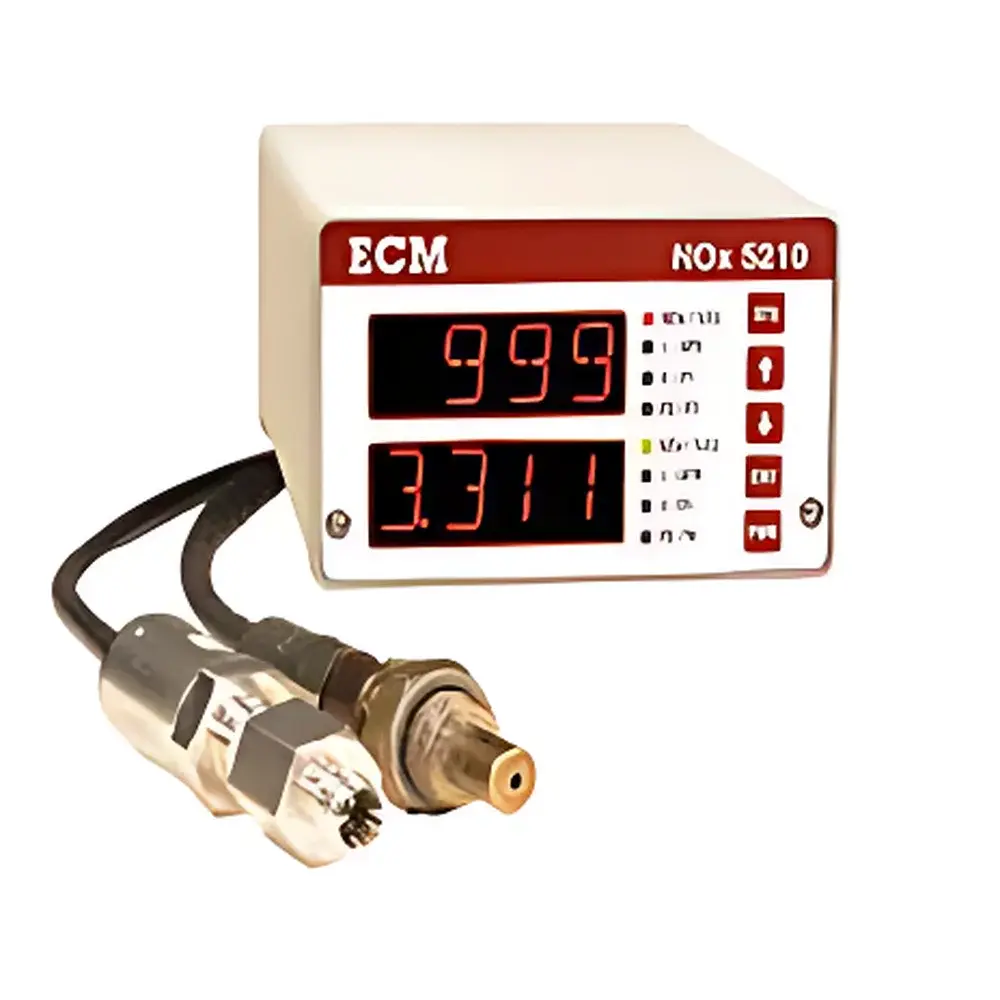
ECM NOx5210g Fast NOₓ Analyzer
| Brand | ECM |
|---|---|
| Origin | USA |
| Model | NOx5210g |
| Measurement Principle | Direct-insertion electrochemical (ceramic zirconia-based) sensing |
| NOₓ Range | 0–5000 ppm (NGK sensor, λ > 1 only) |
| Lambda (λ) Range | 0.4–25 |
| Air–Fuel Ratio (AFR) | 6–364 |
| Equivalence Ratio (Φ) | 0.04–2.5 |
| O₂ Range | 0–25% vol |
| NOₓ Accuracy | ±15 ppm (0–1000 ppm), ±1.5% FS (remaining range) |
| λ Accuracy | ±0.008 @ λ=1, ±0.016 @ λ=0.8–1.2, ±0.018 elsewhere |
| AFR Accuracy | ±0.15 @ 14.6, ±0.4 @ 12–18, ±1 elsewhere |
| Φ Accuracy | ±0.008 @ Φ=1, ±0.016 @ Φ=0.8–1.2, ±0.018 elsewhere |
| O₂ Accuracy | ±0.4% @ 0–2% O₂, ±0.8% elsewhere |
| Response Time | <1 s (NOₓ), <150 ms (λ/Φ/AFR/O₂) |
| Fuel Flexibility | Configurable H:C, O:C, N:C, H₂ ratios |
| Analog Outputs | 6 × 0–5 V (linearized, user-assignable) |
| Digital Interfaces | CAN 2.0B (user-configurable protocol), USB 2.0, RS-232 |
| Power Supply | 11–28 VDC |
| Sensor Mounting | M20×1.5 thread (NGK NOₓ probe) |
| Dimensions (Analyzer) | 105 mm W × 64 mm H × 165 mm D |
| Cable Length | Standard 4 m |
| Weight | Analyzer 676 g, Sensor Module 244 g |
| Operating Temperature | −40 °C to +85 °C |
| Optional Accessories | Pressure compensation module, dual-channel configuration, AC/DC power adapter |
Overview
The ECM NOx5210g Fast NOₓ Analyzer is an engineered solution for real-time, in-situ measurement of nitrogen oxides (NO and NO₂), oxygen concentration, and combustion stoichiometry parameters—including lambda (λ), air–fuel ratio (AFR), equivalence ratio (Φ), and %O₂—in high-dynamic exhaust streams. Designed specifically for development and validation of diesel engines, gas turbines, lean-burn combustion systems, and aftertreatment technologies (e.g., SCR, LNT, DOC), the NOx5210g employs direct-insertion ceramic zirconia-based electrochemical sensing—eliminating the need for sample extraction, heated lines, or vacuum pumps. Its core architecture centers on the NGK-certified NOₓ sensor, mounted directly into the exhaust pipe via a standardized M20×1.5 thread interface. This design ensures sub-second response (<1 s for NOₓ, <150 ms for λ/Φ/AFR/O₂), minimal signal lag, and immunity to condensation-induced drift under transient thermal conditions. The analyzer’s compact form factor (105 × 64 × 165 mm), wide operating temperature range (−40 °C to +85 °C), and automotive-grade power input (11–28 VDC) make it suitable for both engine test benches and onboard vehicle integration—including ignition-switch-triggered power management.
Key Features
- Direct-insertion NGK NOₓ sensor with integrated calibration memory: All calibration coefficients—including zero, span, aging factors, and fuel composition parameters—are stored in the sensor connector’s embedded EEPROM, enabling plug-and-play replacement and field recalibration without host reconfiguration.
- Fuel-agnostic combustion parameter calculation: Supports configurable hydrocarbon (H:C), oxygen (O:C), nitrogen (N:C), and hydrogen (H₂) content inputs to ensure accurate λ, AFR, and Φ computation across diesel, biodiesel, natural gas, LNG, hydrogen-blended, and synthetic fuels.
- Multi-parameter real-time output: Simultaneously measures and outputs NOₓ (0–5000 ppm), λ (0.4–25), AFR (6–364), Φ (0.04–2.5), and O₂ (0–25% vol) with traceable accuracy per ISO 16183 and SAE J1930 guidelines.
- Robust analog and digital interfacing: Six user-assignable 0–5 V linearized analog outputs support legacy DAQ systems; CAN 2.0B (configurable bit rate and message ID), USB 2.0, and RS-232 provide seamless integration with modern ECUs, control platforms, and data loggers.
- Extended sensor cabling: Up to 100 m separation between analyzer and NGK sensor—without degradation in response time or measurement fidelity—enables flexible installation in constrained or high-EMI environments.
- Automotive-ready operational logic: Automatic power-on/off triggered by vehicle ignition signal simplifies deployment in mobile test applications and reduces parasitic drain during storage.
Sample Compatibility & Compliance
The NOx5210g is validated for use with exhaust gases from compression-ignition (CI) and spark-ignition (SI) engines operating under stoichiometric to ultra-lean conditions (λ > 1). It complies with key regulatory and industry frameworks governing emissions instrumentation, including ISO 16183 (measurement of NOₓ in engine exhaust), SAE J1930 (electrical/electronic systems terminology), and EN 14181 (QAL3 performance verification for continuous emission monitoring systems). While not a certified CEMS device, its metrological performance supports R&D-grade compliance testing, prototype validation, and correlation studies aligned with EPA Tier 4, Euro VI, and IMO MARPOL Annex VI development cycles. The unit meets CE marking requirements for electromagnetic compatibility (EN 61000-6-3/-4) and environmental robustness (EN 60068-2 series). All firmware and calibration routines adhere to GLP principles, with full audit trails available via USB export for traceability in regulated development workflows.
Software & Data Management
The NOx5210g operates autonomously without proprietary software dependencies. Configuration, calibration, and diagnostics are performed via ASCII command protocol over USB or RS-232, enabling integration into custom Python, LabVIEW, or MATLAB-based acquisition environments. CAN messages follow a deterministic, timestamped structure compliant with SAE J1939-71 (parameter group numbers pre-assigned for NOₓ, λ, AFR, O₂, and sensor health status). Raw analog outputs are factory-linearized per NIST-traceable calibration curves, eliminating post-processing correction. For long-term durability tracking, the analyzer logs cumulative sensor exposure time, thermal cycling counts, and recalibration history—accessible via serial query. Optional pressure compensation (hardware add-on) enables density-corrected NOₓ reporting per ISO 8716, supporting altitude-invariant measurements in aerospace and high-elevation testing.
Applications
- Development and calibration of selective catalytic reduction (SCR) and lean NOₓ trap (LNT) systems
- Real-time lambda and NOₓ feedback control in closed-loop combustion optimization
- Aftertreatment catalyst light-off characterization and aging studies
- On-vehicle PEMS (Portable Emissions Measurement Systems) validation and correlation
- Fuel-flexible engine mapping for biofuels, e-fuels, and hydrogen-enriched combustion
- Regulatory test cycle support (e.g., WHSC, WHTC, RDE) for OEM and Tier-1 suppliers
- Gas turbine combustor stability analysis and emissions certification prep
FAQ
Does the NOx5210g require external sample conditioning or pumping?
No. It uses direct-insertion ceramic sensing and requires no sample line, pump, filter, or dilution system.
Can the NGK NOₓ sensor be calibrated in the field?
Yes. Zero and span calibrations are performed via serial command; all updated coefficients are written to the sensor’s onboard EEPROM.
Is the analyzer compatible with non-stoichiometric (λ > 1) diesel exhaust only?
Correct. The NGK sensor is optimized for lean-burn applications; it is not rated for rich exhaust (λ < 1).
What is the maximum allowable cable length between analyzer and sensor?
Up to 100 meters using shielded twisted-pair cable meeting CAN bus impedance specifications (120 Ω differential).
Does the unit support FDA 21 CFR Part 11 or similar electronic record compliance?
While not formally validated for Part 11, its audit-log capability, calibration traceability, and write-protected firmware support internal validation under GxP-aligned quality systems.
Related Products







