
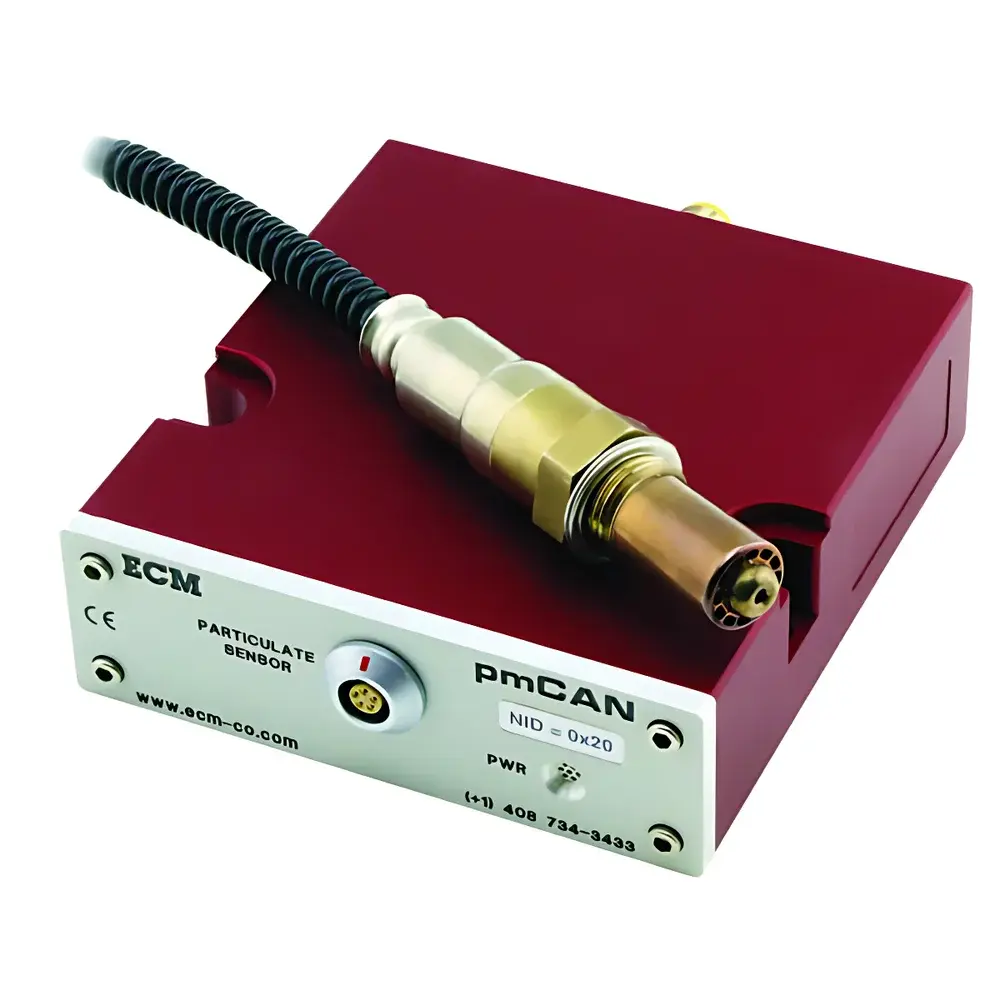
ECM pmCAN Exhaust Particulate Matter Module
| Brand | ECM |
|---|---|
| Origin | USA |
| Manufacturer Status | Authorized Distributor |
| Origin Category | Imported |
| Model | pmCAN |
| Instrument Type | Online |
| Measurement Principle | Electrostatic Charge Detection |
| Maximum Permissible Error | ±10% |
| Mass Concentration Range | 0.05–100 mg/m³ |
| Number Concentration Range | 0.24–480 M/cc |
| Installation Thread | M18×1.5 |
| Exhaust Gas Temperature Limit | 850 °C |
| Module Operating Temperature | −55 to 100 °C |
| Cable Temperature Rating | −55 to 220 °C |
| Electronics Dimensions | 114 × 120 × 35 mm |
| Weight | 540 g |
| Enclosure Rating | IP27 |
| Communication Interface | CANopen (configurable baud rate and Node ID) |
| Power Supply | 6–32 VDC, 0.14 A @ 12 V |
Overview
The ECM pmCAN Exhaust Particulate Matter Module is an engineered online particulate measurement solution designed for real-time, in-situ monitoring of solid-phase emissions from internal combustion engines—including both diesel and spark-ignition (SI) powertrains. Unlike conventional gravimetric, optical, or thermal methods, the pmCAN employs a robust electrostatic charge detection principle: as exhaust particles pass between two electrodes, they acquire charge via corona discharge and are subsequently attracted to the oppositely polarized electrode, generating a measurable current proportional to particle mass flux. This physics-based transduction mechanism eliminates reliance on auxiliary media (e.g., butanol, compressed air), external pumps, or high-power conditioning systems—enabling direct, low-intrusion integration into exhaust manifolds or tailpipes with minimal system footprint.
Key Features
- Compact, spark-plug–form-factor sensor head (M18×1.5 thread) for rapid field installation without exhaust modification or flow conditioning
- High-temperature capable design: sensor tip withstands transient exhaust gas temperatures up to 850 °C; electronics module rated for −55 to 100 °C ambient operation
- Integrated CANopen interface compliant with CiA 301 and CiA 401 standards, supporting configurable Node ID and baud rates (125 kbps to 1 Mbps) for seamless integration into vehicle ECUs, test benches, or fleet telematics platforms
- Low-power operation (6–32 VDC, 0.14 A @ 12 V) suitable for battery-powered mobile testing and long-term unattended deployment
- IP27-rated enclosure provides protection against vertically dripping water and limited dust ingress—validated for under-hood and chassis-mounted applications
- Factory-calibrated with user-accessible incremental correction tables to refine accuracy within the ±10% maximum permissible error specification across defined concentration ranges
Sample Compatibility & Compliance
The pmCAN is optimized for continuous measurement of solid particulate matter (PM) in hot, humid, and chemically aggressive exhaust streams typical of modern light- and heavy-duty engines. It exhibits stable response across variable exhaust stoichiometry, including lean-burn diesel, stoichiometric gasoline, and advanced combustion modes (e.g., HCCI, RCCI). While not a certified reference method per ISO 8549, EN 16454, or US EPA 40 CFR Part 1065, the module meets functional requirements for engineering-grade development testing, durability validation, and OBD-II correlation studies. Its output is traceable to NIST-traceable calibration aerosols (e.g., CAST, DEHS) and supports GLP-aligned data logging when paired with compliant host systems implementing audit trails and electronic signatures per FDA 21 CFR Part 11.
Software & Data Management
Data acquisition is performed via standardized CANopen object dictionary mapping: measured current (raw ADC counts), compensated mass concentration (mg/m³), and number concentration (M/cc) are exposed as PDO-mapped process variables. Host-side software—such as Vector CANoe, ETAS INCA, or custom LabVIEW/Python CAN drivers—can decode and time-synchronize signals with engine speed, torque, lambda, and aftertreatment status. The module supports periodic diagnostics (e.g., electrode health check, temperature fault reporting) through manufacturer-defined SDO services. All configuration parameters—including scaling factors, offset corrections, and communication settings—are retained in non-volatile memory and survive power cycling.
Applications
- Engine development: real-time PM trend analysis during transient cycle testing (e.g., WLTC, FTP-75, RDE)
- Aftertreatment system evaluation: DPF regeneration monitoring, SCR catalyst soot loading assessment, and GPF efficiency quantification
- Fleet emissions surveillance: retrofit installation on commercial vehicles for remote compliance trending
- Regulatory support testing: supplemental data collection for EU Stage V, EPA Tier 4 Final, and China VI certification programs
- Academic research: investigation of nucleation-mode particle formation, volatile/semi-volatile partitioning, and fuel-additive effects on PM morphology
FAQ
Does the pmCAN require zero-gas or span-gas calibration during operation?
No. The sensor operates on a charge-collection principle that does not rely on optical absorption or thermal oxidation, eliminating the need for periodic gas-based calibration. However, users may apply optional incremental correction tables to improve agreement with reference instruments under specific operating conditions.
Can the pmCAN be used downstream of a diesel particulate filter (DPF)?
Yes—provided exhaust temperature remains below 850 °C at the installation point and the sensor is positioned where representative sampling is ensured (e.g., ≥5 pipe diameters downstream of bends or mixing elements). Signal resolution is maintained down to 0.05 mg/m³, enabling low-level breakthrough detection.
Is CANopen configuration supported via standard diagnostic tools?
Yes. Configuration is performed using standard CANopen EDS files and generic SDO editors. ECM provides a validated EDS file compliant with CiA 306 and supports common tools including CANeds, CANopen Magic, and Kvaser CANlib.
What is the recommended maintenance interval for the sensor tip?
Under typical heavy-duty engine testing conditions, inspection and cleaning (using compressed air or ultrasonic solvent bath) are recommended every 200–500 hours of operation, depending on sulfur content and ash accumulation rate. No consumables or replaceable filters are required.
How is temperature compensation implemented?
The module integrates dual thermistors—one embedded near the sensing electrodes, another on the PCB—to decouple thermal drift from particle signal. Compensation coefficients are factory-programmed and updated dynamically during operation based on real-time thermal gradients.







