
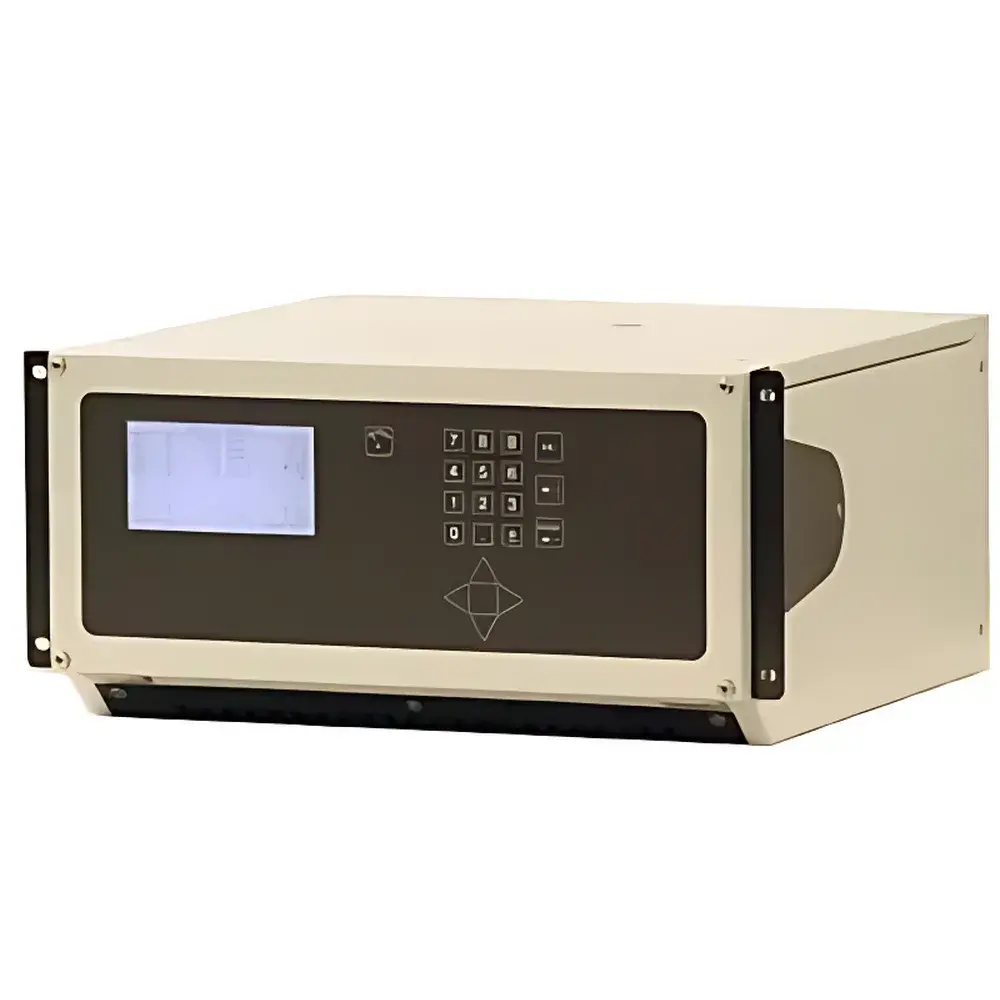
MCA03 Multi-Component Infrared Flue Gas Analyzer
| Origin | USA |
|---|---|
| Manufacturer Type | Authorized Distributor |
| Origin Category | Imported |
| Model | MCA03 |
| Price Range | USD 42,000–70,000 |
| Instrument Type | Extractive In-Situ Flue Gas Analyzer |
| Measurement Accuracy | ≤ ±2% of Full Scale |
| Repeatability | Not Specified |
| Response Time | ≤10 s |
| Stability | Not Specified |
Overview
The MCA03 Multi-Component Infrared Flue Gas Analyzer is an extractive, heated, real-time continuous emission monitoring system (CEMS) engineered for regulatory-grade measurement of up to eight gaseous constituents in hot, wet flue streams. It operates on the principle of gas filter correlation (GFC) spectroscopy—combined with single-beam dual-wavelength referencing—to deliver high selectivity and immunity to spectral interference in complex combustion matrices. Unlike NDIR analyzers relying on broad-band filters or fixed optical paths, the MCA03 employs dynamically matched reference cells for each target infrared-absorbing species (CO, NO, NH₃, HCl, N₂O, CH₄, SO₂, NO₂, CO₂, H₂O), enabling simultaneous quantification without cross-sensitivity artifacts. The integrated zirconia (ZrO₂) oxygen sensor—available as an optional module—is calibrated per ASTM D6522 and provides electrochemical O₂ measurement independent of infrared spectral overlap. All critical sample-handling components—including the heated sampling probe, PTFE-lined sample line, internal diaphragm pump, and optical measurement cell—are maintained at 185 °C (up to 200 °C) to prevent condensation, acid deposition, and adsorption losses—ensuring representative analysis of thermally unstable and corrosive species such as NH₃ and HCl.
Key Features
- Heated extractive architecture: 185 °C constant-temperature control across sampling train and measurement cell, compliant with EPA Method 3A and EN 15267-3 requirements for hot/wet operation
- Simultaneous detection of up to seven IR-active gases plus electrochemical O₂—totaling eight independent channels
- GFC + dual-wavelength referencing eliminates baseline drift and compensates for window fouling and lamp aging
- 6-meter optical path length enhances sensitivity for low-concentration species (detection limit = 1% of full scale)
- RS232 serial interface for bidirectional communication; eight isolated 4–20 mA analog outputs with configurable range and zero/span scaling
- Three programmable relay outputs for CEMS status reporting: analyzer fault, maintenance due, and calibration overdue—aligned with 40 CFR Part 60 PS-18 and Part 75 Appendix A compliance logic
- IP65-rated front panel with sealed membrane keypad and backlit LCD display for field readability under ambient lighting conditions
Sample Compatibility & Compliance
The MCA03 is validated for use with flue gases containing particulate loadings ≤10 mg/m³ (as measured per ISO 9096), moisture content up to 30% v/v, and acid gas concentrations typical of coal-fired, biomass, waste-to-energy, and cement kiln applications. Its heated design eliminates the need for chilled mirror dew point conditioning or chemical scrubbers—reducing maintenance intervals and preserving reactive species integrity. The analyzer meets U.S. EPA Performance Specification 18 (PS-18) for multi-component CEMS, satisfies data quality objectives outlined in 40 CFR Part 60 Appendix B and Part 75 Appendix A, and supports audit-ready documentation required under 21 CFR Part 11 when paired with compliant data acquisition software. It is also designed to support ISO 14064-1 greenhouse gas quantification workflows for CO₂ and N₂O reporting.
Software & Data Management
The MCA03 interfaces with industry-standard CEMS data acquisition systems (DAS) via Modbus RTU or ASCII protocol over RS232. Configuration, calibration logging, and diagnostic history are accessible through embedded firmware menus or external PC-based utility software. All calibration events—including zero/span checks, multipoint linearity verification, and span gas validation—are timestamped and stored with operator ID, gas lot number, and certified concentration values. Audit trails retain a minimum of 18 months of operational metadata, supporting GLP-compliant record retention. Optional integration with cloud-based CEMS dashboards enables remote alarm notification, trend visualization, and automated report generation aligned with EU MRV and EPA e-CFR submission formats.
Applications
- Continuous emissions monitoring at fossil-fueled and waste incineration power plants (subpart Da, Db, and Dc of 40 CFR Part 60)
- Ammonia slip monitoring in SCR/SNCR de-NOₓ systems at thermal power stations and industrial boilers
- HCl and SO₂ compliance tracking in municipal solid waste (MSW) and hazardous waste incinerators (40 CFR Part 62)
- Process optimization and combustion efficiency analysis in cement clinker kilns and lime calciners
- Pharmaceutical and biotech facility stack testing per USP and ISO 14644-8 cleanroom exhaust protocols
- Greenhouse gas (GHG) reporting for CO₂, CH₄, and N₂O under EPA GHGRP Subpart C and ISO 14064-1
FAQ
Does the MCA03 require external sample conditioning systems such as chillers or permeation dryers?
No—the fully heated sample path (185 °C) eliminates condensation and preserves reactive species integrity, rendering external drying or cooling unnecessary.
Can the MCA03 measure NH₃ in the presence of high CO₂ and H₂O concentrations?
Yes—its GFC architecture isolates the 3.0 µm NH₃ absorption band from overlapping CO₂ (4.26 µm) and H₂O (2.7 µm, 6.3 µm) bands, achieving <±2% FS accuracy even at 15% CO₂ and 25% H₂O.
Is the zirconia O₂ sensor factory-calibrated and field-replaceable?
Yes—the ZrO₂ module is pre-calibrated against NIST-traceable gases and can be swapped in under 15 minutes without optical realignment.
What is the recommended calibration frequency for compliance with 40 CFR Part 75?
Daily zero/span checks using certified gases; quarterly multipoint linearity verification; annual full-system performance audit per PS-18.
Does the MCA03 support Modbus TCP/IP for integration into plant DCS networks?
Not natively—the standard interface is RS232 ASCII/Modbus RTU; optional Ethernet gateway modules are available for TCP/IP bridging.
Related Products







