
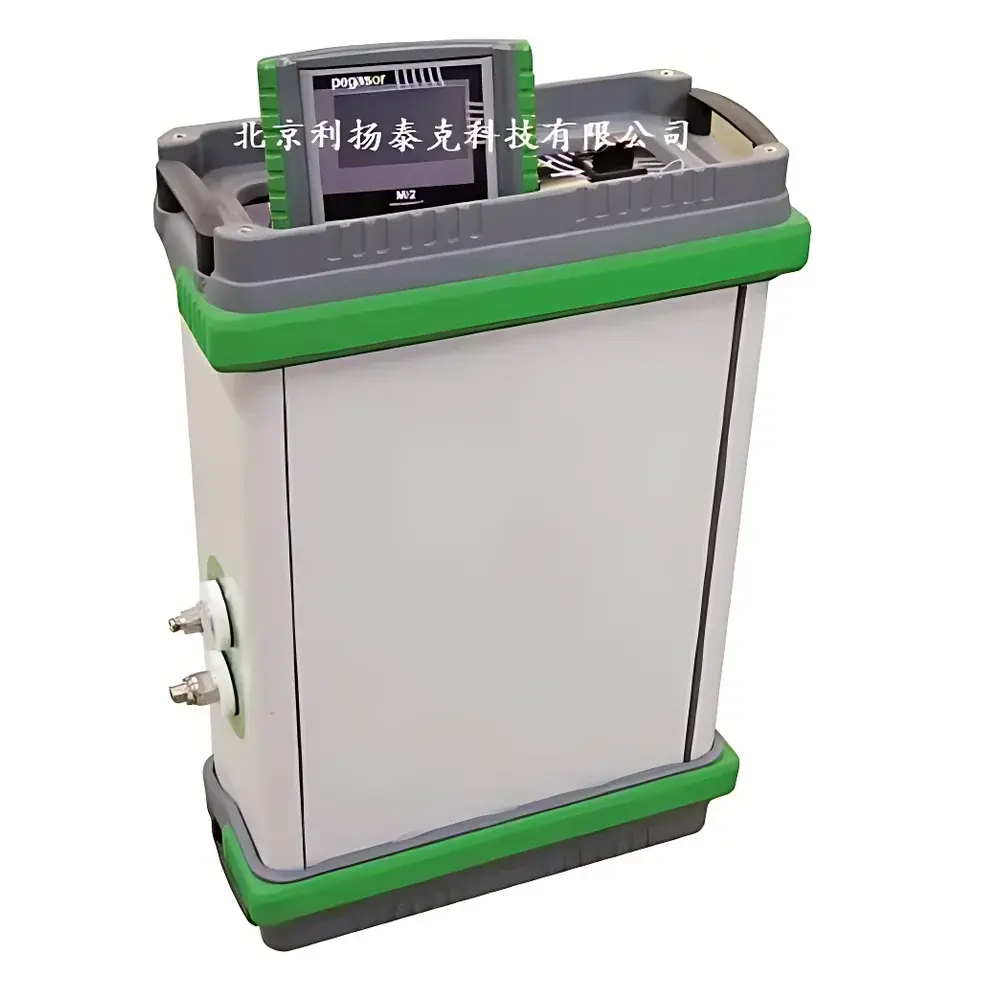
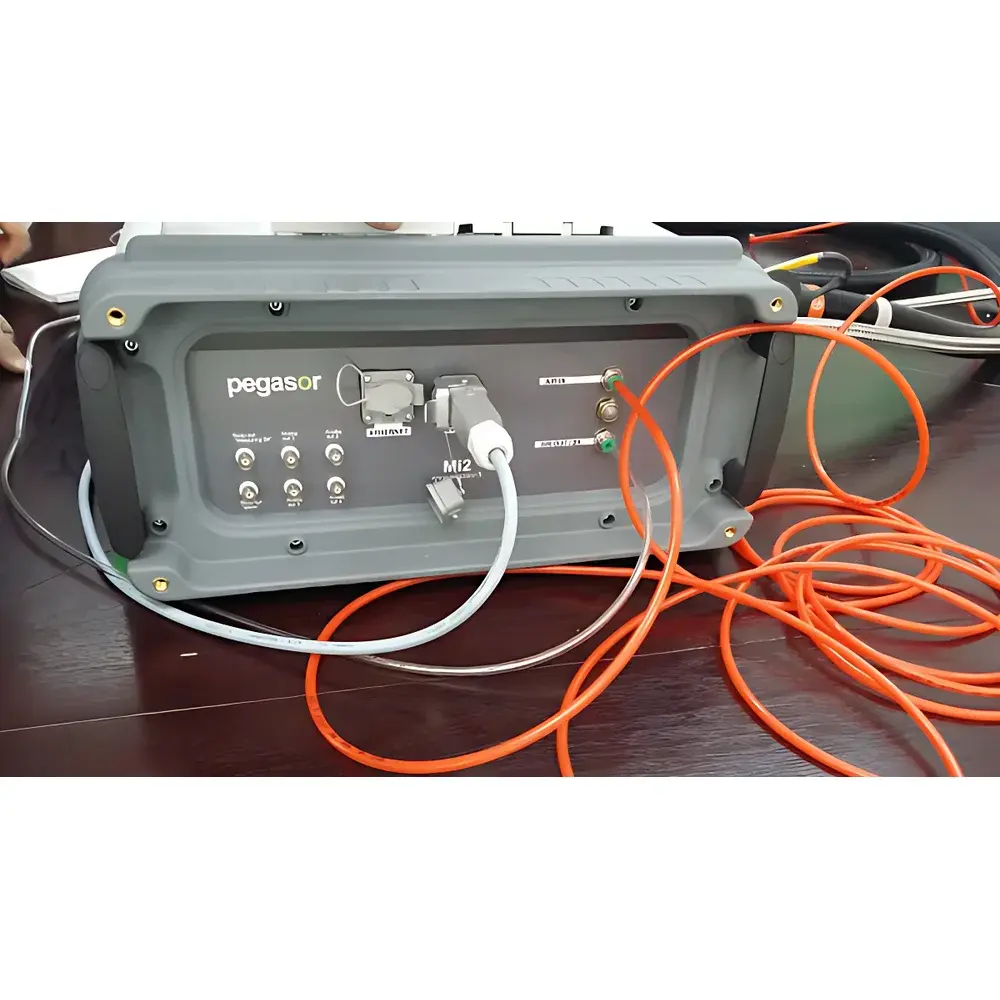
Pegasor Mi2 Fast Particulate Analyzer
| Brand | Pegasor |
|---|---|
| Origin | Finland |
| Model | Mi2 |
| Instrument Type | Online |
| Detection Principle | Electrostatic Detection with Integrated Heated Sampling |
| Particle Size Range | ~1 nm – 2.5 µm |
| Mass Concentration Range | 1 µg/m³ – 250 mg/m³ (at T = −20°C to +700°C) |
| Number Concentration Range | 10² – 10⁸ particles/cm³ (derived) |
| Sampling Frequency | 100 Hz (24-bit ADC) |
| Response Time | ≤ 0.2 s |
| Heated Sampling Line | 2 m, maintained at 200 °C |
| Operating Ambient Temperature | −20 °C to +55 °C |
| Power Supply | 24 VDC / 16 A (Mi2 unit) |
| Dimensions (L×W×H) | 798 × 484 × 208 mm |
| Weight | ~29 kg |
| Display | 4-inch color touchscreen |
| Outputs | 4-channel 4–20 mA analog |
| Interface | USB for PPS software connectivity |
| Auto-zero function | Yes |
| Compliance | Designed for EN 16454, ISO 8502-12, and EPA Method 202–compatible deployment in regulatory-grade exhaust monitoring |
Overview
The Pegasor Mi2 Fast Particulate Analyzer is an online, real-time particulate monitoring system engineered for continuous measurement of both mass and number concentration of solid and liquid aerosols in hot, undiluted exhaust streams—particularly in automotive, engine test bench, and industrial combustion applications. Unlike optical or beta-attenuation methods, the Mi2 employs a proprietary electrostatic detection principle integrated with a heated sampling interface. Its core sensor—the PPS-M—operates on charge induction physics: charged particles passing through a defined sensing volume induce measurable current signals proportional to both particle surface area and mobility-equivalent diameter. This enables simultaneous quantification of mass (µg/m³) and number (particles/cm³) concentrations without reliance on assumed density or spherical morphology. The system is designed for direct insertion into exhaust ducts up to 700 °C, eliminating the need for complex dilution tunnels or cryogenic conditioning—significantly reducing measurement uncertainty introduced by particle losses during sampling.
Key Features
- Real-time dual-parameter output: Simultaneous reporting of mass concentration (µg/m³) and number concentration (particles/cm³) at 100 Hz sampling rate with ≤0.2 s system response time
- Fully integrated heated sampling train: 2-meter, temperature-controlled (200 °C) stainless-steel probe and transfer line to prevent thermophoretic deposition and volatile condensation
- Auto-zero functionality: Internal reference electrode and periodic baseline correction ensure long-term drift stability without manual intervention
- Robust environmental operation: Rated for ambient temperatures from −20 °C to +55 °C and compatible with high-humidity, vibration-prone test cell environments
- Self-contained human-machine interface: 4-inch capacitive touchscreen for local configuration, diagnostics, live trend visualization, and alarm management
- Industrial-grade I/O architecture: Four isolated 4–20 mA analog outputs with configurable scaling; USB 2.0 port for firmware updates and data export via Pegasor’s PPS desktop software
Sample Compatibility & Compliance
The Mi2 is validated for use with undiluted diesel, gasoline, natural gas, and biofuel exhaust streams—including transient engine cycles (e.g., WLTC, RDE, FTP-75). Its electrostatic detection mechanism exhibits minimal bias across particle composition (soot, sulfates, metals, organics) and morphology (agglomerates, fractals), provided particles are electrically chargeable—a condition reliably met in combustion-generated aerosols. The analyzer meets mechanical and electromagnetic compatibility requirements per EN 61326-1 and EN 61000-6-2/6-4. While not a certified reference method per EU 2016/427 or U.S. CFR 40 Part 1065, it is widely deployed as a compliance-supporting continuous emission monitoring system (CEMS) under EN 16454 for non-road mobile machinery and as a performance verification tool aligned with ISO 8502-12 (particulate matter measurement in exhaust gases). Data integrity adheres to GLP principles, with timestamped records, user-access logs, and audit-trail-capable PPS software.
Software & Data Management
The Mi2 interfaces exclusively with Pegasor’s PPS (Particulate Parameter Software), a Windows-based application supporting real-time streaming, historical data review, statistical analysis (e.g., PM1, PM2.5, total count), and export to CSV, MATLAB (.mat), or OPC UA-compatible SCADA systems. PPS implements secure local storage with cyclic buffering (up to 30 days at 1 Hz), configurable alarm thresholds (e.g., exceedance of Euro VI PM limits), and automated report generation compliant with internal QA/QC protocols. All configuration changes and calibration events are logged with user ID, timestamp, and parameter delta—supporting traceability required under ISO/IEC 17025 and FDA 21 CFR Part 11 when used in regulated development labs.
Applications
- On-vehicle OBD-II and PEMS integration for real-driving emissions (RDE) testing
- Engine dynamometer exhaust characterization during transient and steady-state cycles
- In-line monitoring of aftertreatment systems (DPF, GPF, SCR) for regeneration efficiency and filter breakthrough detection
- Development and validation of low-emission combustion strategies (HCCI, RCCI, lean-burn)
- Continuous stack monitoring in stationary power generation and waste incineration where rapid particulate dynamics must be captured
FAQ
Does the Mi2 require zero-gas or span-gas calibration?
No. The Mi2 performs automatic zero compensation using its internal reference electrode and does not rely on external calibration gases. Periodic verification with traceable aerosol generators (e.g., CAST soot, NaCl) is recommended per ISO 29463 for metrological assurance.
Can the Mi2 measure volatile nanoparticles below 10 nm?
Yes—within its stated size range (~1 nm to 2.5 µm)—but detection sensitivity below 3 nm depends on charging efficiency and background noise floor. For sub-3 nm research applications, supplementary DMA classification upstream is advised.
Is the heated sampling line compatible with corrosive exhaust (e.g., high-sulfur fuels)?
The 200 °C heated line uses Inconel 625 sheathing and is resistant to sulfuric acid condensate up to dew points of ~150 °C. For sustained exposure >500 ppm SO₂, optional ceramic-coated probes are available.
How is data synchronization handled across multiple Mi2 units in a multi-engine test facility?
PPS supports NTP-based time synchronization across networked units. All timestamps are referenced to GPS or IEEE 1588 PTP when connected to a master clock, ensuring phase-aligned data fusion for fleet-level analysis.
What maintenance intervals are specified for field operation?
No scheduled consumables. Recommended quarterly inspection includes inlet filter cleaning, touchscreen calibration check, and verification of heater circuit resistance. Mean time between unscheduled service exceeds 18 months in typical automotive lab use.







