
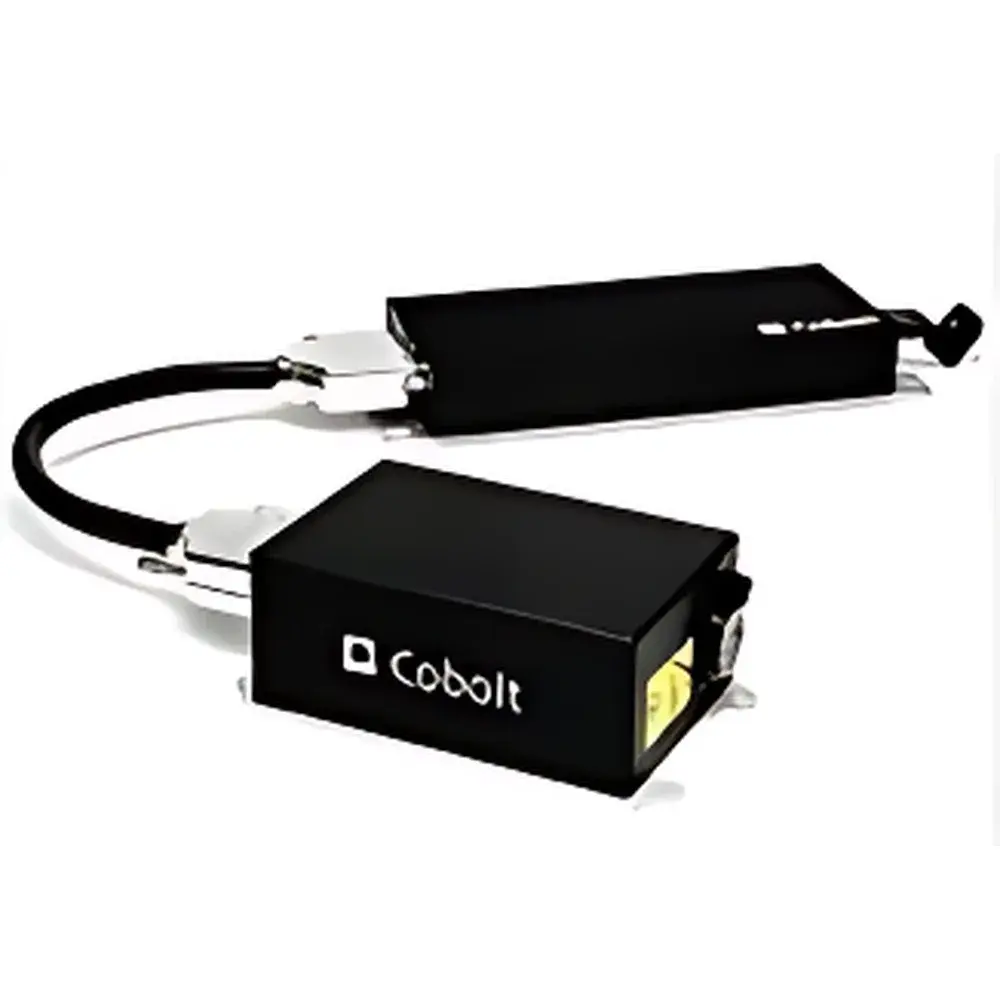
Cobolt Single-Frequency Laser Systems
| Origin | Sweden |
|---|---|
| Manufacturer Type | Authorized Distributor |
| Origin Category | Imported |
| Model Series | Cobolt Zouk / Calypso / Samba / Jive / Flamenco / Rumba |
| Core Technology | Solid-State Diode-Pumped Single-Longitudinal-Mode (SLM) Lasers |
| Wavelength Range | 355–1064 nm |
| Spectral Linewidth | <1 MHz (<0.01 pm) |
| Spatial Mode | TEM₀₀, M² < 1.1 |
| Power Stability (8 h) | <2% |
| Beam Pointing Stability | <10 µrad/°C (typ. 5 µrad/°C) |
| Polarization Ratio | >100:1 |
| Max Head Baseplate Temp | 50°C |
| Recommended Heat Sink Thermal Resistance | 0.2 K/W |
| Controller Interface | RS-232 or USB |
| Warranty | 24 months (Samba/Jive/Flamenco/Rumba), 12 months (Zouk/Calypso) |
Overview
Cobolt single-frequency laser systems are solid-state, diode-pumped lasers engineered for high spectral purity and exceptional temporal coherence. Operating on the principle of forced single-longitudinal-mode (SLM) selection via intra-cavity etalons or volume Bragg gratings, these lasers deliver narrow-linewidth output (<1 MHz) with near-diffraction-limited beam quality (TEM₀₀, M² 50 dB—ensuring robust performance in interferometric, spectroscopic, and quantum optics environments. Unlike broad-area semiconductor lasers, Cobolt’s monolithic cavity architecture integrates thermal management, polarization control, and electronic stabilization into compact, air-cooled modules compliant with Class 3B and Class 4 laser safety standards (CDRH, IEC 60825-1).
Key Features
- Ultra-narrow spectral linewidth: <1 MHz (<0.01 pm), enabling coherence lengths exceeding 300 m
- Exceptional amplitude stability: RMS noise <0.1% (20 Hz–20 MHz) for Samba, Jive, and Rumba series; <0.5% for Calypso and Flamenco
- Optical feedback immunity: Integrated isolator-free design with patented “PowerLock” technology mitigates destabilization from back-reflections up to –30 dB
- Thermally stabilized cavity: Active temperature control maintains wavelength drift <0.5 pm/°C and long-term power drift <2% over 8 hours
- Compact modular architecture: Laser head dimensions as small as 125 × 70 × 45 mm; controller (190 × 72 × 28 mm) supports RS-232 or USB communication with standardized SCPI command set
- Industry-standard beam specifications: Circularized collimated output with beam divergence 100:1
Sample Compatibility & Compliance
Cobolt single-frequency lasers are compatible with standard optical tables, OEM integration platforms, and fiber-coupled subsystems—including PM-fiber pigtailing via optional external coupling mounts. All models comply with ISO 13406-2 for beam quality classification and meet EN 61000-6-3 (EMC emission) and EN 61000-6-2 (immunity) requirements. For regulated laboratory use, the RS-232 CDRH-compliant variants (e.g., model suffix “-500” or “-700”) support audit-ready operation under GLP and GMP frameworks. Firmware includes timestamped event logging and configurable interlock monitoring, aligning with FDA 21 CFR Part 11 data integrity expectations when integrated into validated analytical workflows.
Software & Data Management
The Cobolt Control Software (v4.2+) provides cross-platform GUI support (Windows/macOS/Linux) for real-time parameter monitoring, power ramping, modulation triggering (TTL/analog), and firmware updates. Communication follows IEEE 488.2–compliant SCPI syntax, enabling seamless integration into LabVIEW, MATLAB, Python (PySerial), and EPICS-based control systems. All controllers log operational parameters—including current, temperature, power output, and fault events—with millisecond timestamp resolution. Optional SDKs include C/C++ libraries and .NET wrappers, supporting deterministic latency control for time-critical applications such as pump-probe spectroscopy or adaptive optics wavefront correction.
Applications
- High-resolution spectroscopy: Doppler-free saturation spectroscopy, cavity ring-down measurements, and frequency metrology requiring sub-MHz linewidth stability
- Quantum technologies: Trapping and cooling of neutral atoms (e.g., Rb, Cs), ion shelving in trapped-ion quantum computing, and squeezed state generation
- Biophotonics instrumentation: Confocal and super-resolution fluorescence microscopy (STED, PALM), flow cytometry excitation sources, and DNA sequencing platforms requiring stable 488/561/640 nm lines
- Interferometric sensing: Laser Doppler vibrometry, gravitational wave detector prototype alignment, and absolute distance interferometry (ADI)
- Nonlinear optics: Second-harmonic generation (SHG), optical parametric oscillation (OPO) seeding, and stimulated Raman scattering (SRS) microscopy
- OEM system integration: Embedded laser engines for portable Raman spectrometers, industrial particle sizers, and aerospace-grade inertial navigation calibration sources
FAQ
What distinguishes a single-longitudinal-mode (SLM) laser from a multi-mode laser?
SLM lasers emit light in only one resonant cavity mode, resulting in narrow spectral bandwidth, long coherence length, and minimal phase noise—critical for interference-based measurements. Multi-mode lasers exhibit multiple longitudinal modes, causing mode competition, intensity fluctuations, and reduced temporal coherence.
Can Cobolt lasers be fiber-coupled?
Yes—while all models feature free-space collimated output, optional external fiber coupling mounts enable efficient coupling into polarization-maintaining (PM) or single-mode (SM) fibers. Custom pigtailed versions are available upon request with FC/APC or SMA905 connectors.
Is remote monitoring supported over Ethernet or TCP/IP?
Standard controllers use RS-232 or USB interfaces. For networked operation, third-party USB-to-Ethernet bridges or dedicated industrial gateways (e.g., Moxa NPort) can be deployed with no firmware modification required.
How is thermal management handled in confined enclosures?
Each laser head requires a heatsink with thermal resistance ≤0.2 K/W. Ambient airflow ≥0.5 m/s is recommended. The controller contributes minimal heat load (<5 W), allowing co-location in space-constrained OEM chassis.
Are calibration certificates traceable to NIST or other national standards?
Factory calibration reports include wavelength accuracy (±0.1 nm), output power (±3% at 23°C), and polarization ratio—traceable to PTB (Physikalisch-Technische Bundesanstalt) reference standards. Full calibration services are available through authorized service centers.




