
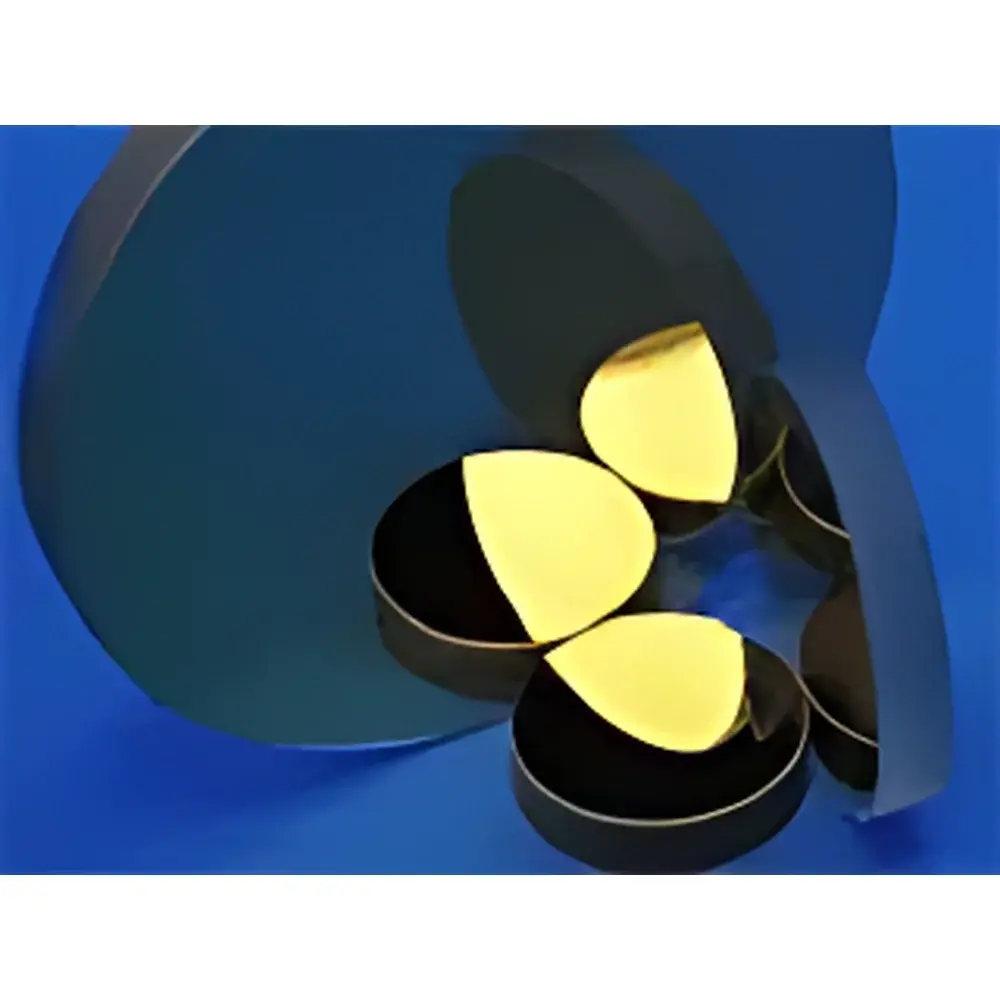
THz Mirrors – Quartz Substrate with Protected Gold Coating
| Origin | Russia |
|---|---|
| Manufacturer Type | Authorized Distributor |
| Origin Category | Imported |
| Model | THz Mirrors |
| Price Range | USD 1,400 – 7,000 (FOB) |
| Component Category | Optical Element |
| Material | Fused Quartz |
| Type | Plano-Plano |
| Dimensional Tolerance | ±0.25 mm |
| Clear Aperture | ≥90% |
| Surface Quality (Polished) | 40/20 Scratch-Dig |
| Surface Roughness (Ground Side) | 2.5 Ra (µm) |
| Surface Accuracy | λ/2 @ 633 nm |
| Coating | Protected Gold |
| Gold Layer Thickness | 400 nm |
Overview
THz Mirrors are high-performance reflective optics engineered for broadband operation across the terahertz (0.1–10 THz) spectral range. Designed for use in time-domain spectroscopy (TDS), continuous-wave (CW) THz imaging systems, and free-space optical alignment in ultrafast laser laboratories, these mirrors leverage the exceptional reflectivity and low absorption characteristics of gold in the far-infrared regime. The substrate is precision-manufactured from synthetic fused quartz—selected for its near-zero thermal expansion coefficient, high transmission in UV–VIS–NIR, mechanical stability, and minimal dispersion in the THz band. Unlike aluminum or silver-coated alternatives, the protected gold coating ensures long-term environmental stability without oxidation-induced degradation in ambient laboratory conditions.
Key Features
- Fused quartz substrate with λ/2 surface flatness referenced at 633 nm He–Ne wavelength—ensuring minimal wavefront distortion for collimated THz beam steering and focusing applications.
- Protected gold thin-film coating (400 nm nominal thickness) deposited via electron-beam evaporation under high-vacuum conditions, followed by a dielectric overcoat to prevent mechanical abrasion and atmospheric sulfurization.
- Optimized for >98% average reflectance between 0.3–5 THz, validated by Fourier-transform infrared (FTIR) reflectometry and THz-TDS calibration measurements.
- Plano-plano geometry enables zero optical path difference (OPD) insertion into interferometric setups such as Michelson or Mach–Zehnder THz configurations.
- Surface quality meets MIL-PRF-13830B standards: polished faces rated 40/20 scratch-dig; ground backside finished to ≤2.5 Ra roughness for secure kinematic mounting without stress-induced birefringence.
- Dimensional tolerance of ±0.25 mm supports interchangeability in modular THz optomechanics (e.g., Thorlabs, Newport, or custom breadboard-integrated platforms).
Sample Compatibility & Compliance
These mirrors are compatible with standard THz sources including photoconductive antennas (PCA), nonlinear optical crystals (e.g., ZnTe, GaP, DAST), and quantum cascade lasers (QCLs). They maintain polarization fidelity for both s- and p-polarized incidence up to 45° angle of incidence (AOI), with negligible depolarization effects due to uniform coating thickness and substrate homogeneity. All units undergo 100% inspection per ISO 10110-7 for surface figure and ISO 10110-8 for coating integrity. Documentation includes traceable metrology reports compliant with ISO/IEC 17025-accredited calibration practices. No hazardous substances are used in manufacturing—fully RoHS 2011/65/EU and REACH SVHC-compliant.
Software & Data Management
While THz Mirrors are passive optical components and require no embedded firmware or driver software, they are fully integrated into industry-standard optical design workflows. Specifications are provided in Zemax-compatible .ZBF and CODE V .DAT formats for ray-tracing simulations across THz bands. Reflectance data (R(ν)) is delivered as ASCII-spectrum files (.csv) calibrated against NIST-traceable reference standards. For GMP/GLP environments, full traceability documentation—including lot-specific coating deposition logs, interferometric surface maps, and environmental aging test summaries—is available upon request and supports FDA 21 CFR Part 11 audit readiness when paired with validated laboratory information management systems (LIMS).
Applications
- Beam steering and folding optics in femtosecond-laser-pumped THz-TDS systems.
- Reference arms and sample arms in coherent THz interferometers for non-destructive testing (NDT) of polymer composites and pharmaceutical tablets.
- External cavity feedback elements in tunable THz QCL systems requiring broadband high-reflectivity surfaces.
- Alignment fiducials in cryogenic THz spectrometers operating below 77 K, where fused quartz’s CTE mismatch with aluminum mounts is minimized.
- Multi-pass cell end mirrors for enhanced THz gas-phase absorption spectroscopy (e.g., H2O, NH3, CH4 detection).
FAQ
What is the maximum recommended power density for continuous-wave THz illumination?
For CW sources below 3 THz, the mirror is rated for ≤100 mW/cm² incident power density without measurable thermal lensing or coating delamination—validated per IEC 60825-1:2014 Class 3R safety thresholds.
Can these mirrors be used in ultra-high vacuum (UHV) environments?
Yes—the fused quartz substrate and e-beam-deposited protected gold coating are UHV-compatible (base pressure ≤1×10⁻⁹ mbar); outgassing rates comply with ASTM E595 for total mass loss (TML) <0.5% and collected volatile condensable materials (CVCM) <0.1%.
Is custom curvature or wedge available?
Standard offerings are plano-plano; however, concave (f/2–f/10) and wedged variants (0.5°–3°) can be manufactured under OEM agreement with minimum order quantities and extended lead times.
How is coating adhesion verified?
Per ISO 2409 (cross-cut test) and ASTM B571 (tape test), all mirrors pass Grade 0 adhesion classification after 24-hour humidity exposure (85% RH, 85°C) and thermal cycling (−40°C to +85°C, 100 cycles).




