
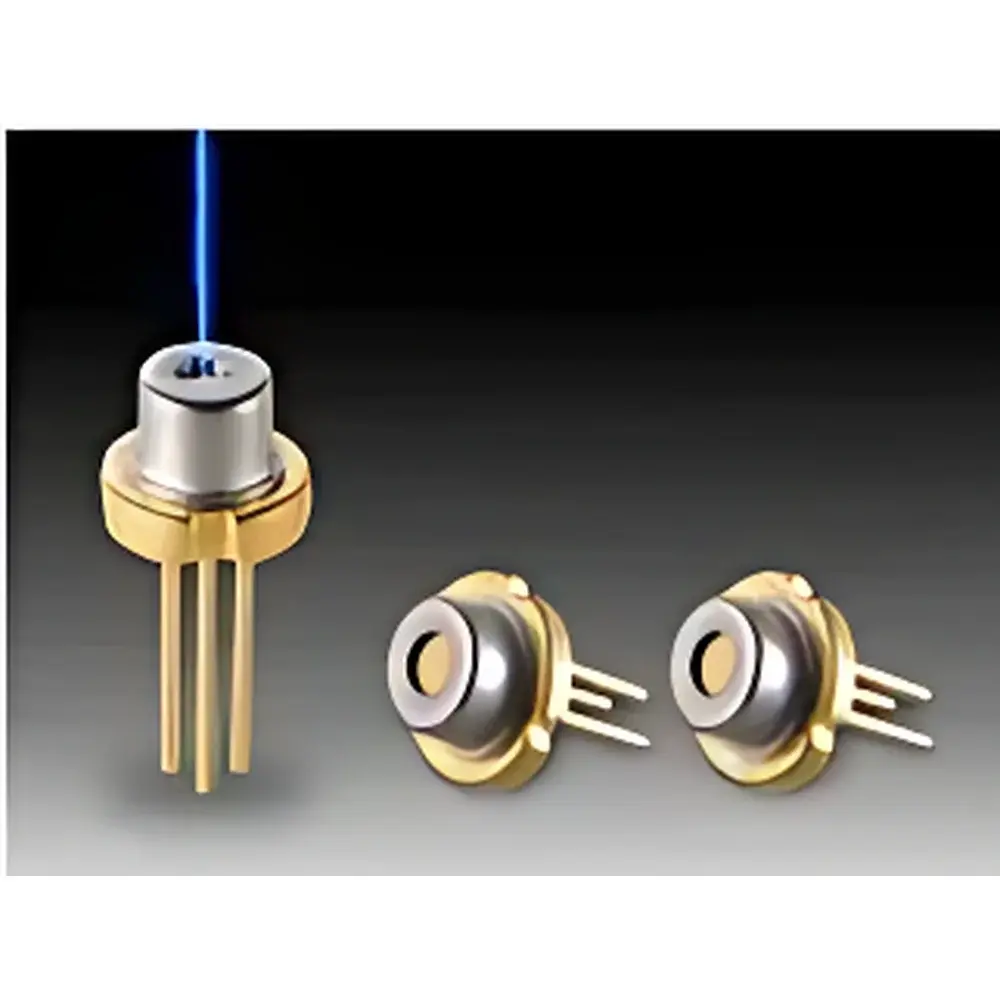
Toptica/eagleyard High-Performance Laser Diodes
| Brand | Toptica |
|---|---|
| Origin | Germany |
| Manufacturer Type | Authorized Distributor |
| Origin Category | Imported |
| Model Series | Toptica/eagleyard |
| Pricing | Available Upon Request |
Overview
Toptica/eagleyard High-Performance Laser Diodes represent a synergistic integration of two leading German photonics engineering entities—TOPTICA Photonics AG and eagleyard Photonics GmbH. These laser diodes are engineered for demanding scientific, industrial, and metrological applications where spectral purity, wavelength stability, narrow linewidth, and long-term reliability are non-negotiable. Leveraging advanced epitaxial growth, precision facet coating (including anti-reflection and high-reflection treatments), and monolithic or hybrid distributed feedback (DFB) and distributed Bragg reflector (DBR) cavity designs, these devices operate across ultraviolet-visible-near-infrared (UV-VIS-NIR) and short-wave infrared (SWIR) spectral ranges. The platform supports both free-space and fiber-coupled configurations, with rigorous thermal and current control interfaces compatible with industry-standard laser drivers and temperature controllers.
Key Features
- Wavelength coverage from 373 nm to 3000 nm—spanning deep UV to SWIR—enabling spectroscopy, atomic physics, gas sensing, and quantum optics applications.
- Multiple cavity architectures: Fabry–Perot (FP), AR-coated FP, DFB, DBR, tapered amplifiers (TA), ridge waveguide, and broad-area emitters—each optimized for specific coherence, power, and linewidth requirements.
- High spectral brightness and low relative intensity noise (RIN), critical for coherent detection, heterodyne spectroscopy, and optical frequency comb seeding.
- Hermetically sealed TO-3, TO-56, or butterfly packages with integrated thermistors and photodiodes for real-time monitoring and closed-loop stabilization.
- Compliance with RoHS and REACH directives; qualified for operation under MIL-STD-883 environmental stress screening protocols in selected variants.
Sample Compatibility & Compliance
The Toptica/eagleyard laser diode portfolio is routinely deployed in systems requiring traceable calibration and regulatory compliance. Devices intended for medical instrumentation or analytical chemistry platforms meet IEC 60825-1:2014 (Laser Product Safety) Class 1, 1M, 2, or 3R classifications depending on output configuration. For laboratory-grade metrology—including atomic fountain clocks, Rb/Cs vapor cell spectroscopy, and cavity-enhanced absorption setups—devices support alignment with ISO/IEC 17025-accredited calibration workflows. Selected DFB and DBR models exhibit <100 kHz intrinsic linewidth (FWHM) and <10 MHz/h drift—parameters verified per ASTM E2912-21 (Standard Practice for Characterizing Tunable Diode Laser Spectrometers).
Software & Data Management
While the laser diodes themselves are hardware components, they are fully interoperable with TOPTICA’s proprietary DCP (Digital Control Platform) and third-party control ecosystems (e.g., LabVIEW™, Python-based PyVISA, MATLAB® Instrument Control Toolbox). Drivers provide SCPI-compliant serial communication over USB or RS-232, enabling automated wavelength tuning, current ramping, temperature setpoint adjustment, and real-time photodiode feedback logging. Audit trails, parameter versioning, and timestamped operational logs can be implemented in accordance with FDA 21 CFR Part 11 requirements when integrated into validated GxP environments using compliant data acquisition software.
Applications
- Atomic & Molecular Physics: Pumping and probing of alkali (Rb, Cs), alkaline-earth (Sr, Yb), and molecular transitions (e.g., H₂O, CO₂, CH₄) in precision spectroscopy and cold atom experiments.
- Gas Sensing & Environmental Monitoring: TDLAS (Tunable Diode Laser Absorption Spectroscopy) systems operating at fundamental or overtone absorption lines with ppm-to-ppt detection sensitivity.
- Quantum Technology Infrastructure: Seeding of optical parametric oscillators (OPOs), pumping of Ti:sapphire amplifiers, and generation of entangled photon pairs via SPDC.
- Industrial Metrology: Interferometric displacement measurement, vibrometry, and linewidth-sensitive surface inspection in semiconductor fabrication and aerospace component testing.
- Biophotonics & Medical Device Development: Flow cytometry excitation sources, OCT light engines (with swept-source compatibility), and photoacoustic imaging illumination modules.
FAQ
Are these laser diodes certified for use in Class 1 laser systems?
Yes—many models are available in factory-configured Class 1 or Class 1M variants, incorporating integrated safety interlocks and beam-shaping optics to meet IEC 60825-1 requirements without external enclosures.
Can I obtain calibration certificates traceable to NIST or PTB standards?
Traceable calibration reports (wavelength, power, linewidth, SMSR) are available upon request for select DFB/DBR devices, issued by TOPTICA’s in-house metrology lab accredited to ISO/IEC 17025:2017.
Do you offer fiber-coupled versions with polarization-maintaining (PM) or single-mode (SM) fibers?
Yes—standard options include PM980, SMF-28, and HI1060 fiber pigtails with FC/APC or FC/PC connectors; custom coupling efficiencies (>50% for tapered devices) and polarization extinction ratios (>20 dB) are specified per order.
What thermal management solutions are recommended for continuous-wave operation above 500 mW?
Active cooling via thermoelectric coolers (TECs) mounted on copper or aluminum heatsinks is required; TOPTICA provides mechanical drawings and thermal interface recommendations aligned with JEDEC JESD51-1 guidelines.
Is remote firmware update capability supported?
Firmware updates apply only to intelligent driver units (e.g., TOPTICA’s iBeam smart series); bare laser diodes do not contain embedded firmware but support full analog/digital modulation via external controllers.



