
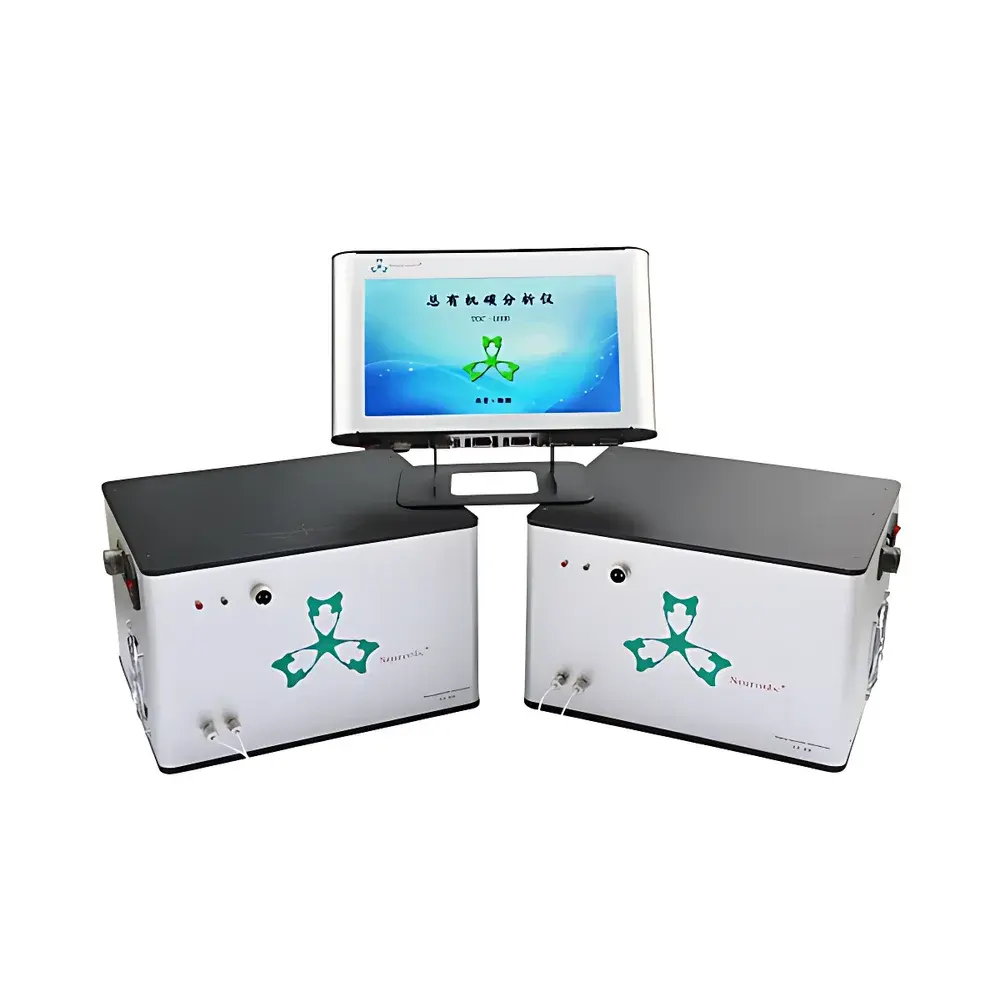
NeuronBC TA-5.0 Multi-Point Online Total Organic Carbon (TOC) Analyzer
| Brand | NeuronBC |
|---|---|
| Origin | Beijing, China |
| Model | TA-5.0 |
| Instrument Type | Online TOC Analyzer |
| Detection Principle | Direct Conductivity Method |
| Oxidation Method | UV Photolysis (Static Oxidation) |
| Measurement Range | 1–1500 ppb (0.001–1.5 mg/L) |
| Accuracy | ±5% |
| Detection Limit | 1 ppb (0.001 mg/L) |
| Resolution | 1 ppb |
| Repeatability | ±3% |
| Sample Temperature Range | 0–100 °C |
| Conductivity Range | 0.055–6.000 µS/cm |
| Ambient Operating Temperature | 5–65 °C |
| Relative Humidity | ≤85% |
| Power Supply | 220 V ±10%, 50 Hz ±10% |
| Response Time | <5 minutes |
| Drift | ±5% FS/24 h |
| Rated Power per Sensor Unit | 50 W |
| Communication Interface | RS-485 |
| Display | 10-inch capacitive touchscreen |
| Sample Inlet/Outlet Tubing | 1 mm ID PTFE tubing with 50-quick-connect fittings |
| Data Terminal | TOC-S500 (supports up to 8 TA-5.0 sensor units) |
Overview
The NeuronBC TA-5.0 Multi-Point Online Total Organic Carbon (TOC) Analyzer is an engineered solution for continuous, real-time monitoring of organic carbon contamination in high-purity water systems. It operates on the direct conductivity detection principle following ultraviolet (UV) photolysis oxidation—a method standardized in pharmacopeial and semiconductor industry guidelines for its reliability in low-conductivity matrices. Unlike combustion-based TOC analyzers, the TA-5.0 employs static UV oxidation at 185 nm wavelength, enabling complete mineralization of non-purgeable organic compounds into CO₂ without catalysts or high-temperature furnaces. The resulting CO₂ dissolves in the aqueous stream, altering solution conductivity proportionally to TOC concentration. This conductometric measurement—calibrated against NIST-traceable potassium hydrogen phthalate (KHP) standards—is inherently drift-stable and suitable for ultra-low-level quantification in resistivity >15 MΩ·cm water. The system architecture decouples sensing and data handling: up to eight independent TA-5.0 sensor units interface with a central TOC-S500 data terminal, enabling distributed monitoring across multiple process points—such as pretreatment, RO permeate, EDI output, storage tanks, and point-of-use loops—without signal degradation or cross-talk.
Key Features
- Multi-point scalability: One TOC-S500 terminal synchronously manages up to eight TA-5.0 sensor units via RS-485 Modbus RTU protocol, supporting time-synchronized data acquisition and alarm coordination across geographically dispersed sampling locations.
- Ultra-low detection capability: Achieves a validated detection limit of 1 ppb (0.001 mg/L) with resolution of 1 ppb, meeting USP , EP 2.2.44, and JP 17 requirements for purified water and water for injection (WFI).
- Static UV oxidation chamber: Utilizes low-pressure mercury lamp emitting at 185 nm, ensuring consistent photon flux and oxidation efficiency across operating temperature (0–100 °C) and flow conditions—eliminating need for persulfate addition or catalytic surfaces prone to fouling.
- PTFE-wetted path: Entire fluidic path—including 1 mm inner diameter PTFE tubing and ISO 50 quick-connect fittings—is chemically inert, minimizing adsorption losses and extractables, critical for semiconductor-grade UPW (ASTM D5127) and biopharmaceutical applications.
- Integrated data management: 10-inch industrial touchscreen provides local configuration, real-time trend visualization, historical data query (by timestamp), and on-demand report generation; supports CSV export via USB.
- Compliance-ready operation: Built-in audit trail logging, user access levels (admin/operator), and configurable alarm thresholds (high/low, rate-of-change) align with FDA 21 CFR Part 11 and EU Annex 11 expectations for electronic records.
Sample Compatibility & Compliance
The TA-5.0 is validated for use with purified water (PW), water for injection (WFI), and ultrapure water (UPW) across pharmaceutical, biotechnology, and microelectronics manufacturing environments. Its direct conductivity detection mechanism is optimized for low-ionic-strength samples (conductivity 0.055–6.000 µS/cm), eliminating interference from inorganic carbon carryover when paired with appropriate system design (e.g., degassing or membrane separation where required). The analyzer complies with ISO 8573-7 for compressed air TOC monitoring support, and meets mechanical and electromagnetic compatibility requirements per IEC 61326-1 (industrial environment). All firmware and calibration procedures are documented per GMP Annex 15 and ICH Q2(R2) guidelines for analytical instrument qualification (AIQ), including Installation Qualification (IQ), Operational Qualification (OQ), and Performance Qualification (PQ) templates.
Software & Data Management
The TOC-S500 terminal runs embedded Linux-based firmware with deterministic real-time scheduling. Data acquisition occurs at user-defined intervals (1–60 min), with raw conductivity readings, temperature-compensated TOC values, oxidation efficiency diagnostics, and system status flags stored locally in non-volatile memory (≥12 months at 5-min intervals). Historical data retrieval is performed via timestamp-based search or batch export. Optional OPC UA server integration enables seamless connectivity to SCADA, MES, or LIMS platforms. Audit trails record all parameter changes, calibration events, and user logins with timestamps and operator IDs—retained for ≥18 months and exportable for regulatory review. Calibration verification is supported using certified KHP standards traceable to NIST SRM 84d.
Applications
- Pharmaceutical water systems: Continuous TOC surveillance at critical control points in PW/WFI generation loops per USP and EU GMP Annex 1.
- Semiconductor UPW distribution: Monitoring TOC excursions during wafer cleaning, etching, and rinsing stages where sub-ppb organic contamination causes defectivity.
- Power plant demineralized water: Early detection of organic breakdown products from ion exchange resins or biofilm shedding in condensate polishing systems.
- Research laboratories: Reference-grade TOC validation for ultrapure water purification systems and analytical reagent preparation.
- Contract manufacturing organizations (CMOs): Integrated TOC compliance for multi-client facility audits under FDA, EMA, and PMDA inspection scopes.
FAQ
What sample flow rate is required for stable TA-5.0 operation?
The system operates in batch-mode static oxidation; no continuous flow is needed. A single 10–20 mL sample aliquot is drawn automatically every measurement cycle, minimizing water consumption and pressure drop.
Can the TA-5.0 detect chlorinated organics or humic substances?
Yes—UV photolysis at 185 nm effectively oxidizes refractory compounds including chloroform, haloacetic acids, and fulvic acids, provided they remain soluble and non-volatile under ambient sampling conditions.
Is third-party calibration verification supported?
Yes. The TOC-S500 accepts external calibration inputs via analog 4–20 mA or digital Modbus register write, enabling integration with automated calibration stations compliant with ASTM D5905.
How is oxidation efficiency monitored during routine operation?
Each measurement cycle includes a blank subtraction step and internal conductivity baseline tracking; deviation >±3% triggers automatic diagnostic flagging and optional maintenance alert.
Does the system require periodic reagent replacement?
No. The UV lamp has a rated lifetime of ≥12,000 hours; no chemical oxidants, catalysts, or consumable membranes are used in the core detection pathway.
Related Products







