
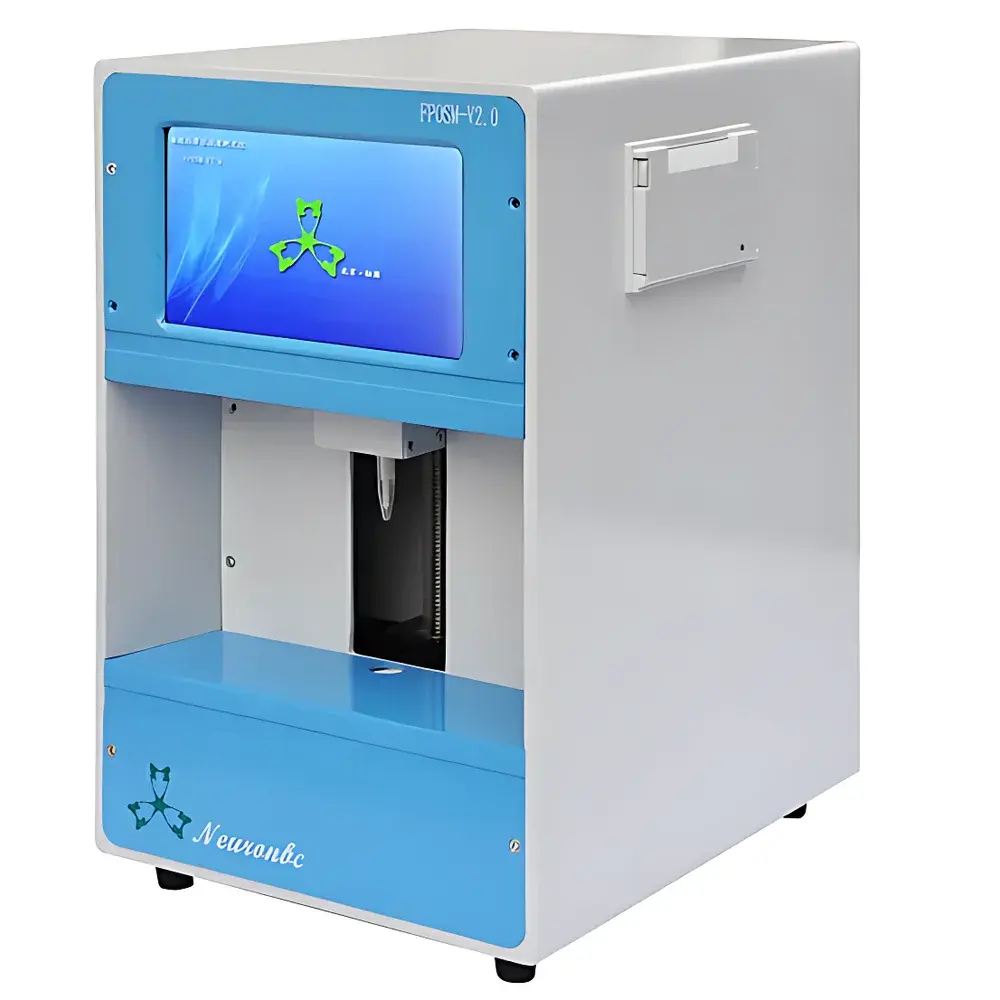
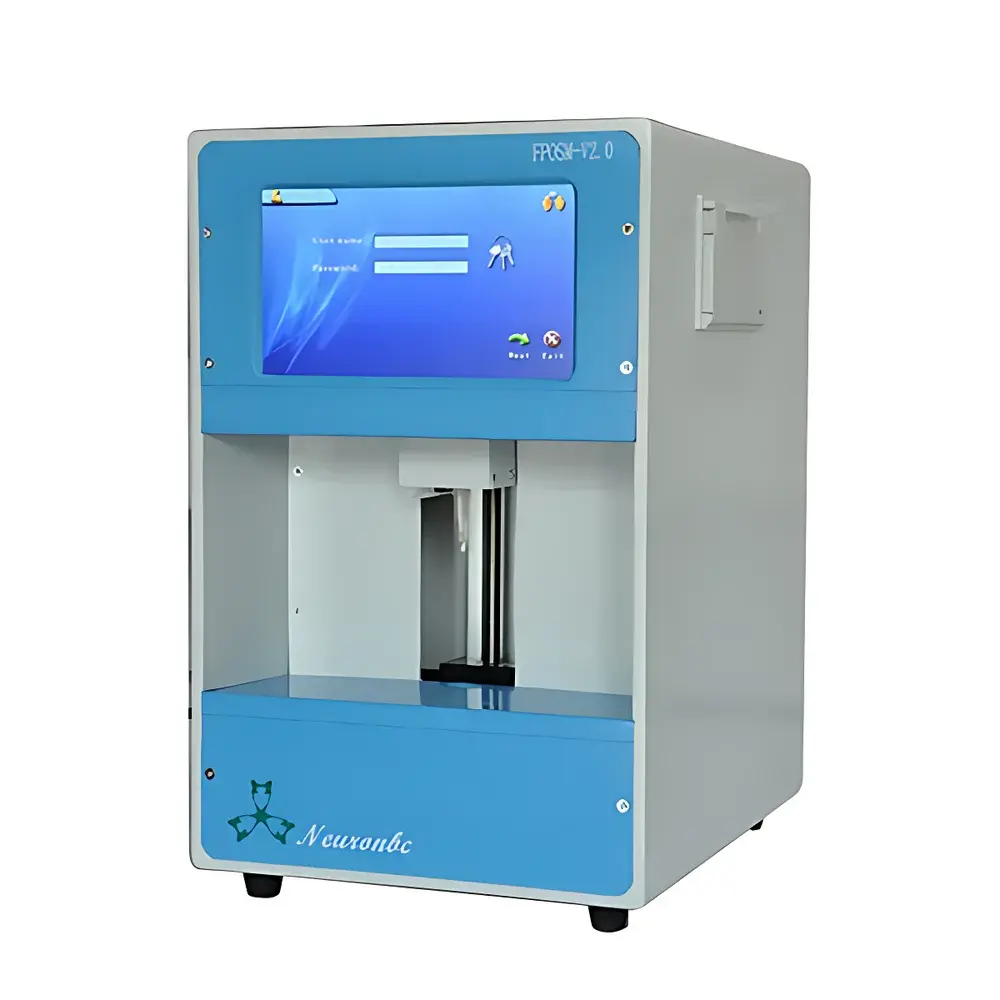
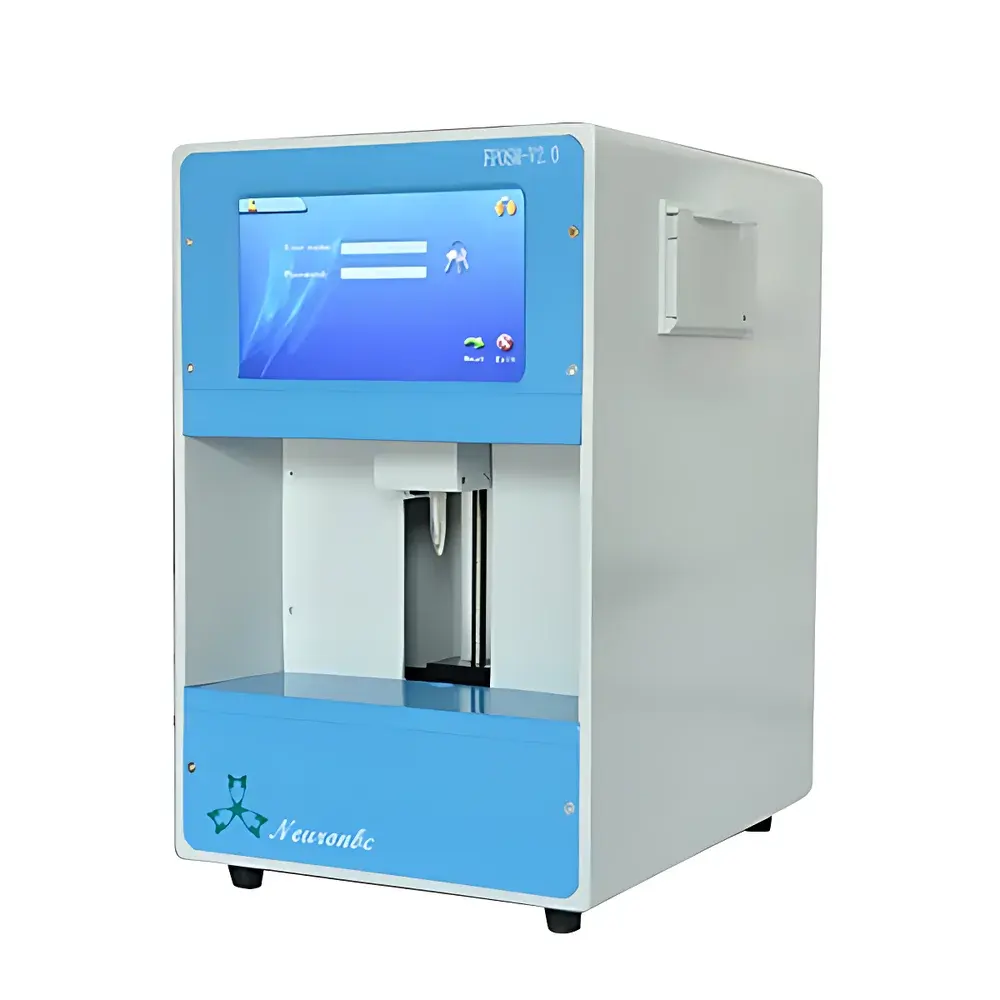
NeuronBC FPOSM-2.0 Ice Point Osmometer
| Brand | NeuronBC |
|---|---|
| Origin | Beijing, China |
| Model | FPOSM-2.0 |
| Measurement Principle | Cryoscopic Depression (Ice Point Depression) |
| Measurement Range | 0–3000 mOsm/kg H₂O |
| Sample Volume | 50–70 µL |
| Pre-cooling Time | ≤3 min |
| Test Time | <2 min |
| Accuracy | ±1% (≤300 mOsm/kg and ≥400 mOsm/kg) |
| Repeatability (RSD) | ≤±1% at 300 mOsm/kg |
| Resolution | 1 mOsm/kg H₂O |
| Linearity | <1% (linear fit) |
| Calibration Points | 31-point programmable calibration (2-point or multi-point linear correction supported) |
| Display | Full-color LED LCD |
| Data Storage | 20,000 test records with recall & print capability |
| Built-in Pharmacopoeia Database | Preloaded Chinese Pharmacopoeia (2010 Edition) injection names |
| Cooling System | Dual-stage semiconductor refrigeration, refrigerant-free thermal transfer design |
| Compliance | Fully compliant with Chinese Pharmacopoeia (2010 Edition), USP <785>, and ISO 17511:2020 (in vitro diagnostic medical devices — requirements for establishing metrological traceability of values assigned to calibrators and human samples) |
Overview
The NeuronBC FPOSM-2.0 Ice Point Osmometer is a precision cryoscopic instrument engineered for the quantitative determination of osmolality in aqueous solutions—particularly pharmaceutical formulations, parenteral preparations, biological fluids, and cell culture media. It operates on the fundamental thermodynamic principle of freezing point depression: as solute concentration increases, the solution’s freezing point decreases linearly within defined physiological and pharmaceutical ranges. This relationship enables direct, absolute quantification of total solute particle concentration (expressed in milliosmoles per kilogram of water, mOsm/kg H₂O), independent of molecular identity or charge. Designed for regulatory-grade compliance, the FPOSM-2.0 meets the methodological requirements specified in the Chinese Pharmacopoeia (2010 Edition), USP Chapter “Osmolality”, and aligns with metrological traceability frameworks outlined in ISO 17511:2020. Its application spans quality control laboratories in pharmaceutical manufacturing, contract testing organizations (CTOs), regulatory agencies, and academic research facilities engaged in formulation development and biocompatibility assessment.
Key Features
- High-fidelity cryoscopic detection using dual-stage Peltier cooling, eliminating reliance on volatile or maintenance-intensive coolant fluids.
- True-color LED LCD interface with intuitive navigation, real-time parameter display (osmolality, freezing point temperature, and molal ratio), and on-device data review.
- Onboard storage capacity for up to 20,000 test records—including timestamp, sample ID, operator code, and calibration status—with export-ready print functionality via integrated thermal printer.
- 31-point programmable calibration matrix supporting both two-point verification and multi-point linear regression, enabling traceable accuracy adjustment across the full 0–3000 mOsm/kg range.
- Minimal sample requirement (50–70 µL), reducing material consumption and accommodating low-volume clinical specimens or high-value biologics.
- Preloaded database of over 300 injectable drug monographs from the Chinese Pharmacopoeia (2010 Edition), allowing rapid assay setup with preconfigured parameters and pass/fail thresholds.
- Robust mechanical architecture with vibration-dampened sensor housing and thermally stabilized measurement chamber to ensure signal stability during sequential analysis.
Sample Compatibility & Compliance
The FPOSM-2.0 accepts standard 1.5 mL microcentrifuge tubes and compatible capillary sample cells. It is validated for use with saline-based IV solutions, amino acid infusions, dextrose preparations, monoclonal antibody formulations, vaccine suspensions, dialysate fluids, urine, serum, cerebrospinal fluid (CSF), and tear film samples. All measurements adhere to the validation criteria defined in ICH Q2(R2) for analytical procedure verification—specifically addressing accuracy, repeatability, intermediate precision, linearity, and range. The system supports audit-trail-enabled operation when integrated into GLP- or GMP-compliant environments, and its calibration logs, user access controls, and electronic record retention are structured to facilitate FDA 21 CFR Part 11 readiness upon configuration with validated LIMS or ELN platforms.
Software & Data Management
While the FPOSM-2.0 operates as a standalone instrument, its embedded firmware supports RS-232 and USB virtual COM port communication for bidirectional data exchange. Raw output includes osmolality value (mOsm/kg), measured freezing point (°C), calculated molality ratio, operator ID, calibration validity flag, and environmental drift compensation status. Exported CSV files conform to ASTM E1447-22 standards for laboratory data interchange. Optional PC-based companion software (available under separate license) provides advanced trending, SPC charting, batch-level statistical summaries, and automated report generation aligned with Annex 11 and EU GMP Annex 11 expectations.
Applications
- Final product release testing of injectables, ophthalmic solutions, and lyophilized reconstituted drugs per pharmacopoeial monographs.
- In-process monitoring of buffer exchange steps during protein purification and viral vector manufacturing.
- Stability-indicating assay for detecting degradation-related solute accumulation (e.g., hydrolysis, aggregation).
- Compatibility assessment of excipients in novel delivery systems (e.g., liposomes, nanoparticles, micelles).
- Clinical laboratory quantification of serum/urine osmolality for diagnostic evaluation of electrolyte disorders and renal concentrating ability.
- Cell therapy QC: verification of cryopreservation medium osmolality prior to freezing and post-thaw viability correlation studies.
FAQ
What regulatory standards does the FPOSM-2.0 directly support?
It fulfills method requirements in the Chinese Pharmacopoeia (2010 Edition), USP , and EP 2.2.36. Its metrological design follows ISO 17511:2020 for traceability assurance.
Can the instrument be calibrated using non-certified standards?
For routine verification, primary calibrants must be NIST-traceable or ISO 17034-accredited reference materials; secondary checks may use in-house prepared standards validated against certified references.
Is the cooling system serviceable in-field?
Yes—the solid-state thermoelectric modules are field-replaceable without vacuum recharging or refrigerant handling, minimizing downtime and lifecycle maintenance costs.
Does the device meet data integrity requirements for regulated environments?
When operated with enabled user authentication, audit trail logging, and electronic signature protocols (via optional software), it supports ALCOA+ principles and 21 CFR Part 11 Subpart B implementation.
How is temperature drift compensated during extended operation?
The system employs dual-sensor thermal referencing: one measures sample phase transition kinetics, while the second monitors ambient chamber thermal gradient, enabling real-time algorithmic correction of baseline drift.





