
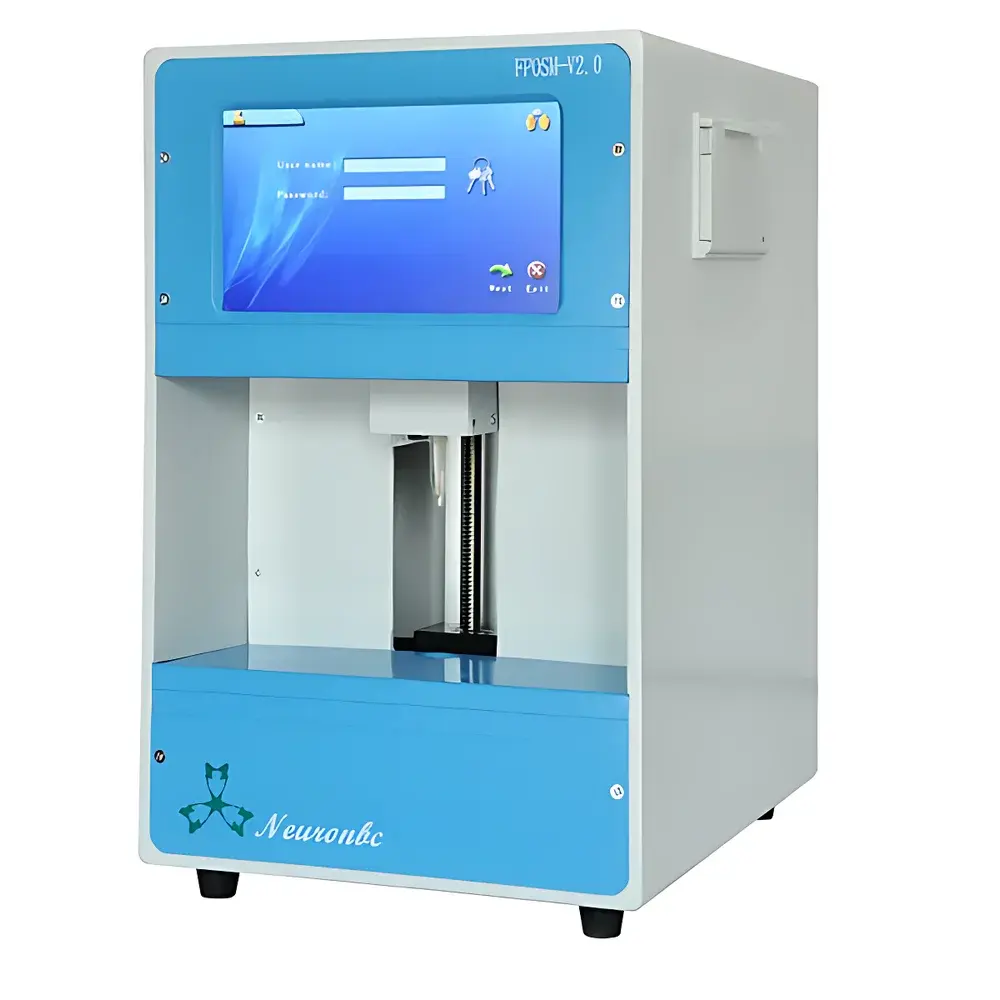
NeuronBC FPOSM-V2.0 Freezing Point Osmometer
| Brand | NeuronBC |
|---|---|
| Origin | Beijing, China |
| Model | FPOSM-V2.0 |
| Measurement Range | 0–2000 mOsm/kg H₂O |
| Sample Volume | 100 µL |
| Analysis Time | ≤3 min |
| Pre-cooling Time | ≤3 min |
| Accuracy | ≤±1% |
| Repeatability | ≤1% |
| Linearity | ≤1% |
| Operating Temperature | 0–30 °C (recommended 15–25 °C) |
| Relative Humidity | ≤60% RH |
| Power Supply | 220 V AC, 50 Hz, 150 VA |
| Dimensions | 225 × 275 × 345 mm |
| Weight | 15 kg |
| Cooling System | Dual-stage thermoelectric (no heat-transfer fluid) |
| Display | 7-inch color capacitive touchscreen |
| Data Storage | 3-year audit-trail compliant archive with timestamped records |
| Calibration | Up to 31-point linear calibration |
| Regulatory Support | CFR 21 Part 11–compatible electronic signatures, user-level access control, GLP/GMP-ready data management |
Overview
The NeuronBC FPOSM-V2.0 Freezing Point Osmometer is a precision laboratory instrument engineered for the quantitative determination of osmolality in aqueous solutions based on the colligative property of freezing point depression. Grounded in Raoult’s law and the thermodynamic relationship between solute concentration and phase transition temperature, the system measures the precise temperature at which a sample transitions from liquid to solid phase under controlled supercooling conditions. The magnitude of the freezing point depression (ΔTf) is directly proportional to the molal concentration of solute particles—enabling accurate calculation of osmotic pressure expressed in milliosmoles per kilogram of water (mOsm/kg H₂O). This principle is universally accepted in pharmacopeial standards—including the Chinese Pharmacopoeia, USP General Chapter <785>, and EP 2.2.35—and forms the scientific basis for quality control of parenteral drugs, biologics, ophthalmic solutions, cell culture media, and diagnostic reagents.
Key Features
- High-precision thermistor-based temperature sensing with sub-millikelvin resolution and active thermal stabilization to ensure measurement reproducibility across repeated runs.
- Dual-stage Peltier cooling architecture enabling rapid pre-cooling (<3 min) and consistent thermal equilibration—eliminating reliance on hazardous or maintenance-intensive heat-transfer fluids.
- Automated mechanical probe actuation via lead-screw linear motor drive, ensuring repeatable sample immersion depth and minimizing operator-induced variability.
- 7-inch capacitive touchscreen interface with intuitive Chinese/English bilingual navigation, real-time graphical display of freezing curve dynamics, and on-screen parameter configuration.
- Comprehensive regulatory compliance framework: role-based user authentication, electronic signatures compliant with 21 CFR Part 11, immutable audit trail with time/date stamping, and secure local storage supporting ≥3 years of traceable test records.
- Flexible calibration protocol supporting single-point verification or multi-point (up to 31 points) linear regression, validated across the full 0–2000 mOsm/kg range to maintain accuracy in low- and high-concentration regimes.
Sample Compatibility & Compliance
The FPOSM-V2.0 is optimized for small-volume aqueous samples (100 µL), accommodating formulations commonly encountered in pharmaceutical development and QC labs—including saline-based injectables, monoclonal antibody solutions, lyophilized reconstitution buffers, and sterile ophthalmic preparations. Its measurement algorithm accounts for non-ideal solution behavior through empirically derived correction factors aligned with pharmacopeial reference standards. Instrument validation documentation supports IQ/OQ/PQ execution per ASTM E2918 and ISO/IEC 17025 requirements. Built-in drug database includes over 300 entries from the Chinese Pharmacopoeia (2020 Edition), allowing rapid selection of predefined sample types with associated acceptance criteria and reporting templates.
Software & Data Management
Data acquisition, processing, and archival are managed by embedded firmware compliant with Good Documentation Practice (GDP) and aligned with GMP Annex 11 expectations. All measurements are timestamped, digitally signed, and stored in an encrypted local database with automatic backup capability. Export options include CSV and PDF formats suitable for regulatory submission. Audit trail logs capture operator ID, method parameters, calibration history, raw thermogram data, and any manual overrides—fully retrievable by date range, sample ID, or user account. Software architecture supports periodic integrity checks and exportable validation reports for internal QA review or external auditor requests.
Applications
- Final product release testing of intravenous, intramuscular, and subcutaneous injectables per USP <785> and ChP Section 0411.
- Stability-indicating assay during accelerated and long-term stability studies of biopharmaceuticals.
- Formulation development support for isotonicity optimization of nasal sprays, eye drops, and wound irrigation solutions.
- In-process monitoring of dialysate and parenteral nutrition admixtures in hospital pharmacy compounding units.
- Research-grade osmolality profiling in cell therapy workflows, including cryopreservation medium verification and wash buffer characterization.
FAQ
What regulatory standards does the FPOSM-V2.0 comply with?
The instrument meets technical and procedural requirements outlined in USP <785>, EP 2.2.35, ChP 0411, and ISO 15197 for osmometer performance verification. Its software architecture satisfies 21 CFR Part 11 for electronic records and signatures.
Is calibration traceable to national metrology institutes?
Yes—calibration standards are certified against NIST-traceable reference solutions (e.g., 0, 100, 300, 1000, and 2000 mOsm/kg NaCl or KCl standards), with certificates provided upon request.
Can the system integrate with LIMS or enterprise QMS platforms?
Raw data export via USB or optional RS-232/RS-485 interface enables integration with third-party laboratory information management systems using standardized CSV schema.
How is thermal drift compensated during extended operation?
Real-time ambient temperature monitoring combined with dynamic offset correction ensures measurement stability across environmental fluctuations within the specified operating range (15–25 °C recommended).
Does the instrument require routine maintenance beyond probe cleaning?
No consumables or refrigerants are used. Routine maintenance is limited to periodic verification of probe cleanliness, calibration verification, and software updates—typically performed quarterly per internal SOPs.






