
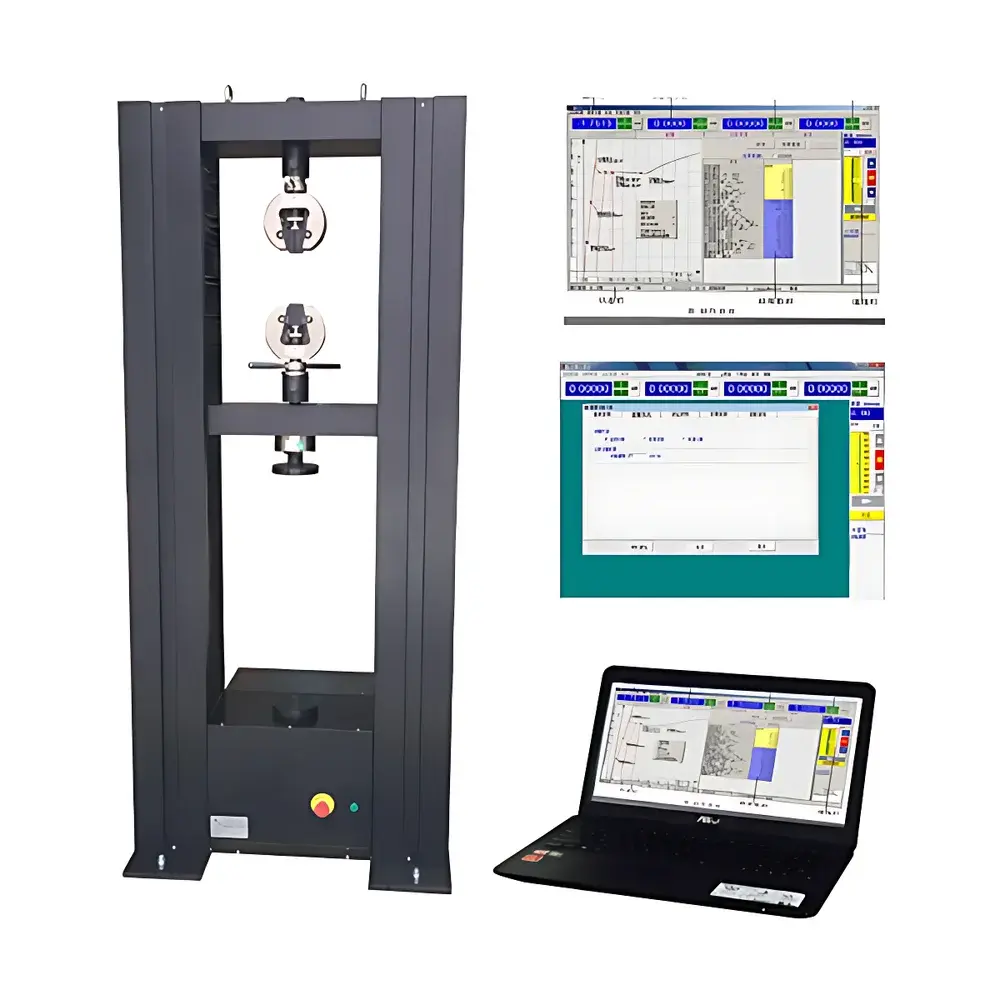
YANRUN WDW-100 Universal Testing Machine
| Brand | YANRUN |
|---|---|
| Origin | Shanghai, China |
| Manufacturer Type | Direct Manufacturer |
| Model | WDW-100 |
| Max. Test Load | 100 kN |
| Load Range | 0.4–100 kN |
| Load Accuracy | Class 1: ±1%, Class 0.5: ±0.5% |
| Displacement Resolution | 0.0025 mm |
| Test Space (Tension/Compression) | 600 mm |
| Effective Width | 570 mm |
| Crosshead Speed Range | 0.001–500 mm/min (infinitely variable) |
| Deformation Measurement Accuracy | ±1% or ±0.5% |
| Weight | 2000 kg |
| Power Supply | Single-phase, 220 V ±10%, 50 Hz |
| Data Acquisition | Four-channel 32-bit A/D converter, resolution up to 1/500,000, full-scale unsegmented |
| Protection Features | Mechanical/electrical limit switches, overload, overcurrent, overvoltage, and overtravel protection |
Overview
The YANRUN WDW-100 Universal Testing Machine is a floor-standing electromechanical testing system engineered for high-precision static mechanical characterization of metallic, polymeric, composite, and ceramic materials. It operates on the principle of controlled force application via a servo-controlled AC motor-driven ball-screw actuator, enabling bidirectional tensile, compression, bending, and shear testing under ISO 6892-1, ASTM E8/E9, and GB/T 228.1 compliant conditions. With a maximum capacity of 100 kN and a load accuracy conforming to ISO 7500-1 Class 0.5 (±0.5%) or Class 1 (±1%), the WDW-100 delivers metrologically traceable results across its full operational range—without range switching—thanks to its unsegmented 32-bit data acquisition architecture. Its rigid welded frame minimizes deflection during high-load testing, ensuring dimensional stability and long-term repeatability in both R&D laboratories and quality control environments.
Key Features
- Floor-mounted structural design with reinforced steel frame, optimized for minimal elastic deformation under peak load (≤0.02% strain at 100 kN), supporting long-term calibration stability.
- Servo-motor-driven crosshead with precision-ground ball screw transmission, delivering speed control from 0.001 to 500 mm/min—achieving a speed ratio of 1:500,000 without gear reduction stages.
- High-fidelity load measurement using calibrated S-type or column-type load cells (imported origin), certified to ISO 376 requirements for transducer class C or better.
- Integrated four-channel 32-bit analog-to-digital conversion system with real-time sampling at ≥1 kHz, offering effective resolution of 1 part in 500,000 across the entire 0.4–100 kN range.
- Comprehensive hardware safety suite including dual mechanical end-stop limiters, electronic overload cutoff, overcurrent/overvoltage monitoring, and emergency stop circuitry compliant with IEC 60204-1.
- Optional RS232/USB interface for direct connection to host PCs; supports optional thermal printer integration for GLP-compliant hardcopy output of test reports.
Sample Compatibility & Compliance
The WDW-100 accommodates standard test specimens per ASTM E8 (tensile bars), ASTM C39 (concrete cylinders), ISO 178 (flexural bars), and ISO 604 (compression plastics), with customizable grips and fixtures—including wedge-action tensile grips, compression platens (150 mm diameter), and三点 bending fixtures. Its mechanical design meets CE machinery directive 2006/42/EC requirements when configured with appropriate guarding and interlocks. Load cell calibration certificates are supplied with NIST-traceable documentation. The system supports audit-ready operation under ISO/IEC 17025-accredited labs and satisfies foundational requirements for FDA 21 CFR Part 11 compliance when paired with validated software featuring electronic signatures and audit trails.
Software & Data Management
The WDW-100 operates with YANRUN’s proprietary PC-based control and analysis software, compatible with Windows 10/11 (64-bit). The software enables real-time graphical display of stress–strain, load–displacement, and time-based curves; automatic yield point detection (0.2% offset method); modulus calculation (secant/tangent); and fracture energy integration. All raw data files are saved in ASCII CSV format for third-party statistical analysis (e.g., JMP, Minitab). Test methods can be pre-configured and password-protected to enforce SOP adherence. Audit logs record user ID, timestamp, parameter changes, and test execution status—supporting GLP/GMP documentation workflows.
Applications
- Mechanical property validation of structural steels, aluminum alloys, and stainless grades per EN 10002-1 and ASTM A370.
- Quality assurance of polymer injection-molded parts, including tensile strength, elongation at break, and flexural modulus per ISO 527 and ISO 178.
- Compressive strength evaluation of concrete, mortar, and geopolymer composites in civil engineering QA/QC labs.
- R&D-level characterization of biomedical implant materials (e.g., Ti-6Al-4V, PEEK) under quasi-static loading per ISO 5832-3 and ISO 13314.
- Calibration verification of extensometers, load cells, and material testing standards in metrology laboratories.
FAQ
Is the WDW-100 suitable for dynamic or fatigue testing?
No—the WDW-100 is designed exclusively for quasi-static mechanical testing. It does not support cyclic loading or high-frequency actuation required for fatigue or impact applications.
Can the machine be integrated into an existing LIMS or MES environment?
Yes—via OPC UA or TCP/IP protocol extensions (available as optional firmware modules), enabling bidirectional data exchange with laboratory information management systems.
What calibration documentation is provided upon delivery?
Each unit ships with a factory calibration certificate referencing national metrological standards, including load verification at 20%, 40%, 60%, 80%, and 100% of full scale, plus displacement verification traceable to laser interferometry.
Does the system comply with ISO 17025 requirements for accredited testing?
The base hardware meets mechanical and electrical prerequisites; full accreditation requires site-specific validation, documented SOPs, and participation in interlaboratory comparison programs—supported by YANRUN’s technical documentation package.
Is remote diagnostics or firmware update capability available?
Yes—through secure HTTPS-based remote maintenance portal (optional subscription), allowing authorized service engineers to monitor system health and deploy verified firmware updates without onsite visits.



