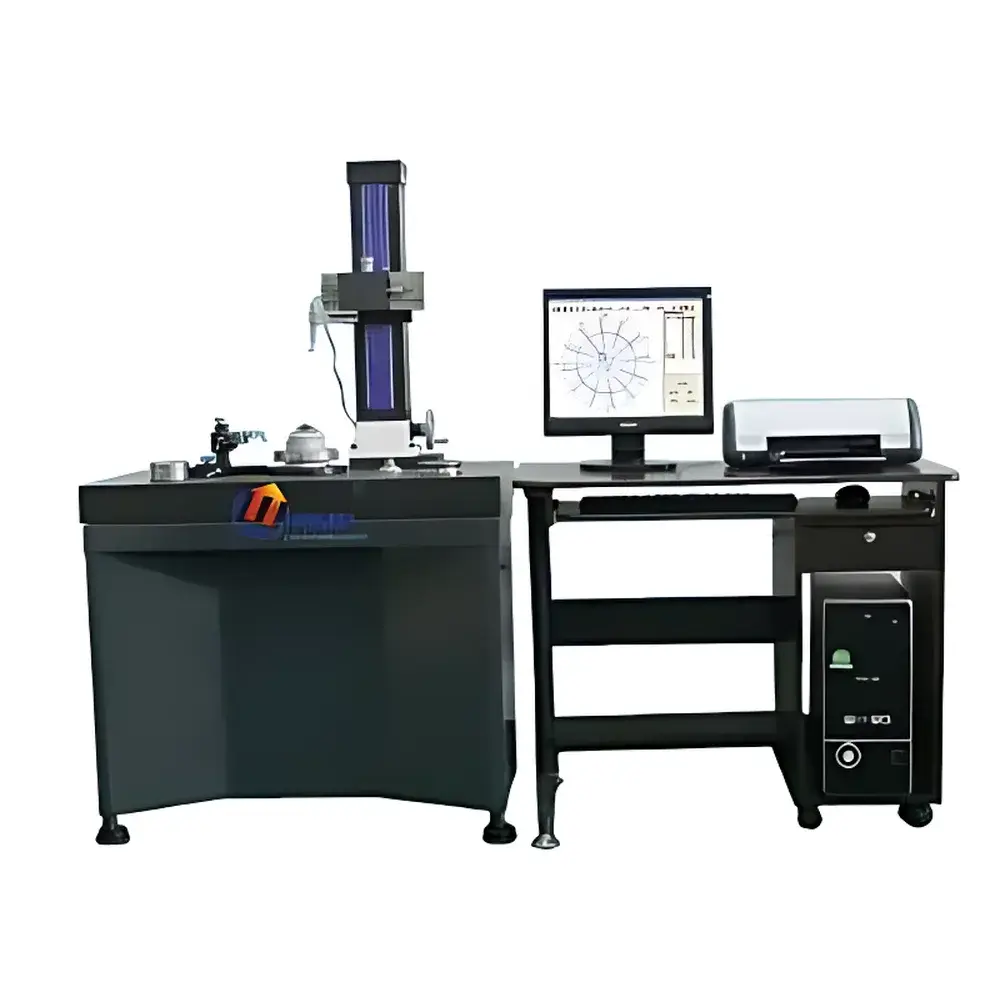
MC012-Y9025E Roundness and Waviness Measuring Instrument
| Origin | China |
|---|---|
| Manufacturer Type | Authorized Distributor |
| Model | MC012-Y9025E |
| Spindle Accuracy | ±0.018 µm |
| System Accuracy | 0.045 µm |
| Data Acquisition | Hall-effect Sensor |
| Max. External Diameter | Ø300 mm (standard Ø140 mm, optional extensions to Ø200/Ø250/Ø300 mm) |
| Min. Internal Diameter | Ø3 mm |
| Max. Measurement Height | 300 mm (extendable) |
| Radial Range | ≤30 µm |
| Sensor Resolution | 0.01 µm |
| Max. Load Capacity | 10 kg |
| Spindle Speed | 115 rpm |
| Power Supply | 220 V, 50 Hz, 250 W |
| Air Pressure Requirement | ≥0.45 MPa |
Overview
The MC012-Y9025E Roundness and Waviness Measuring Instrument is a high-precision, air-bearing-based geometric metrology system engineered for the quantitative evaluation of rotational symmetry and surface texture deviations in annular and cylindrical components. It operates on the principle of axisymmetric deviation analysis—rotating the workpiece about a highly stable, low-drift air spindle while a contact-type probe traces radial displacement with sub-micron resolution. The instrument simultaneously captures roundness, waviness, coaxiality, perpendicularity, parallelism, and planarity according to ISO 1101, ISO 12181 (Roundness), ISO 12180 (Cylindricity), and ASME Y14.5 standards. Its dual-sensor configuration supports both external and internal diameter measurement across a broad dimensional range—from miniature bearing balls (Ø3 mm bore) to large-diameter ring components (up to Ø300 mm OD), making it suitable for final inspection, in-process verification, and process capability studies in precision manufacturing environments.
Key Features
- Air-bearing main spindle with ±0.018 µm radial error motion ensures long-term stability, zero mechanical wear, and repeatable reference axis generation without lubrication or thermal drift.
- Integrated air filtration system maintains clean, dry, particle-free air supply (≥0.45 MPa) to sustain spindle performance under workshop conditions.
- Windows-based proprietary metrology software provides real-time graphical display of polar plots, harmonic spectra, and deviation envelopes; supports customizable report templates compliant with ISO/IEC 17025 documentation requirements.
- Two interchangeable probe modules—high-stiffness lever arm sensor for outer surfaces and miniature cantilever sensor for narrow bores—enable seamless transition between OD and ID measurement modes.
- Full keyboard-and-mouse operation with configurable hotkeys allows ergonomic workflow adaptation for metrologists, QC technicians, and process engineers.
- Harmonic decomposition algorithm delivers amplitude and phase data for individual wave components (e.g., 1st–50th harmonics), enabling root-cause diagnosis of machine tool errors, chuck runout, or grinding wheel vibration signatures.
- Modular height column design permits vertical extension beyond standard 300 mm—supporting tall bearing assemblies, gear blanks, and hydraulic valve bodies.
Sample Compatibility & Compliance
The MC012-Y9025E accommodates a wide range of rotationally symmetric parts including bearing raceways (inner/outer rings), rolling elements (steel balls, cylindrical rollers), turbine discs, sealing rings, optical lens mounts, and precision-machined flanges. It meets fundamental traceability requirements per ISO/IEC 17025 when operated within validated environmental conditions (temperature stability ±1°C, humidity <60% RH, vibration isolation). Calibration is performed using NIST-traceable master rings and step gauges; certificate of calibration includes uncertainty budget per GUM (JCGM 100). The system supports audit-ready data archiving—including raw point clouds, filtered waviness profiles, and harmonic tables—with timestamped operator logs and file integrity checksums.
Software & Data Management
The embedded metrology platform runs on Windows 10 IoT Enterprise, offering native support for CSV, DXF, and XML export formats. All measurement sessions are automatically time-stamped and stored with metadata (operator ID, part number, fixture ID, environmental readings). Audit trail functionality complies with FDA 21 CFR Part 11 requirements when configured with electronic signature and role-based access control. Spectral analysis module enables band-pass filtering (e.g., separating roughness 50 µm), with user-defined cutoff wavelengths aligned to ISO 13565-2. Batch reporting supports SPC chart generation (X̄-R, Cpk, Ppk) directly from measurement databases.
Applications
- Final inspection of automotive and aerospace bearing components against OEM specifications (e.g., SKF, Timken, NTN).
- Process validation for grinding, lapping, and superfinishing operations—correlating harmonic content with machine condition and wheel dressing frequency.
- Root-cause analysis of premature bearing failure via phase-resolved waviness mapping (e.g., identifying 3-peak patterns indicative of 3-jaw chuck distortion).
- Tooling setup verification: alignment of lathe chucks, grinding wheel centers, and CNC rotary tables using eccentricity and angular position output.
- GD&T verification per ASME Y14.5—especially for Position, Concentricity, and Total Runout tolerances referenced to datum axes.
- Research-grade surface texture characterization in tribology labs studying lubricant film formation and contact mechanics.
FAQ
What standards does the MC012-Y9025E comply with for roundness measurement?
It adheres to ISO 12181-1 (roundness deviation definition), ISO 12180-1 (cylindricity), ISO 1101 (geometrical tolerancing), and ANSI/ASME B89.3.4M for instrumentation accuracy verification.
Can the system perform automated pass/fail evaluation against tolerance limits?
Yes—tolerance bands can be pre-loaded per feature; software highlights out-of-spec harmonics and generates compliance flags in reports.
Is environmental conditioning required for lab-grade accuracy?
While operational in shop-floor settings, optimal system accuracy (0.045 µm) is achieved at 20 ±1°C with active temperature stabilization and anti-vibration mounting.
How is traceability maintained during routine calibration?
Certified master rings (diameters 25 mm to 250 mm) and step-height standards are used; calibration certificates include expanded uncertainty (k=2) and measurement procedure references.
Does the software support multi-part batch processing?
Yes—programmable measurement sequences allow unattended operation across up to 99 parts with unique identifiers, automatic report naming, and database synchronization.