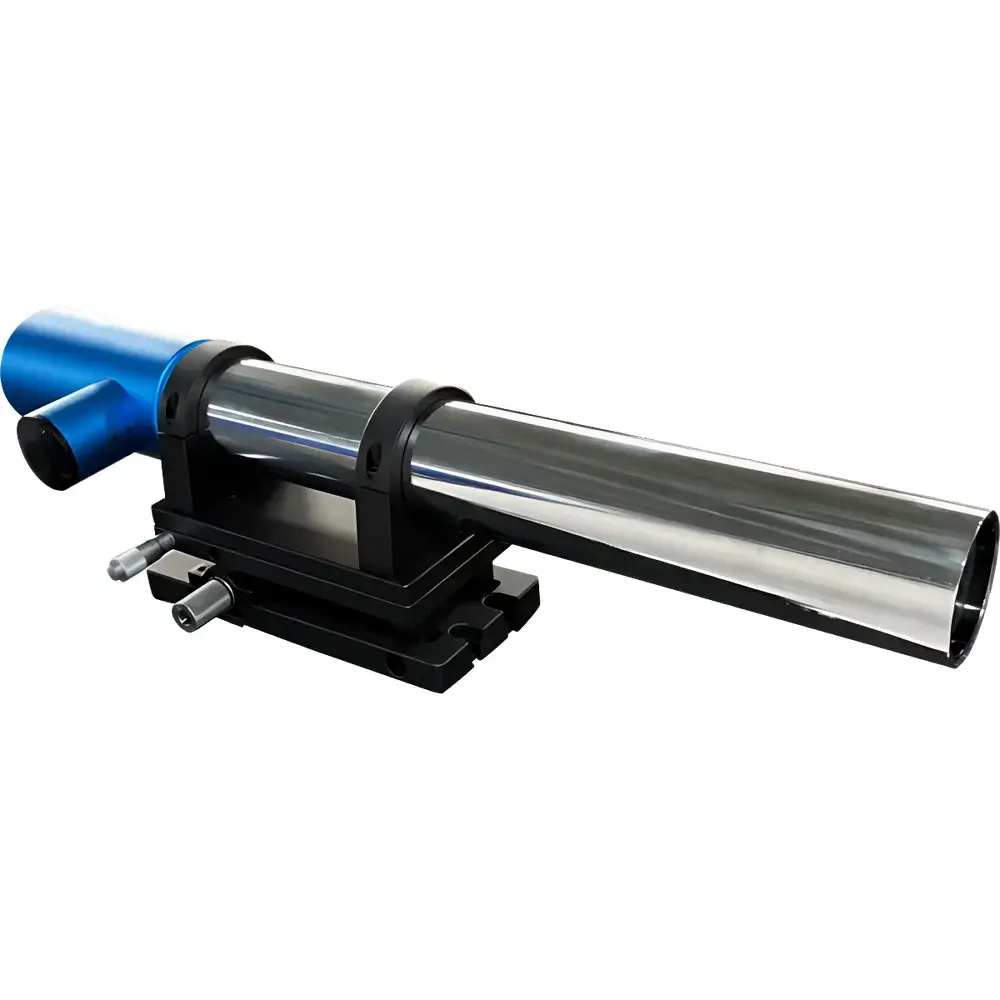
YANRUN MC030-LD500/80/0.3 High-Precision Photoelectric Autocollimator
| Brand | YANRUN |
|---|---|
| Origin | Shanghai, China |
| Manufacturer | Yes |
| Model | MC030-LD500/80/0.3 |
| Focal Length | 500 mm |
| Aperture | 80 mm |
| Light Source | Imported Semiconductor LED |
| Measurement Range | 0–80 m |
| Detector | High-Accuracy Photodetector |
| Display Resolution | Adjustable to 0.1″ / 0.01″ / 0.001″ / 0.0001″ (arc sec) |
| Field of View (X/Y) | 1450″ × 1200″ (arc sec) |
| Accuracy (Center) | ±0.3″ (0–±100″), ±0.5″ (0–±600″) |
| Frequency Response | ≤30 Hz |
| Interface | USB 2.0 |
| OS Compatibility | Windows 7 or later (64-bit) |
Overview
The YANRUN MC030-LD500/80/0.3 is a high-precision photoelectric autocollimator engineered for non-contact angular metrology in industrial metrology, precision alignment, and optical system calibration. It operates on the fundamental principle of optical autocollimation: a collimated beam—generated by projecting a reticle located at the focal plane of a high-aperture objective lens—is reflected back from a planar mirror surface. Any angular deviation (α) of the mirror results in a linear displacement (ΔS) of the returned image on a co-located photodetector array, where ΔS = 2f·tan(α) ≈ 2f·α (for small angles in radians). With a 500 mm focal length and 80 mm clear aperture, the instrument achieves exceptional light-gathering efficiency and signal-to-noise ratio, enabling sub-arcsecond resolution across its full 1450″ × 1200″ field of view. Designed for laboratory-grade repeatability and factory-floor robustness, it serves as a primary reference tool for verifying straightness, flatness, perpendicularity, parallelism, and rotational axis stability in critical assemblies.
Key Features
- Simultaneous dual-axis (X and Y) angular measurement with real-time electronic eyepiece visualization—eliminating parallax and observer-dependent aiming errors inherent in manual optical autocollimators.
- Adjustable display resolution down to 0.0001 arc second, supporting traceable calibration workflows compliant with ISO 10360 and VDI/VDE 2617 standards.
- Imported long-life semiconductor LED illumination system, providing stable spectral output and >50,000-hour operational lifetime without intensity drift or warm-up delay.
- High-dynamic-range photodetector with integrated analog-to-digital conversion and on-board signal conditioning, optimized for low-noise performance at ≤30 Hz measurement bandwidth.
- Modular hardware architecture: compatible with interchangeable retroreflectors, kinematic mounts, rotary stages, and translation stages for extended application flexibility.
- Native USB 2.0 interface with vendor-provided SDK and DLL libraries—enabling seamless integration into custom automation environments and PLC-controlled metrology cells.
Sample Compatibility & Compliance
The MC030-LD500/80/0.3 is compatible with all optically flat reflective surfaces—including polished steel, fused silica, silicon wafers, and coated optical mirrors—with reflectivity ≥40% in the visible spectrum (400–700 nm). Its measurement range extends from contact proximity (≥100 mm) up to 80 meters, making it suitable for both benchtop component verification and large-scale machinery alignment (e.g., CNC guideways, turbine casings, telescope mounts). The system complies with electromagnetic compatibility (EMC) requirements per IEC 61326-1:2013 and meets safety standards IEC 61010-1:2010 for electrical equipment used in measurement applications. All firmware and software modules support audit-trail logging and user-access control—facilitating adherence to GLP and GMP documentation practices where required.
Software & Data Management
The included Windows-based control software (64-bit, Windows 7 or newer) provides real-time vector plotting, statistical process monitoring (SPC), and automated pass/fail evaluation against user-defined tolerance bands. Raw angular data (X, Y, timestamp, temperature sensor input if external probe connected) are logged in IEEE-compliant binary format and exportable to CSV or native Excel (.xlsx) with embedded metadata (operator ID, calibration certificate ID, environmental conditions). The software supports multi-language UI (English, Chinese, Russian, Korean) and includes built-in tools for least-squares fitting, harmonic error separation, and thermal drift compensation using optional ambient temperature inputs. Exported reports conform to ISO/IEC 17025 documentation guidelines and include digital signatures for integrity verification.
Applications
- Precision alignment of optical benches, interferometer tables, and laser cavity components.
- Verification of straightness and flatness in granite surface plates, machine tool beds, and coordinate measuring machine (CMM) rails per ISO 230-1 and ASME B89.1.10.
- Dynamic testing of air-bearing spindles and precision rotary stages—capturing angular jitter and wobble under operational load.
- Aerospace structural assembly: wing spar alignment, fuselage joint flatness validation, and gimbal platform orthogonality checks.
- Calibration of angle encoders, inclinometers, and other angular transducers via comparison method traceable to national metrology institutes.
- Research applications in gravitational wave detector suspension systems, synchrotron beamline collimation, and adaptive optics wavefront sensing infrastructure.
FAQ
What is the maximum recommended working distance for optimal accuracy?
For guaranteed specification compliance (±0.3″ within ±100″ range), the recommended maximum distance is 30 meters. At 80 meters, signal attenuation may require higher-reflectivity targets or averaging over ≥16 frames to maintain stated uncertainty.
Does the system support external temperature or humidity sensors for environmental compensation?
Yes—the software API accepts calibrated analog voltage inputs (0–5 V) mapped to temperature (°C) and relative humidity (%RH), enabling real-time refractive index correction per Ciddor or Edlén equations.
Is the USB interface compatible with Linux or macOS for custom scripting?
While native drivers are Windows-only, the device enumerates as a CDC ACM-class serial device; cross-platform communication is achievable via Python (pySerial) or LabVIEW with appropriate low-level protocol parsing.
Can the instrument be used in vacuum or cleanroom environments?
The base unit is rated for ISO Class 8 (100,000) cleanrooms. For vacuum operation (<10⁻³ Pa), external optical path purging and non-outgassing mounting hardware are required—consult YANRUN Engineering for validated configurations.
How is traceability maintained for calibration certificates?
Each unit ships with a factory calibration report referencing NIM (National Institute of Metrology, China) angular standards, with uncertainty budgets reported per GUM (JCGM 100:2008). On-site recalibration services include ISO/IEC 17025-accredited certification upon request.