
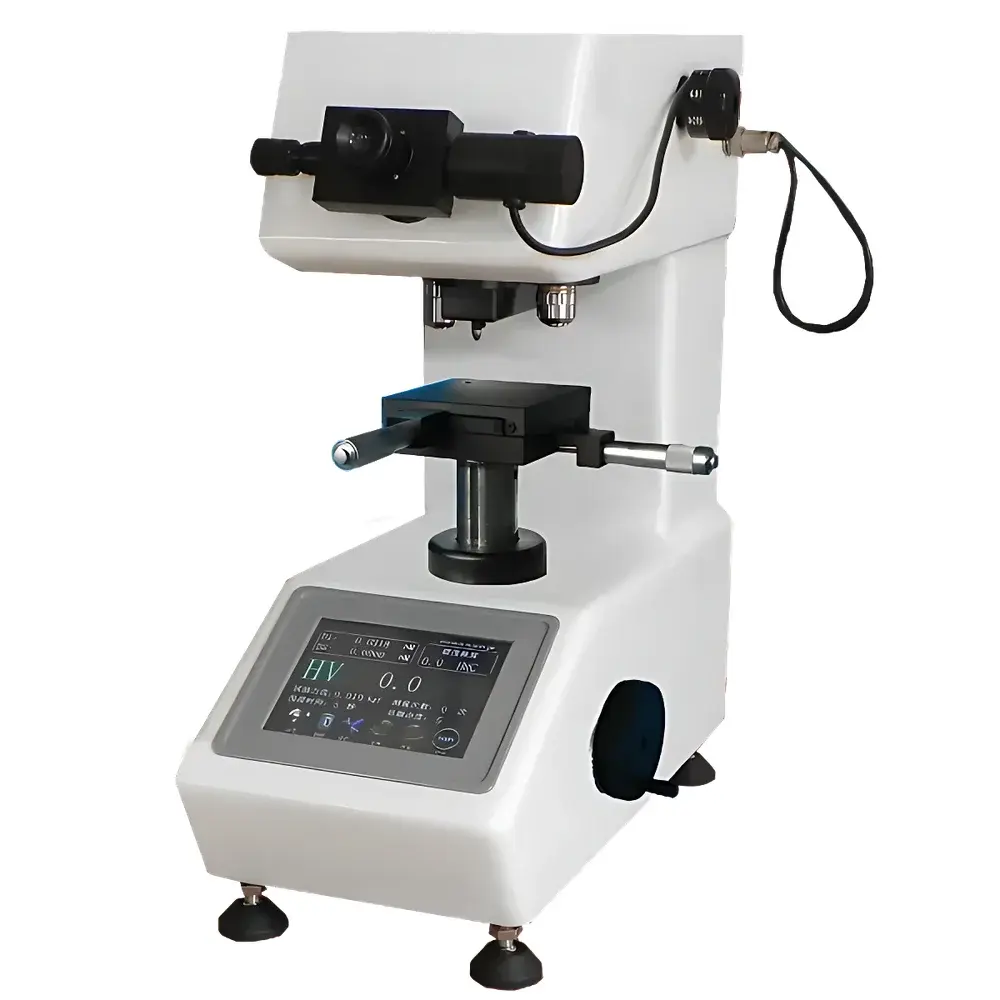
YANRUN HVS-1000BMZ Touchscreen Digital Microhardness Tester
| Brand | YANRUN |
|---|---|
| Origin | Shanghai, China |
| Manufacturer Type | OEM Manufacturer |
| Product Category | Domestic |
| Model | HVS-1000BMZ |
| Instrument Type | Microhardness Tester |
| Hardness Measurement Range | 0.001–6000 HV |
| Total Test Forces | 10, 25, 50, 100, 200, 300, 500, 1000 gf |
| Standards Compliance | GB/T 4340 |
| Automation | Fully Automatic Loading/Unloading/Holding |
| Objective Magnifications | 10×, 40× (optional 20×, 50×, 100×) |
| Total Optical Magnifications | 100× and 400× (dual-scale measurement) |
| Minimum Detectable Indentation Resolution | ~0.013 µm at 400× |
| X-Y Stage Travel | 25 × 25 mm |
| Maximum Specimen Height | 80 mm |
| Depth from Indenter to Chamber Wall | 110 mm |
| Data Storage Capacity | Up to 60 test records on-device |
| Integrated Thermal Printer | Yes |
| Power Supply | AC 220 V / 50 Hz |
| Dimensions (W×D×H) | 460 × 230 × 490 mm |
| Construction | Cast aluminum body |
Overview
The YANRUN HVS-1000BMZ is a fully automated digital microhardness tester engineered for precision measurement of Vickers (HV) and Knoop (HK) hardness in metallurgical, thin-film, coating, ceramic, and brittle material applications. It operates on the principle of static indentation testing: a diamond pyramid indenter (Vickers) or rhombic-based pyramidal indenter (Knoop) is loaded onto the specimen surface under controlled force for a defined dwell time; hardness is calculated from the diagonal length(s) of the resulting permanent impression using standardized geometric relationships. The instrument integrates a high-stability cast aluminum frame, coaxial optical-mechanical design (objective–turret–illumination–stage), and real-time synchronized test progress visualization—ensuring mechanical rigidity, optical fidelity, and operational transparency. Its dual-magnification capability (100× and 400×) enables both rapid survey scanning and high-resolution indentation analysis within a single platform.
Key Features
- 5.6-inch true-color capacitive touchscreen interface with intuitive, automotive-grade multimedia navigation logic—designed for glove-compatible operation and minimal learning curve.
- Direct digital encoder-based indentation measurement system delivering sub-micron positional resolution (~0.013 µm at 400× magnification) and eliminating parallax or manual micrometer reading errors.
- Optimized optical path architecture: co-aligned objective turret, lighting module, and stage base ensure >99% light throughput efficiency and diffraction-limited image clarity across all magnifications.
- Motorized auto-turret with eight pre-calibrated test forces (10–1000 gf), each selectable via front-panel rotary dial with tactile feedback and automatic load-path engagement.
- Dual-scale measurement mode: simultaneous calibration and reporting at both 100× (for coarse screening) and 400× (for critical micro-indentation metrology), supporting ASTM E384 and ISO 6507-1 compliant workflows.
- Integrated thermal printer for immediate hardcopy documentation of test parameters, indentation images, and hardness values—traceable per GLP requirements.
- Onboard data storage (up to 60 test records) with timestamp, load, dwell time, diagonal measurements, and calculated HV/HK values—all accessible via touchscreen without external PC dependency.
Sample Compatibility & Compliance
The HVS-1000BMZ accommodates specimens up to 80 mm in height and 100 × 100 mm on the XY stage, with a minimum clearance of 110 mm from indenter axis to chamber interior wall—enabling evaluation of irregularly shaped components, cross-sectioned coatings, and miniaturized electronic substrates. Its Knoop testing capability (with optional HK indenter) is particularly suited for shallow-depth hardness profiling of thin films (<1 µm), brittle ceramics, case-hardened layers, and fracture-prone materials where Vickers loading may induce cracking. The system complies with GB/T 4340.1–2012 (equivalent to ISO 6507-1:2018) for Vickers hardness testing and supports ASTM E384–22 for Knoop microhardness. All force application cycles meet ±1.0% accuracy tolerance per ISO 6507-2, with dwell time programmable from 1 to 60 seconds in 1-second increments.
Software & Data Management
While fully functional as a standalone instrument, the HVS-1000BMZ is compatible with the optional HMAS professional microhardness analysis software suite. HMAS provides advanced image processing (edge detection, contrast optimization, multi-point auto-measurement), statistical reporting (Cp/Cpk, X-bar R charts), compliance-ready audit trails (user login, parameter changes, result exports), and 21 CFR Part 11–compliant electronic signatures when deployed in regulated environments. Raw measurement data—including pixel-to-micron calibration maps, load/dwell logs, and raw diagonal coordinates—is exportable in CSV, PDF, and XML formats. On-device storage retains full traceability: operator ID, date/time stamp, test sequence number, and pass/fail flags based on user-defined acceptance criteria.
Applications
This microhardness tester serves quality control and R&D laboratories engaged in metallurgical phase analysis, heat treatment validation, PVD/CVD coating adhesion assessment, semiconductor wafer edge characterization, dental alloy certification, and failure analysis of turbine blade thermal barrier coatings. Its ability to perform sequential multi-load testing (e.g., HV0.01 → HV0.1 → HV1) on the same location enables depth-profiling of gradient-hardened surfaces. In academic settings, it supports fundamental studies of dislocation density correlation, nanostructure–mechanical property relationships, and irradiation-induced hardening in nuclear materials. The Knoop option extends utility to geological thin sections, optical glass substrates, and biomedical hydroxyapatite scaffolds.
FAQ
Is the HVS-1000BMZ compliant with international hardness testing standards?
Yes—it conforms to GB/T 4340 (equivalent to ISO 6507) and supports ASTM E384 for Knoop testing. Calibration certificates are issued traceable to NIM (National Institute of Metrology, China).
Can the instrument measure non-metallic or brittle materials without cracking?
Yes—Knoop testing at low loads (e.g., 10–50 gf) minimizes lateral stress, making it suitable for glasses, sintered carbides, and intermetallic compounds.
Does the system support automated hardness mapping?
Not natively—but when paired with HMAS software and an optional motorized XY stage (sold separately), grid-based microhardness mapping with programmable step size and dwell time is achievable.
What maintenance is required for long-term accuracy?
Annual verification of indenter geometry (via certified reference blocks), optical alignment check, and encoder calibration are recommended. No routine lubrication or mechanical adjustment is needed due to gear-driven load mechanism and sealed turret design.
Is remote diagnostics or firmware update supported?
Firmware updates are performed via USB drive; remote desktop access is not enabled by default but can be configured under IT-managed network policies for enterprise deployments.



