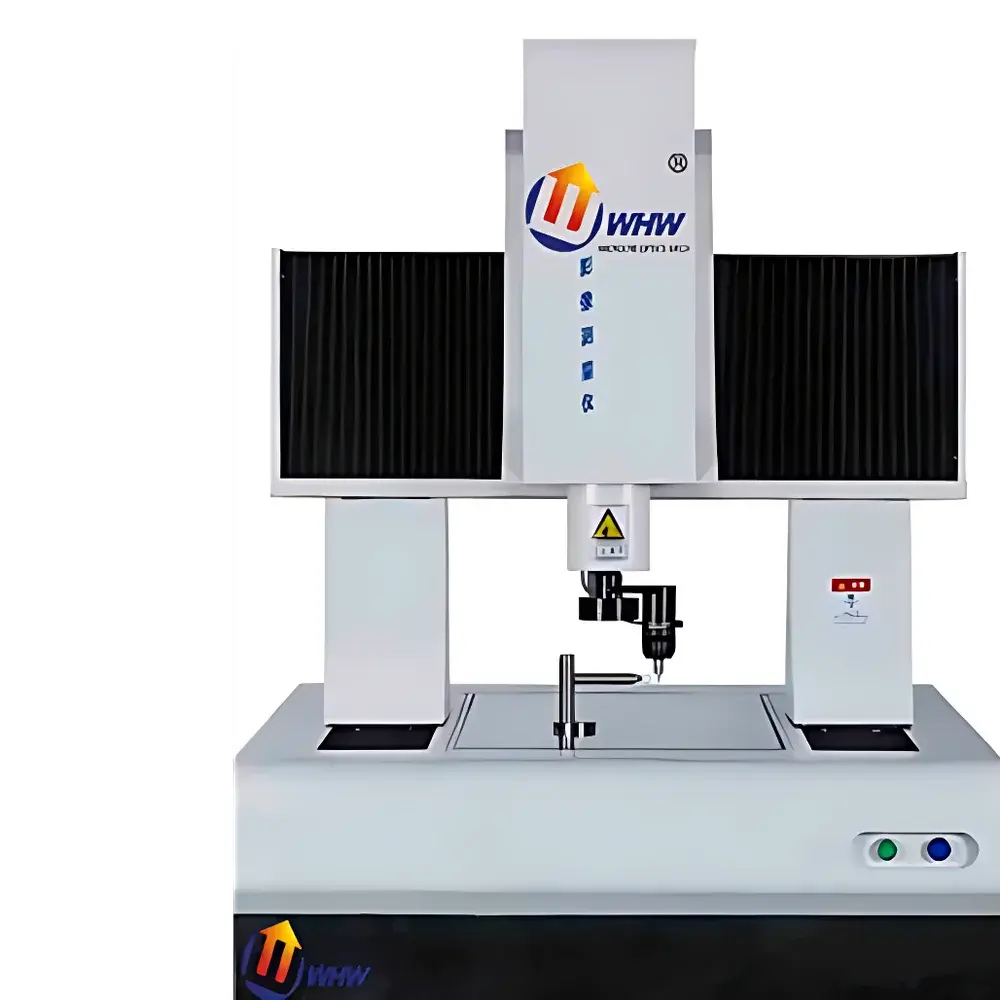
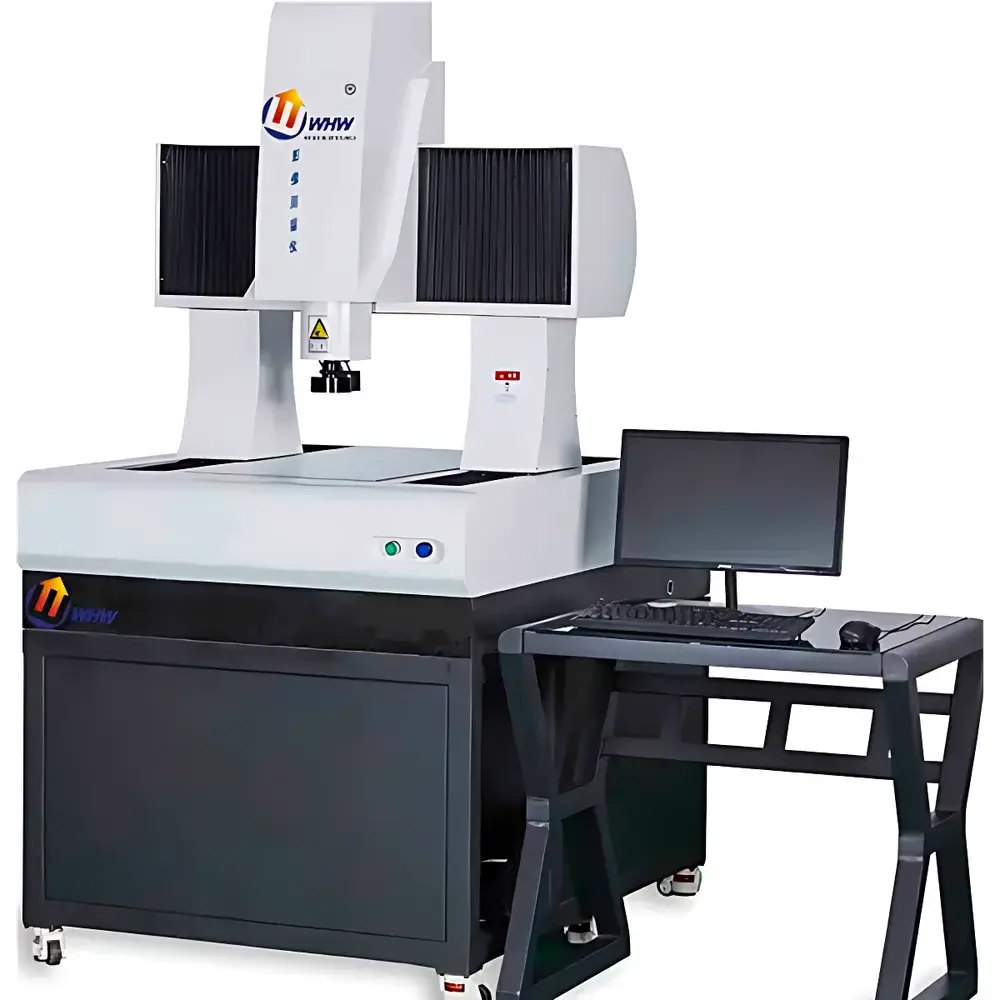
YANRUN YR8060-M Bridge-Type Fully Automated 3D Vision Measuring Machine
| Brand | YANRUN |
|---|---|
| Origin | Shanghai, China |
| Manufacturer Type | OEM Manufacturer |
| Country of Origin | China |
| Model | YR8060-M |
| Operation Mode | Fully Automatic |
| XY Measurement Accuracy | (3 + L/200) µm |
| Z-Axis Measurement Accuracy | (5 + L/200) µm |
| Enclosed Linear Encoder Resolution | 1 µm |
| XY Axis Speed | 280 mm/s |
| Z-Axis Speed | 100 mm/s |
| Optical Magnification | 0.7×–4.5× |
| System Magnification | 21×–200× |
| Camera | Hikvision GigE Color Industrial Digital Camera |
| Surface Illumination | 5-Ring 8-Zone LED Cold Light Source, 256-Step Adjustable Brightness |
| Profile Illumination | LED Cold Light Source, 256-Step Adjustable Brightness |
Overview
The YANRUN YR8060-M is a high-precision bridge-type coordinate vision measuring machine engineered for metrological-grade dimensional inspection of medium-to-large mechanical components in production and quality assurance environments. It operates on the principle of non-contact optical imaging metrology, combining high-resolution digital imaging with CNC-controlled motion axes and calibrated geometric reconstruction algorithms to deliver traceable, repeatable measurements of length, angle, form, and position. Designed for compliance with ISO 10360-7 (coordinate measuring machines using optical distance sensors) and aligned with the measurement uncertainty framework defined in ISO/IEC 17025, the system supports rigorous GD&T evaluation—including flatness, circularity, perpendicularity, concentricity, and positional tolerance—under controlled environmental conditions (20 °C ±2 °C, <0.002 g vibration, 30–80% RH). Its granite-based structural architecture (Grade 00 natural granite base and column, planarity ≤3 µm) ensures thermal stability and mechanical rigidity, while integrated temperature compensation adjusts dimensional results based on real-time ambient deviation from standard 20 °C reference.
Key Features
- Fully automated CNC-controlled XYZ motion system with Mitsubishi precision servo motors (AC servo on XY, DC servo with electromagnetic brake on Z-axis)
- High-stability optical path: 6.5:1 motorized zoom lens with manual magnification change and automatic re-calibration-free operation
- Dual-illumination control system: independently addressable 5-ring 8-zone surface LED lighting and coaxial profile LED lighting, both with 256-step brightness resolution for optimal edge contrast across diverse material finishes
- Sub-micron linear positioning: Taiwan HIWIN precision linear guideways paired with enclosed 1 µm-resolution optical encoders on all axes
- Real-time autofocus capability enabling rapid height-differential measurement via focus peak detection
- Multi-modal image acquisition: Hikvision GigE color industrial camera (2.3 MP or higher, progressive scan) supporting texture segmentation, multi-region extraction, and edge-enhanced contour mapping
- Integrated 3D visualization engine supporting depth-encoded surface rendering and orthographic projection overlays
Sample Compatibility & Compliance
The YR8060-M accommodates workpieces up to 800 mm × 600 mm × 300 mm (L×W×H) with maximum load capacity of 80 kg. Its open-bridge configuration permits unobstructed access for complex geometries including machined housings, stamped sheet metal parts, injection-molded plastic assemblies, and PCB substrates. The system complies with CE safety directives (2014/30/EU EMC, 2014/35/EU LVD), meets RoHS 2011/65/EU material restrictions, and supports audit-ready documentation per ISO 9001:2015 and IATF 16949 quality management requirements. Optional Renishaw MCP 3D tactile probe integration enables hybrid measurement workflows compliant with ISO 15530-3 (calibration using calibrated workpieces) and facilitates first-article inspection reporting per AS9102.
Software & Data Management
The CNC4000 intelligent metrology software platform provides full GLP/GMP-aligned data governance: audit trail logging (user actions, parameter changes, calibration events), electronic signatures, and FDA 21 CFR Part 11-compliant secure user authentication (role-based access control). Measurement tasks are stored in proprietary .rst format with embedded metadata (timestamp, operator ID, environmental logs, lens calibration state). Export formats include CSV (SPC-ready), Excel (customizable templates), PDF (certified reports), DXF/AutoCAD (GD&T annotation overlay), and STEP/AP214 (for CAD comparison workflows). SPC modules support Cp/Cpk calculation, X-bar-R chart generation, and out-of-tolerance alerting with configurable thresholds. Image stitching (panoramic scanning), CAD-to-part alignment, and thermal expansion correction algorithms are embedded at firmware level.
Applications
This system is routinely deployed in Tier-1 automotive component suppliers for verification of bracket hole patterns and flange flatness; in medical device manufacturing for dimensional validation of stainless-steel surgical instrument housings; in electronics manufacturing for solder paste volume analysis and BGA pad registration; and in aerospace subcontractors for turbine blade root geometry assessment. Its ability to perform automated batch measurement of identical parts—including statistical process monitoring via exported CSV datasets—makes it suitable for high-volume QC labs operating under ISO/IEC 17025 accreditation. The optional Renishaw MCP probe extends functionality to critical features inaccessible to optical view (e.g., internal threads, blind holes, deep cavities), enabling comprehensive CMM-like inspection without requiring dedicated tactile hardware.
FAQ
What environmental conditions are required for certified measurements?
The system must operate within 20 °C ±2 °C, relative humidity 30–80%, and floor vibration <0.002 g below 15 Hz. Temperature compensation is active but does not replace climate-controlled metrology lab requirements.
Is CAD model import supported for GD&T comparison?
Yes—DXF files can be imported and registered to measured features using best-fit alignment or datum-based coordinate system matching. Tolerance zones are rendered as semi-transparent overlays.
Can measurement programs be reused across different operators?
Yes—task files (.rst) contain full procedural logic, feature definitions, and pass/fail criteria. Operators execute predefined routines with read-only access unless granted engineering privileges.
Does the system support multi-language UI and reporting?
The interface and report templates support Simplified Chinese, Traditional Chinese, English, Japanese, and Korean—switched dynamically without restart.
How is calibration traceability maintained?
Factory calibration uses NIST-traceable step gauges and sphere artifacts. On-site verification follows ISO 10360-7 procedures with certified reference standards; calibration certificates include expanded uncertainty (k=2) statements.