
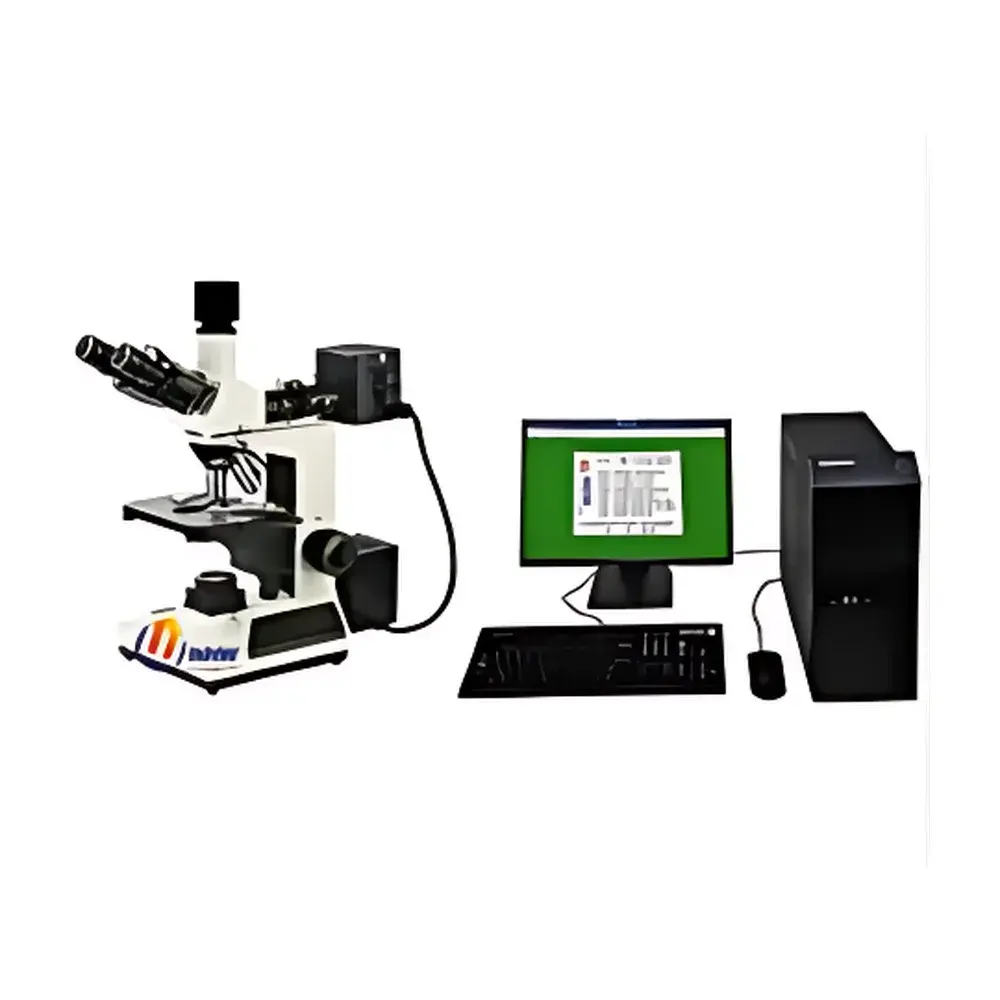
YANRUN MMAS-8 Upright Dual-Illumination (Transmitted & Reflected) Metallurgical Microscope with Integrated Image Analysis System
| Brand | YANRUN |
|---|---|
| Origin | Shanghai, China |
| Manufacturer Type | Direct Manufacturer |
| Product Type | Upright Metallurgical Microscope |
| Imaging System | Integrated MMAS Software Suite |
| Total Magnification Range | 50× to 600× |
| Eyepieces | Wide-Field WF10X (Φ18 mm) |
| Objective Lenses | PL 5X/0.12, PLL10X/0.25, PLL40X/0.60, PLL60X/0.75 (spring-loaded) |
Overview
The YANRUN MMAS-8 is an upright dual-illumination metallurgical microscope engineered for high-fidelity microstructural characterization of opaque and semi-opaque materials—primarily metals, alloys, ceramics, and composites. Its optical architecture integrates both transmitted and reflected (epi-illumination) light paths within a single robust mechanical platform, enabling simultaneous or selective illumination modes critical for comprehensive metallographic evaluation. The system employs a parfocal, long-working-distance plan achromat objective set (5×, 10×, 40×, 60×), optimized for use without cover slips—ensuring minimal optical distortion across the full field of view. Coupled with wide-field WF10X eyepieces (18 mm field number), the MMAS-8 delivers uniform resolution, high contrast, and exceptional depth-of-field stability across its 50×–600× magnification range. The trinocular head incorporates an internal analyser that enables seamless switching between brightfield, darkfield, and polarized light observation—supporting ASTM E3, ISO 643, and GB/T 13298-compliant microstructure assessment protocols.
Key Features
- Upright mechanical design with dual-path Köhler illumination: independent 6 V / 20 W halogen sources for both transmitted and reflected illumination, each with continuously adjustable intensity control.
- Four-position objective turret (standard), with optional five-position ball-bearing indexed nosepiece for enhanced repeatability and alignment stability.
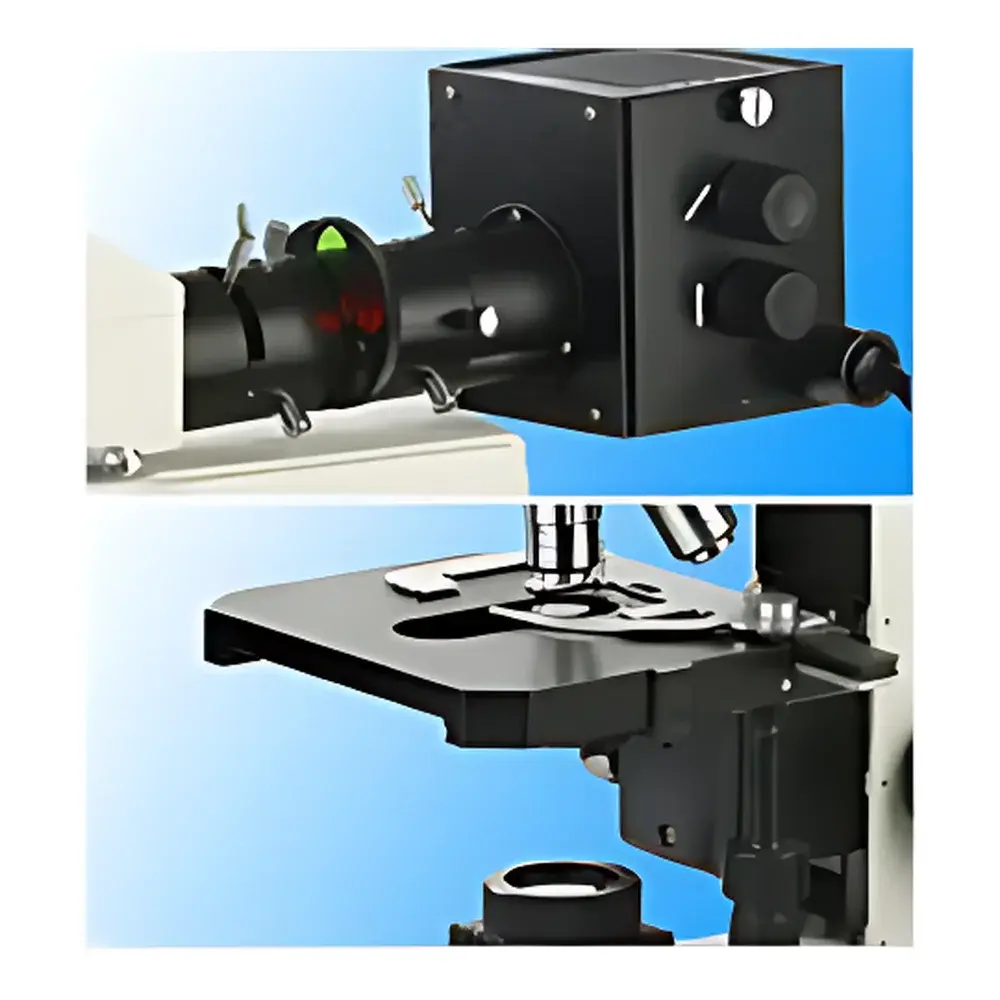
- Double-layer mechanical stage (160 × 140 mm), offering 75 × 50 mm travel range with vernier-calibrated X/Y scales and low-friction linear motion.
- Coaxial coarse/fine focusing mechanism: fine focus graduation at 2 µm per division; coarse focus tension adjustment with upper/lower limit stops and locking capability.
- Reflected-light illuminator includes built-in field and aperture diaphragms, removable polarizer, and interchangeable blue/green/red/yellow interference filters—enabling contrast enhancement for phase differentiation and etch-pit analysis.
- Transmitted-light Abbe condenser (NA 1.25), height-adjustable with centering screws, integrated filter holder, and frosted glass diffuser for uniform illumination of polished thin sections or transparent specimens.
Sample Compatibility & Compliance
The MMAS-8 accommodates standard 25 mm and 30 mm diameter metallographic specimens up to 30 mm in thickness, including mounted and unmounted samples. Its long-working-distance objectives provide ≥10.5 mm clearance at 10× and ≥3.5 mm at 40×—sufficient for most as-polished or lightly etched bulk specimens. The system supports routine compliance with international metallography standards including ASTM E3 (Standard Guide for Preparation of Metallographic Specimens), ASTM E112 (Grain Size Determination), ISO 643 (Steel—Micrographic Determination of Ferrite Grain Size), and ISO 4967 (Non-Metallic Inclusions in Steels). Polarization optics meet requirements for birefringent phase identification per ASTM E407 and ISO 80000-7. All hardware components are CE-marked and RoHS-compliant; software modules adhere to audit-trail and data-integrity principles aligned with GLP and GMP documentation frameworks.
Software & Data Management
The MMAS image analysis suite is a validated Windows-based application designed specifically for quantitative metallography. It features over 400 standardized analysis modules mapped directly to national and industry-specific standards (e.g., ASTM, ISO, GB/T, JIS). Core capabilities include automated grain size classification (ASTM E112, ISO 643), inclusion rating (ASTM E45, ISO 4967), phase area fraction quantification, and precipitate dispersion analysis. Geometric measurement tools support line, polygon, circle, and angular measurements—with calibration traceability to NIST-traceable stage micrometers. Reporting functions generate PDF or editable DOCX outputs compliant with laboratory information management systems (LIMS); reports embed raw images, measurement metadata, operator ID, timestamp, and instrument configuration logs. Optional modules include Z-stack image fusion (extended depth-of-field reconstruction), mosaic stitching for large-area mapping, and customizable report templates supporting 21 CFR Part 11–compatible electronic signatures when deployed on validated networked environments.
Applications
The MMAS-8 serves as a primary inspection platform in quality control laboratories, foundry R&D departments, failure analysis centers, and academic metallurgy programs. Typical use cases include: verification of heat treatment homogeneity in forged steel components; assessment of weld zone microstructures (HAZ, fusion line, base metal); evaluation of coating adhesion and interfacial diffusion layers; characterization of powder metallurgy sintering density and pore distribution; and forensic analysis of fatigue crack initiation sites. Its dual-illumination flexibility allows side-by-side comparison of surface topography (reflected mode) and subsurface defects (transmitted mode through thin foils or etched cross-sections). Educational institutions utilize the system for hands-on instruction in crystallography, phase transformation kinetics, and corrosion morphology interpretation.
FAQ
Does the MMAS-8 support oil immersion objectives?
Yes—optional plan achromat oil-immersion objectives (e.g., PLL100×/1.25 NA) are compatible via the five-position turret upgrade.
Is the MMAS software compliant with FDA 21 CFR Part 11?
The software supports Part 11–aligned configurations—including user authentication, electronic signatures, and immutable audit trails—when installed on validated IT infrastructure with appropriate administrative controls.
Can third-party cameras be integrated with the trinocular port?
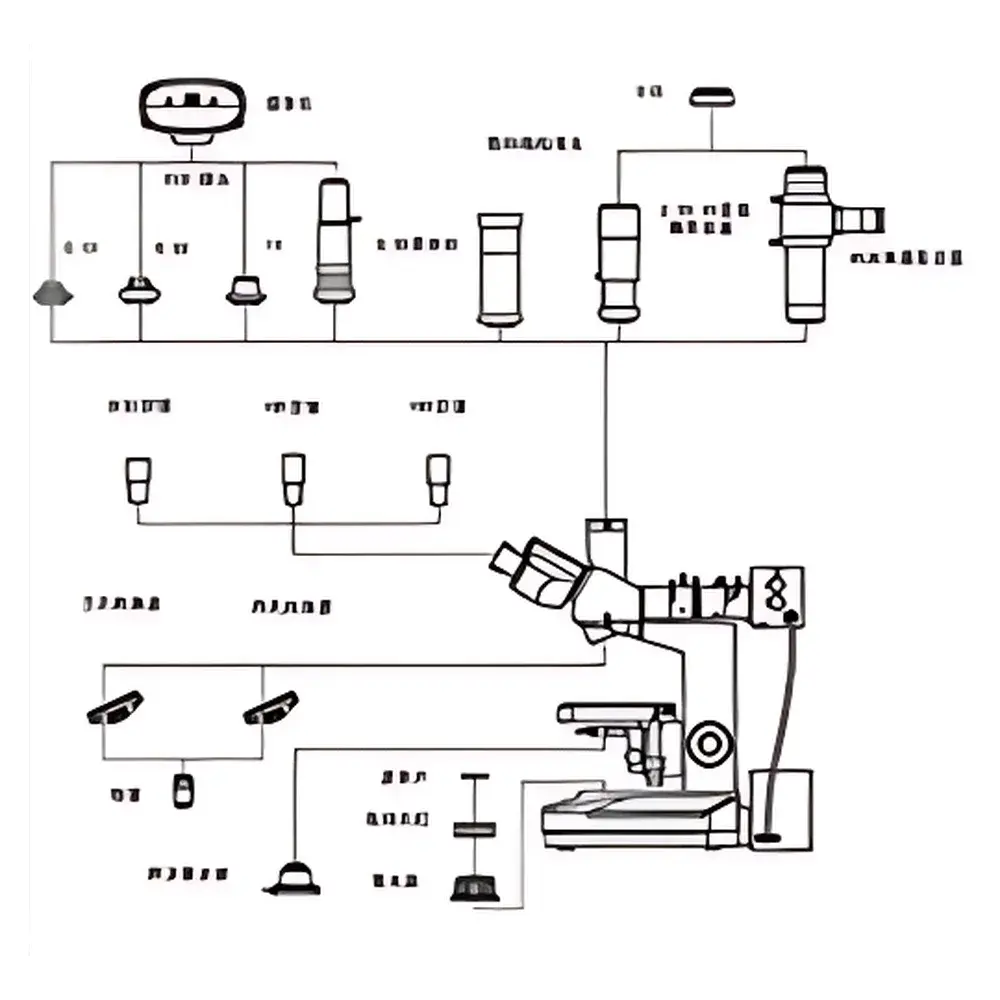
Yes—the C-mount adapter (1× standard, optional 0.4×/0.5× reduction) ensures compatibility with USB3/UVC and GigE industrial cameras from major vendors (e.g., FLIR, Basler, IDS).
What is the maximum specimen height clearance under the 60× objective?
Approximately 3.5 mm working distance—sufficient for standard 25 mm-diameter mounted specimens with typical epoxy or phenolic resin mounts.
Are calibration certificates available for the stage micrometer and eyepiece graticule?
NIST-traceable calibration certificates for both components can be supplied upon request, with documented uncertainty budgets per ISO/IEC 17025 requirements.




