
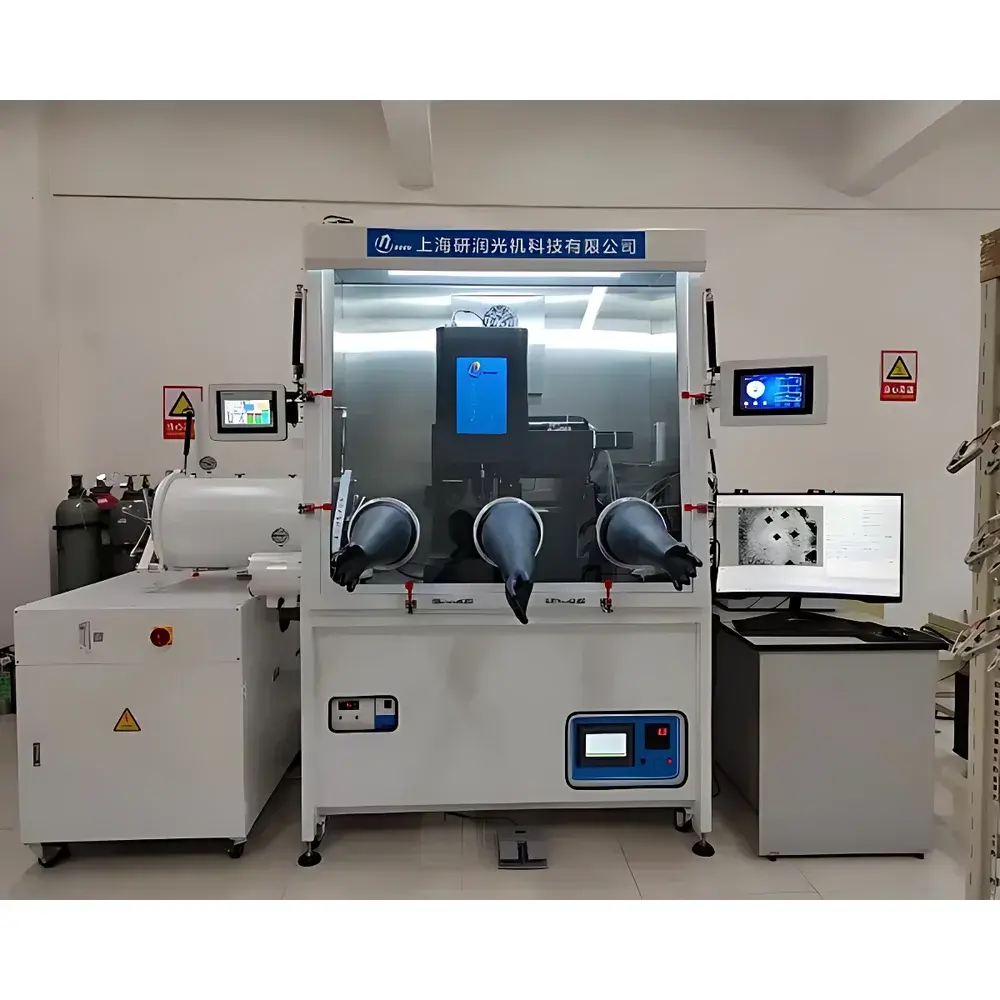
YANRUN HMAS-HT900CM Full-Temperature-Field High-Temperature Vickers Hardness Tester (up to 800 °C)
| Brand | YANRUN |
|---|---|
| Origin | Shanghai, China |
| Manufacturer Type | Manufacturer |
| Country of Origin | China |
| Model | HMAS-HT900CM |
| Instrument Type | Vickers Hardness Tester |
| Maximum Operating Temperature | 800 °C |
| Load Range | 0.1–30 kgf (standard), up to 150 kgf (optional) |
| Load Control Modes | Constant Load / Constant Loading Rate |
| Load Resolution | 0.01% FS |
| Temperature Uniformity | ≤ ±5 °C across 100 × 80 × 80 mm chamber |
| Temperature Stability | ±1 °C |
| Heating Element | HRE high-temp alloy |
| Thermocouple | Type S |
| Objective Working Temp | ≤ 800 °C (10× or 20×) |
| Optical Magnification | 1000× (standard), 2000× (optional) |
| Objective Resolution | 1.44 µm (10×), 1.19 µm (20×) |
| In-situ Dwell Time | Up to 72 h |
| Sample Size Limit | Ø30 × 30 mm |
| Multi-axis Motion Control | Up to 9 axes |
| Positioning Accuracy | ≤ ±1 µm |
| Z-axis Travel | 12 mm |
| XY Stage Travel (10×) | 250 × 90 mm |
| Sample Exchange Time (in situ) | ≤ 50 s at 800 °C |
| Cooling Options | Circulating water (≤ ±0.3 °C stability), inert gas jet (cool-down ≤ 5 s), optional glovebox (H₂O/O₂ ≤ 1 ppm) |
Overview
The YANRUN HMAS-HT900CM is a full-temperature-field high-temperature Vickers hardness tester engineered for in-situ mechanical property characterization under controlled thermal environments ranging from ambient temperature to 800 °C. Unlike conventional hardness testers with external heating stages or limited thermal isolation, the HMAS-HT900CM integrates a fully enclosed, uniform-temperature furnace chamber (100 × 80 × 80 mm) with co-located optical imaging, dynamic load application, and multi-axis positioning—all operating continuously at elevated temperatures. Its core measurement principle follows ASTM E92 and ISO 6507-1 for Vickers microhardness determination, adapted for high-temperature conditions via thermally stable load train architecture, high-temperature-resistant CBN-tipped pyramidal indenters, and S-type thermocouple-regulated closed-loop temperature control (±1 °C stability, ≤ ±5 °C axial gradient). The system enables real-time force–time acquisition during loading, dwell, and unloading phases—supporting empirical force modeling, creep analysis, and time-dependent plasticity studies in metallic alloys, ceramics, intermetallics, and refractory composites.
Key Features
- Full-temperature-field operation: All critical subsystems—including 10×/20× objectives, load cell, indenter, XY stage, and imaging optics—function continuously at up to 800 °C without thermal drift or performance degradation.
- Dynamic load control: 0.1–30 kgf standard range (extendable to 150 kgf); dual-mode actuation (constant-load or constant-rate); force resolution of 0.01% full scale; real-time force–time logging at ≥1 kHz sampling rate.
- In-situ high-resolution imaging: 1000× total magnification (10× objective + 100× eyepiece equivalent); 1.44 µm lateral resolution at 800 °C; optional 20× objective for enhanced crack-tip or indentation edge analysis.
- Multi-axis synchronized motion: Up to 9-axis coordinated control (X/Y/Z/sample lift/Y-A/Y-B/Y-C/rotary/tilt) with ≤ ±1 µm repeatability and 0.1 µm step resolution—enabling precise indenter alignment, multi-point mapping, and gradient thermal profiling.
- Rapid in-situ sample exchange: Manual or automated handling within ≤50 seconds at operational temperature—minimizing thermal perturbation and enabling high-throughput comparative testing across compositionally varied specimens.
- Extended dwell capability: Programmable hold times up to 72 hours at constant temperature and load—critical for investigating thermal relaxation, oxidation-assisted creep, and environmental embrittlement mechanisms.
- Modular environmental integration: Optional inert-atmosphere glovebox (H₂O/O₂ ≤ 1 ppm), circulating water cooling (±0.3 °C stability), and pulsed inert-gas quenching (≤5 s cooldown to <55 °C).
Sample Compatibility & Compliance
The HMAS-HT900CM accommodates cylindrical or disc-shaped specimens up to Ø30 × 30 mm, compatible with polycrystalline metals (e.g., Ni-based superalloys, Ti-6Al-4V), oxide and non-oxide ceramics (Al₂O₃, SiC, ZrO₂), bulk metallic glasses, and functionally graded materials. It supports ASTM E384 (microindentation hardness), ISO 20477 (high-temperature indentation), and GB/T 4340.1–2009 (Chinese national standard for Vickers hardness). When configured with glovebox and data audit trail modules, the system meets GLP-compliant documentation requirements per FDA 21 CFR Part 11 for regulated R&D environments. All temperature and force calibration protocols are traceable to NIM (National Institute of Metrology, China) standards, with optional third-party certification available upon delivery.
Software & Data Management
The proprietary YANRUN HT-TestSuite v4.2 software provides integrated control of thermal ramping, load profiling, image capture, and motion sequencing via a wall-mounted industrial PC. It features synchronized timestamped data streams for force, temperature, position, and pixel-intensity values—exportable in CSV, HDF5, or MATLAB-compatible formats. Real-time visualization includes live force–time curves, thermal gradient maps, and auto-detected indentation geometry (diagonal length, crack length, pile-up ratio). For regulatory compliance, the software supports user-level access control, electronic signatures, and immutable audit logs—including operator ID, parameter changes, and calibration events—with retention configurable per institutional SOP. Raw image stacks and metadata are archived with SHA-256 checksums to ensure data integrity across long-term projects.
Applications
- High-temperature creep and stress relaxation behavior in turbine blade alloys under simulated service conditions.
- Thermal barrier coating (TBC) adhesion and interfacial toughness evolution during cyclic oxidation exposure.
- Time-dependent hardness transitions in shape-memory alloys across austenite–martensite transformation ranges.
- Indentation size effect (ISE) quantification in nanocrystalline ceramics at elevated homologous temperatures.
- Crack initiation and propagation thresholds in brittle nuclear fuel matrix materials (e.g., UO₂, SiC composites).
- Validation of constitutive models (e.g., Norton–Bailey, Garofalo) using in-situ load–displacement–temperature triad datasets.
- Correlation of nanoindentation-derived modulus/hardness with synchrotron XRD phase evolution during in-situ heating experiments.
FAQ
What is the maximum continuous operating temperature of the optical system?
The 10× and 20× objectives are rated for uninterrupted operation at ≤800 °C for up to 50 hours per cycle, verified via thermal lensing and focus-shift testing under steady-state conditions.
Can the system perform hardness testing under vacuum or reactive atmospheres?
Yes—when equipped with the optional glovebox module, the system operates under inert gas (Ar, N₂) or high-vacuum (<10⁻³ Pa) environments; oxygen and moisture levels are continuously monitored and maintained below 1 ppm.
Is force calibration traceable to international standards?
All load cells undergo factory calibration against deadweight standards traceable to NIM; on-site recalibration kits and procedure documentation are provided with each unit.
How is thermal uniformity validated across the test chamber?
Uniformity is verified using a 3×3 thermocouple array mapped inside the furnace cavity per ISO/IEC 17025 procedures; full validation reports—including gradient contour plots—are supplied with commissioning documentation.
Does the system support custom indenter geometries beyond standard Vickers?
Yes—CBN-tipped spherical, conical, and cylindrical indenters are available as options; full-dimension 1700 °C-rated repairable indenters (φ6.35/φ8 mm shank) can be retrofitted for extended ultra-high-temperature campaigns.



