
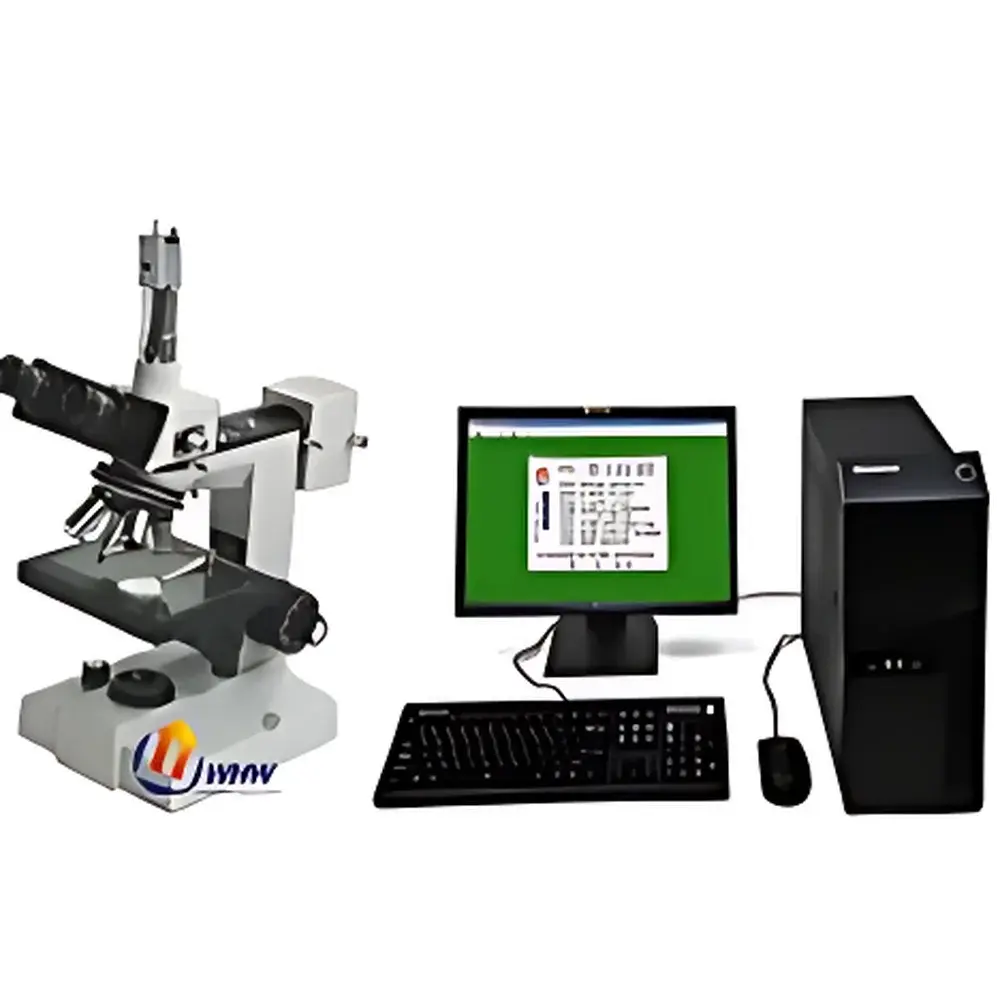
YANRUN AMM-200D Digital Trinocular Upright Metallurgical Microscope
| Brand | YANRUN |
|---|---|
| Origin | Shanghai, China |
| Manufacturer Type | Direct Manufacturer |
| Origin Category | Domestic (China) |
| Model | AMM-200D |
| Microscope Type | Upright (not inverted) |
| Image Analysis System Included | No |
| Eyepieces | Widefield 10× (18 mm field number), Widefield 16× (11 mm field number) |
| Objectives | Plan Achromatic, Cover-Slip-Free: 4×/NA 0.10, 10×/NA 0.25, 40×/NA 0.65 (Spring-Loaded), 63×/NA 0.85 (Spring-Loaded) |
| Mechanical Stage | 160 × 130 mm, Travel Range 76 × 50 mm, Vernier Resolution 0.1 mm |
| Nosepiece | Ball-Bearing Quadruple Revolving Nosepiece |
| Focus Mechanism | Coaxial Coarse/Fine Focus, Total Travel 40 mm, Fine Focus Graduation 2 µm |
| Illumination | Reflected (Epi-) Illuminator with 6 V / 20 W Halogen Lamp, Dual Voltage Input (110 V / 220 V), Adjustable Brightness, Optional Color Filters (Light Blue, Light Green) |
Overview
The YANRUN AMM-200D Digital Trinocular Upright Metallurgical Microscope is engineered for high-fidelity microstructural analysis of polished and etched metallic, ceramic, and composite specimens. Unlike inverted metallurgical systems, its upright configuration enables direct observation of large, flat, or irregularly shaped samples mounted on standard metallographic slides — ideal for quality control laboratories, failure analysis centers, and academic materials science departments. The microscope operates on reflected light (epi-illumination) principles, where incident light is directed onto the specimen surface via a beam-splitter cube and collected through the same objective lens, ensuring optimal contrast for phase boundaries, grain structures, inclusions, and surface defects. Its optical path supports trinocular observation — accommodating simultaneous visual inspection, real-time digital imaging, and optional eyepiece phototube integration — without compromising parfocality or illumination uniformity.
Key Features
- Trinocular head with 30° inclined eyepiece tubes and interpupillary adjustment (55–75 mm), optimized for extended operator ergonomics and binocular fatigue reduction.
- Plan achromatic objectives (cover-slip-free design) delivering flat-field correction across the full field of view — critical for quantitative grain size measurement per ASTM E112 and ISO 643 standards.
- Ball-bearing quadruple nosepiece ensures precise, repeatable objective alignment and minimal axial shift during magnification changes.
- Coaxial coarse/fine focusing mechanism with 40 mm total travel and 2 µm fine-focus graduation enables sub-micron Z-axis positioning stability required for focused ion beam (FIB) site targeting or serial sectioning preparation.
- Reflected-light illumination system with 6 V / 20 W halogen lamp provides stable, color-temperature-consistent output; integrated brightness control and removable light-blue/light-green interference filters enhance contrast for specific etchants (e.g., Nital, Kroll’s reagent) and oxide layer visualization.
- Large mechanical stage (160 × 130 mm) with vernier-calibrated X–Y translation (76 × 50 mm range, 0.1 mm resolution) accommodates standard 25 × 75 mm metallographic slides as well as oversized castings or weld cross-sections.
Sample Compatibility & Compliance
The AMM-200D is designed for opaque, reflective specimens requiring no transmission capability. It supports standard metallographic sample preparation protocols including grinding, polishing (SiC paper to 0.05 µm alumina suspension), and chemical/electrolytic etching. Compatible with ASTM E3, E407, and ISO 13095 for specimen preparation; suitable for routine compliance with ISO/IEC 17025 laboratory accreditation requirements when paired with traceable calibration tools (e.g., stage micrometers, focus check standards). While not supplied with image analysis software, the trinocular port conforms to C-mount (1×) and CS-mount (0.5×) adapter standards, enabling integration with third-party digital cameras certified under FDA 21 CFR Part 11-compliant platforms for regulated environments.
Software & Data Management
The AMM-200D functions as a hardware platform for modular digital imaging ecosystems. Its trinocular phototube accepts industry-standard C-mount or CS-mount cameras (e.g., USB3.0 CMOS sensors with 5–20 MP resolution). When coupled with validated third-party software — such as Olympus Stream, Zeiss ZEN Core, or open-source alternatives like Fiji/ImageJ with calibrated scale bars — users can perform automated grain counting (ASTM E112), inclusion rating (ASTM E45), phase fraction analysis, and hardness impression measurement (ASTM E384). Audit trail functionality, user access controls, and electronic signature support depend entirely on the selected software stack and local IT infrastructure validation.
Applications
- Microstructural characterization of ferrous and non-ferrous alloys (steels, aluminum, titanium, superalloys)
- Weld metal and heat-affected zone (HAZ) evaluation per AWS D1.1 and ISO 5817
- Failure analysis of fracture surfaces, fatigue striations, and intergranular corrosion
- Coating thickness verification and delamination assessment in thermal spray or PVD-deposited layers
- Quality assurance in foundry, forging, and additive manufacturing post-processing workflows
- Teaching laboratories for undergraduate metallurgy and materials engineering curricula
FAQ
Is the AMM-200D compatible with oil immersion objectives?
Yes — the optional 100× spring-loaded oil-immersion objective (NA 1.25) can be installed using the standard quadruple nosepiece; immersion oil (Type A, nD = 1.515) is required for optimal resolution at this magnification.
Does the microscope include camera or image analysis software?
No — the AMM-200D is supplied as an optical platform only. Digital imaging components and analytical software must be selected and validated separately per application and regulatory context.
Can the illumination system be upgraded to LED?
Yes — the halogen illuminator housing accepts OEM or aftermarket 6 V DC LED modules with CCT tuning (5000–6500 K) and PWM dimming, improving lamp lifetime (>20,000 h) and reducing thermal drift during long-duration observations.
What calibration accessories are recommended for ISO/IEC 17025 compliance?
Stage micrometers (10 µm and 1 µm divisions), focus check standards (NIST-traceable step heights), and objective-specific resolution test targets (e.g., USAF 1951) are essential for periodic performance verification and uncertainty budgeting.
Is the mechanical stage motorized or programmable?
No — the standard stage is manually operated. However, the dovetail mounting interface and stage dimensions allow retrofitting with third-party motorized XY stages and Z-height encoders for semi-automated mapping workflows.




