
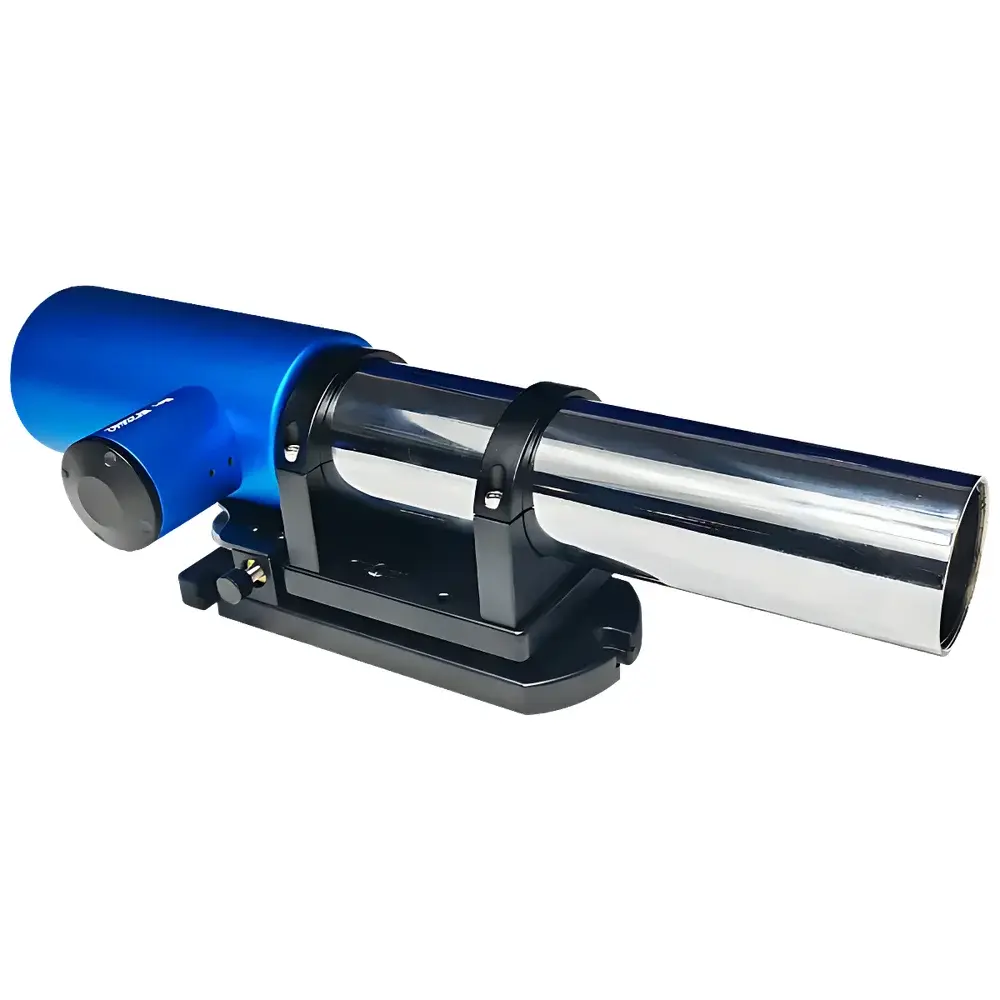
YANRUN MC030-ZJUH3000/0.1 Dual-Axis Electronic Autocollimator
| Brand | YANRUN |
|---|---|
| Origin | Shanghai, China |
| Manufacturer Type | Direct Manufacturer |
| Model | MC030-ZJUH3000/0.1 |
| Angular Resolution | 0.1 arcsecond |
| Measurement Axes | X and Y (simultaneous) |
| Sensor Type | High-Resolution CMOS Imaging Array |
| Data Processing | Real-Time Digital Image Analysis Algorithm |
| Compliance | ISO 10110-7, GB/T 22168–2008, JJG 924–2018 |
Overview
The YANRUN MC030-ZJUH3000/0.1 is a dual-axis electronic autocollimator engineered for high-precision angular metrology in controlled industrial and laboratory environments. It operates on the fundamental principle of optical autocollimation—where a collimated beam is reflected from a target mirror back into the instrument’s objective lens, and angular deviations are quantified by measuring the displacement of the returned image on a calibrated CMOS sensor array. Unlike traditional visual or analog autocollimators, this system integrates real-time digital image acquisition, sub-pixel centroid detection algorithms, and bidirectional signal processing to deliver simultaneous, non-contact measurement of angular displacement in both X and Y orthogonal planes. Designed for traceable calibration workflows, it supports angular measurements with a base resolution of 0.1 arcsecond (5 × 10⁻⁷ rad), making it suitable for alignment verification of precision optical benches, coordinate measuring machine (CMM) granite tables, CNC machine tool guideways, and interferometric reference surfaces.
Key Features
- Dual-axis simultaneous measurement capability—no mechanical reorientation required between X and Y axis readings.
- High-stability optical architecture incorporating temperature-compensated achromatic doublet objectives and low-drift LED illumination source.
- Real-time digital image processing engine enabling dynamic tracking of mirror tilt at up to 50 Hz frame rate (configurable).
- Integrated USB 3.0 interface with native support for Windows-based host systems; no external frame grabber required.
- Robust mechanical housing rated IP52 for dust resistance and operational stability under ambient workshop conditions (15–30 °C, <70% RH non-condensing).
- Modular calibration protocol compliant with ISO/IEC 17025 requirements—factory calibration certificate includes uncertainty budget per ISO/IEC Guide 98-3 (GUM).
Sample Compatibility & Compliance
The MC030-ZJUH3000/0.1 is compatible with standard optical flats, kinematic mirror mounts (e.g., Thorlabs KM100 series), and retroreflector-equipped alignment targets. It requires a reflective surface with minimum reflectivity ≥85% in the visible spectrum (400–700 nm) and surface roughness ≤λ/10 (RMS) for optimal centroid detection. The instrument conforms to national metrological verification regulation JJG 924–2018 (China), general specification GB/T 22168–2008 for electro-optical angle measuring instruments, and optical component standard ISO 10110-7 for surface quality assessment. While not FDA-regulated, its data integrity framework—including timestamped raw image logs, user-accessible audit trails, and password-protected configuration files—supports GLP and GMP-aligned documentation practices where angular alignment records must be retained for regulatory review.
Software & Data Management
YANRUN provides proprietary Windows-native software (v3.2.1, 64-bit) supporting live display, statistical process control (SPC) charting, multi-point trend analysis, and export to CSV, XML, and PDF formats. All measurement sessions automatically generate metadata-rich log files containing instrument ID, operator ID, environmental temperature/humidity tags (when connected to optional external sensors), and full-resolution image captures. Software enforces role-based access control (Admin/User/Viewer), implements electronic signature capability per 21 CFR Part 11 Annex 11 guidelines, and maintains immutable audit trails for parameter changes, calibration events, and report generation. Raw image datasets are stored losslessly in TIFF format with embedded EXIF metadata for third-party validation.
Applications
- Alignment and straightness verification of ultra-precision linear and rotary stages in semiconductor lithography equipment.
- In-process angular monitoring during assembly of high-numerical-aperture (NA) microscope objectives and laser cavity optics.
- Calibration of angular encoders and servo-controlled goniometers used in synchrotron beamline instrumentation.
- Verification of orthogonality between axes in multi-axis metrology systems including laser trackers and photogrammetric CMMs.
- Thermal drift characterization of optical support structures under controlled environmental chamber conditions.
- Validation of angular repeatability in aerospace-grade inertial sensor housings and gimbal mechanisms.
FAQ
What is the maximum working distance supported by the MC030-ZJUH3000/0.1?
Standard configuration supports 0.3–10 m measurement range; extended-range optics (optional) extend this to 20 m with maintained 0.1″ resolution.
Does the instrument require periodic recalibration, and what is the recommended interval?
Annual calibration is recommended under ISO/IEC 17025–accredited laboratories; interim verification using NIST-traceable reference mirrors is advised before critical measurement campaigns.
Can the system interface with LabVIEW or MATLAB for custom automation?
Yes—DLL-based SDK and documented TCP/IP command set enable seamless integration with LabVIEW, MATLAB, Python (via PySerial), and PLC-based control systems.
Is the 0.1 arcsecond resolution guaranteed across the full angular range?
Resolution is specified at ±100 arcseconds full scale; linearity error remains within ±0.5% of reading over this range per JJG 924–2018.
How does environmental vibration affect measurement stability?
The instrument incorporates passive damping and motion-compensation firmware algorithms; for sub-0.05″ stability, use on a pneumatic isolation table meeting ISO 22477-1 Class B specifications.






