
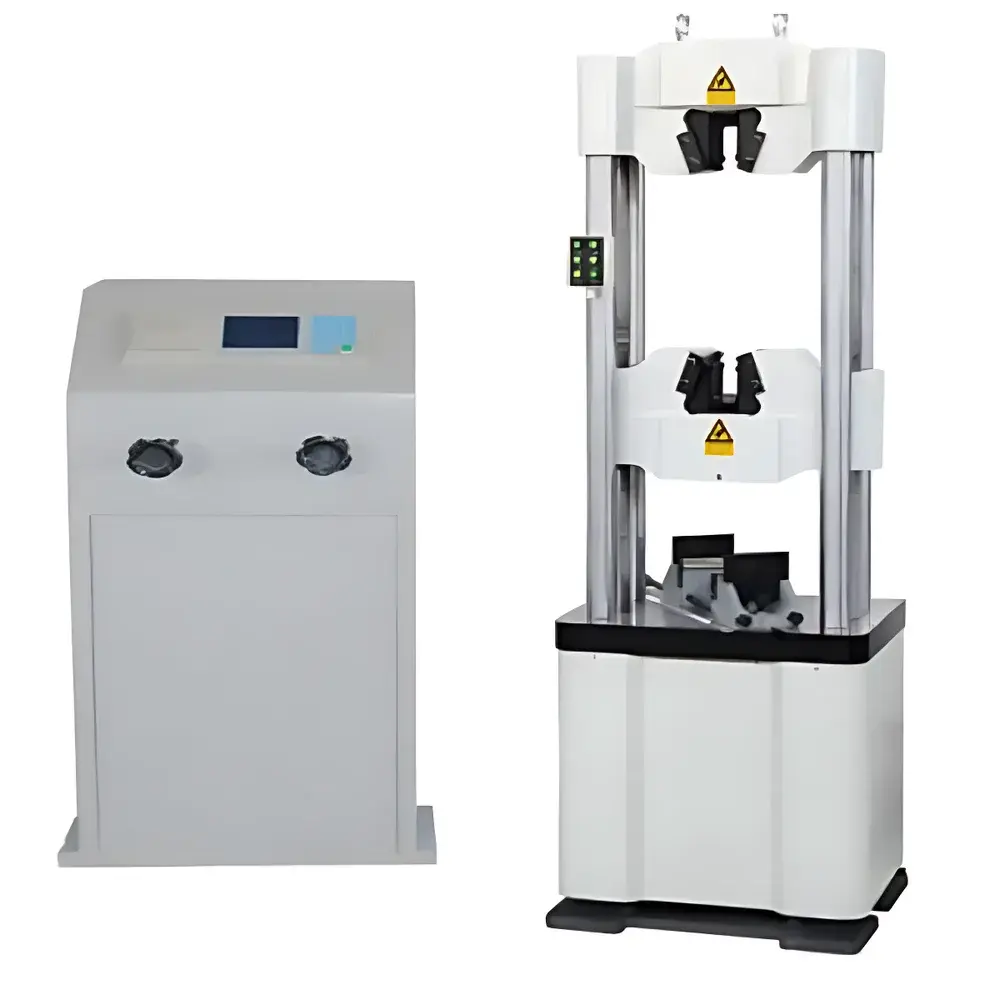
YANRUN WES-1000D Electro-Hydraulic Servo Universal Testing Machine
| Brand | YANRUN |
|---|---|
| Origin | Shanghai, China |
| Manufacturer Type | Direct Manufacturer |
| Country of Origin | China |
| Model | WES-1000D |
| Instrument Type | Electro-Hydraulic Servo Testing Machine |
| Maximum Test Force | 1000 kN |
| Force Measurement Range | 4–100% F.S. |
| Force Indication Relative Error | ≤ ±1% |
| Force Resolution | 0.1 kN |
| Tensile Test Space | 600 mm |
| Compression Test Space | 550 mm |
| Clamping Method | Hydraulic |
| Round Specimen Clamping Diameter | Φ13–40 mm |
| Flat Specimen Thickness Capacity | 0–20 mm |
| Flat Specimen Maximum Jaw Width | 125 mm |
| Upper/Lower Compression Plate Diameter | φ160 mm (optional 204×204 mm) |
| Maximum Distance Between Bending Supports | 450 mm |
| Distance Between Twin Columns (Tensile Zone) | 500 mm |
| Oil Pump Motor Power | 1.5 kW |
| Crosshead Vertical Movement Motor Power | 0.75 kW |
| Machine Dimensions (W×D×H) | 890×660×2200 mm |
| Net Weight | 3000 kg |
Overview
The YANRUN WES-1000D Electro-Hydraulic Servo Universal Testing Machine is a heavy-duty, load-frame-based mechanical testing system engineered for high-accuracy static tensile, compression, bending, and shear evaluation of metallic, composite, and high-strength nonmetallic materials. It operates on the principle of closed-loop electro-hydraulic servo control, where a precision pressure-controlled hydraulic actuator—driven by a high-response servo valve—applies calibrated axial loads under real-time feedback from a calibrated load cell and position transducer. The machine conforms to fundamental structural and metrological requirements outlined in ISO 7500-1 (static calibration of uniaxial testing machines), ASTM E4 (practices for force verification), and ASTM E8/E8M (tension testing of metallic materials). Designed for laboratory and industrial quality control environments, the WES-1000D delivers robust architecture, thermal stability across extended test cycles, and mechanical rigidity essential for reproducible force transmission at full-scale capacity.
Key Features
- Full-scale 1000 kN capacity with dual-range force measurement (4–100% F.S.), enabling high-resolution data acquisition even at low-load regimes without range switching.
- Hydraulically actuated, self-aligning wedge-type grips ensure uniform stress distribution and minimize bending moments during tensile testing of round and flat specimens.
- Integrated digital display console provides real-time readout of load (kN), displacement (mm), and test speed (mm/min); supports manual jog operation and preset load/displacement hold functions.
- Rigid two-column load frame constructed from high-tensile steel, optimized for minimal deflection under maximum load—critical for maintaining alignment per ISO 7500-1 Class 1 compliance.
- Modular tooling interface accommodates standardized accessories including cold-bending fixtures, compression platens (φ160 mm standard; optional 204×204 mm square platen), and auxiliary extensometer mounting brackets.
- Dual-motor drive system: 1.5 kW oil pump motor ensures stable hydraulic pressure supply; 0.75 kW crosshead vertical movement motor enables precise positioning and repeatable return-to-start functionality.
Sample Compatibility & Compliance
The WES-1000D supports a broad spectrum of specimen geometries and material classes. Round specimens ranging from Φ13 mm to Φ40 mm are clamped using hardened, replaceable jaw inserts; flat specimens up to 125 mm wide and 20 mm thick are secured via adjustable parallel-faced jaws. The 450 mm maximum span between bending supports meets ASTM E290 requirements for ductility assessment of structural metals. All mechanical components—including load train elements, grip assemblies, and platens—are traceably manufactured to dimensional tolerances aligned with ISO 2740 (testing machine components) and undergo factory calibration per ISO 376. While the base configuration does not include GLP/GMP-compliant audit trails or electronic signature capability, it serves as a foundation for integration into validated QA/QC workflows when paired with third-party compliant software solutions.
Software & Data Management
The WES-1000D ships with an embedded digital control panel supporting basic test sequencing and parameter entry (e.g., target load, displacement limit, hold duration). For advanced data capture and analysis, the system features analog voltage outputs (±10 V) compatible with external DAQ systems and industry-standard signal conditioning hardware. Optional PC-based software packages—available separately—enable automated test protocols, real-time curve plotting (load vs. displacement, stress vs. strain), export to CSV/Excel, and generation of ASTM/ISO-compliant test reports. These software modules support configurable pass/fail criteria, multi-curve overlay, and batch report consolidation—facilitating routine compliance documentation for internal audits or customer-facing certification.
Applications
- Mechanical property validation of structural steels, aluminum alloys, and high-strength fasteners per ASTM A370, ISO 6892-1, and GB/T 228.1.
- Compression testing of concrete cylinders, cementitious composites, and ceramic tiles in accordance with ASTM C39, ISO 7500-1 Annex B, and EN 12390-3.
- Cold bending qualification of reinforcing bars (rebar) and sheet metal per ASTM A615/A615M and ISO 7438.
- Quality assurance testing in foundries, rolling mills, and aerospace component suppliers requiring traceable, repeatable static load verification.
- Educational use in university materials science laboratories for hands-on instruction in mechanical behavior fundamentals and standard test methodology.
FAQ
What standards does the WES-1000D comply with for force calibration?
It adheres to ISO 7500-1 Class 1 accuracy requirements and is factory-calibrated per ASTM E4 procedures using NIST-traceable reference standards.
Can the machine be upgraded for automatic data logging and reporting?
Yes—via optional PC-based software with USB/RS232 connectivity, supporting automated test execution, curve fitting, and export to PDF/CSV formats.
Is the hydraulic system maintenance-intensive?
The closed-loop servo system uses ISO VG 46 anti-wear hydraulic oil; recommended oil change interval is every 2,000 operating hours or annually, whichever occurs first.
What safety protections are built into the control system?
Hardware interlocks prevent crosshead overtravel; software-enforced load and displacement limits; emergency stop circuit compliant with IEC 60204-1.
Does the system support extensometer integration?
Yes—the frame includes dedicated mounting points and analog input channels for clip-on or non-contact extensometers used in modulus and yield point determination.



