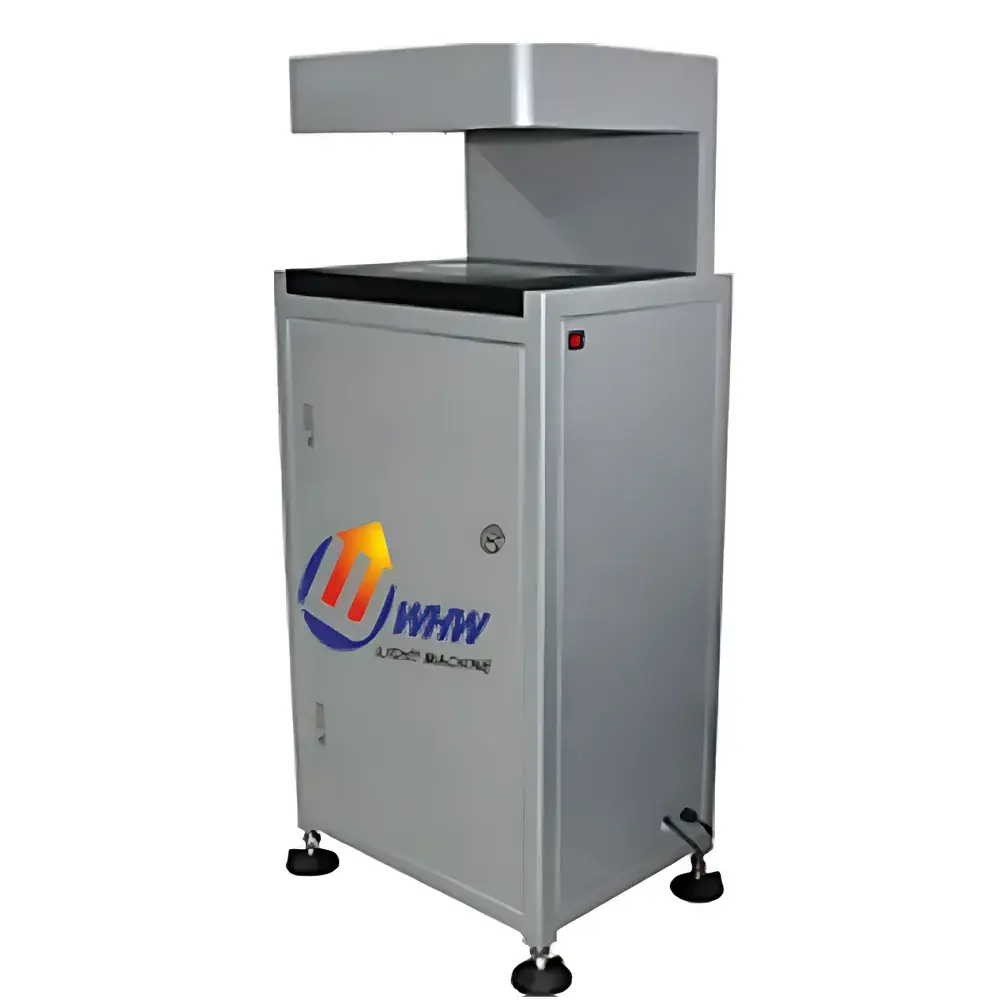
YANRUN YR-150I High-Throughput Batch Image Measuring System
| Brand | YANRUN |
|---|---|
| Origin | Shanghai, China |
| Manufacturer Type | OEM Manufacturer |
| Country of Origin | China |
| Model | YR-150I |
| Operation Mode | Fully Automatic |
| Image Sensor | MVTECH 2/3" 5 MP CCD |
| Telecentric Lens Magnification | 0.061X |
| Measurement Range | 142 × 96 mm |
| Positioning Accuracy | ±0.01 mm |
| Working Height | 200 mm |
| Illumination | Parallel LED Light Source |
| Dimensions (W×D×H) | 460 × 620 × 1440 mm |
Overview
The YANRUN YR-150I High-Throughput Batch Image Measuring System is an industrial-grade optical coordinate measuring instrument engineered for rapid, non-contact geometric metrology in high-volume production environments. It operates on the principle of telecentric imaging combined with sub-pixel edge detection algorithms to deliver repeatable two-dimensional dimensional measurements without mechanical probing or stage translation during acquisition. Unlike traditional CNC-based vision systems requiring sequential point-by-point scanning, the YR-150I captures a full-field image of the entire measurement area in a single exposure—enabling simultaneous evaluation of multiple features across one or several identical parts placed within its 142 × 96 mm field of view. This architecture eliminates stage motion latency and significantly reduces cycle time to ≤2 seconds per batch, making it suitable for inline or near-line quality control in electronics, precision machining, and micro-component manufacturing.
Key Features
- Fully automated measurement workflow: Initiated by a single operator command, the system executes autofocus, image capture, feature extraction, dimensional analysis, and pass/fail classification without manual intervention.
- High-resolution telecentric optical path: Equipped with an Italian-made large-aperture telecentric lens (magnification 0.061X) and a MVTECH 2/3″ 5-megapixel CCD sensor, ensuring minimal perspective distortion and consistent magnification across the entire FOV.
- Parallel LED illumination system: Provides uniform, shadow-free backlighting and front lighting modes optimized for edge contrast enhancement of both opaque and transparent components such as smartphone glass and stamped metal parts.
- Zero-clamp, zero-motion positioning: Parts are placed freely on the static granite base; no fixtures, vacuum chucks, or motorized XY stages are required for alignment or repositioning.
- Real-time SPC-ready output: Measurement results—including deviation from nominal CAD data—are automatically generated in industry-standard formats (Microsoft Excel .xlsx and Word .docx) with embedded statistical summaries and annotated measurement reports.
Sample Compatibility & Compliance
The YR-150I is validated for geometric inspection of small-to-medium-sized manufactured parts with maximum planar dimensions up to 142 × 96 mm and height clearance of 200 mm. Typical applications include gear tooth profiles, screw thread geometry, injection-molded housings, sapphire cover glass, and stamped sheet metal components. Its measurement uncertainty of ±0.01 mm conforms to ISO 10360-7 (coordinate measuring machines using optical distance sensors) and supports traceable calibration via NIST-traceable step gauges and ring gauges. The system’s software architecture allows configuration to meet GLP/GMP documentation requirements, including user access control, audit trail logging, and electronic signature support compliant with FDA 21 CFR Part 11 when deployed in regulated medical device or pharmaceutical packaging QA labs.
Software & Data Management
The embedded metrology software provides native CAD import functionality (DXF, STEP, IGES), enabling automatic overlay of theoretical geometry onto acquired images for deviation mapping. Measurement routines can be saved as reusable inspection programs, each defining feature types (e.g., circles, lines, distances, angles, concentricity), tolerances, and reporting templates. All raw images, coordinate data, and metadata are stored in a structured SQLite database with timestamped revision history. Export modules support direct integration into MES and QMS platforms via CSV, XML, or OPC UA interfaces. Audit trails record every user action—including program edits, result overrides, and calibration events—with immutable timestamps and operator IDs.
Applications
- Electronics manufacturing: Dimensional verification of PCB fiducials, connector pins, and camera module apertures.
- Automotive micro-components: Gear pitch error analysis, fastener head geometry, and bracket hole position verification.
- Consumer hardware: Smartphone frame flatness, glass edge chamfer consistency, and speaker mesh aperture uniformity.
- Medical device assembly: Syringe barrel diameter tolerance checks, catheter hub concentricity, and microfluidic channel width validation.
- Quality gate inspection: Pass/fail binary classification at production line endpoints using configurable Go/No-Go logic based on GD&T callouts.
FAQ
What is the maximum number of parts that can be measured simultaneously?
The system accommodates multiple identical parts within its 142 × 96 mm field of view—typically up to 8–12 small components (e.g., M2 screws or SIM card trays), depending on part layout and spacing requirements.
Does the system require periodic recalibration?
Yes. Recommended recalibration interval is every 6 months or after any physical impact or environmental shift exceeding ±2°C/hour; calibration uses certified reference artifacts traceable to national metrology institutes.
Can custom GD&T symbols be evaluated?
Yes. The software supports position, concentricity, symmetry, profile of a line/surface, and parallelism calculations per ASME Y14.5–2018 and ISO 1101 standards.
Is remote monitoring or network deployment supported?
Yes. The system includes Ethernet connectivity and supports remote desktop access, centralized report aggregation servers, and secure HTTPS-based web dashboard viewing for multi-site quality teams.
What operating system does the controller run?
The embedded industrial PC runs Windows 10 IoT Enterprise LTSB with long-term security update support and locked-down peripheral access to ensure stability in factory environments.