
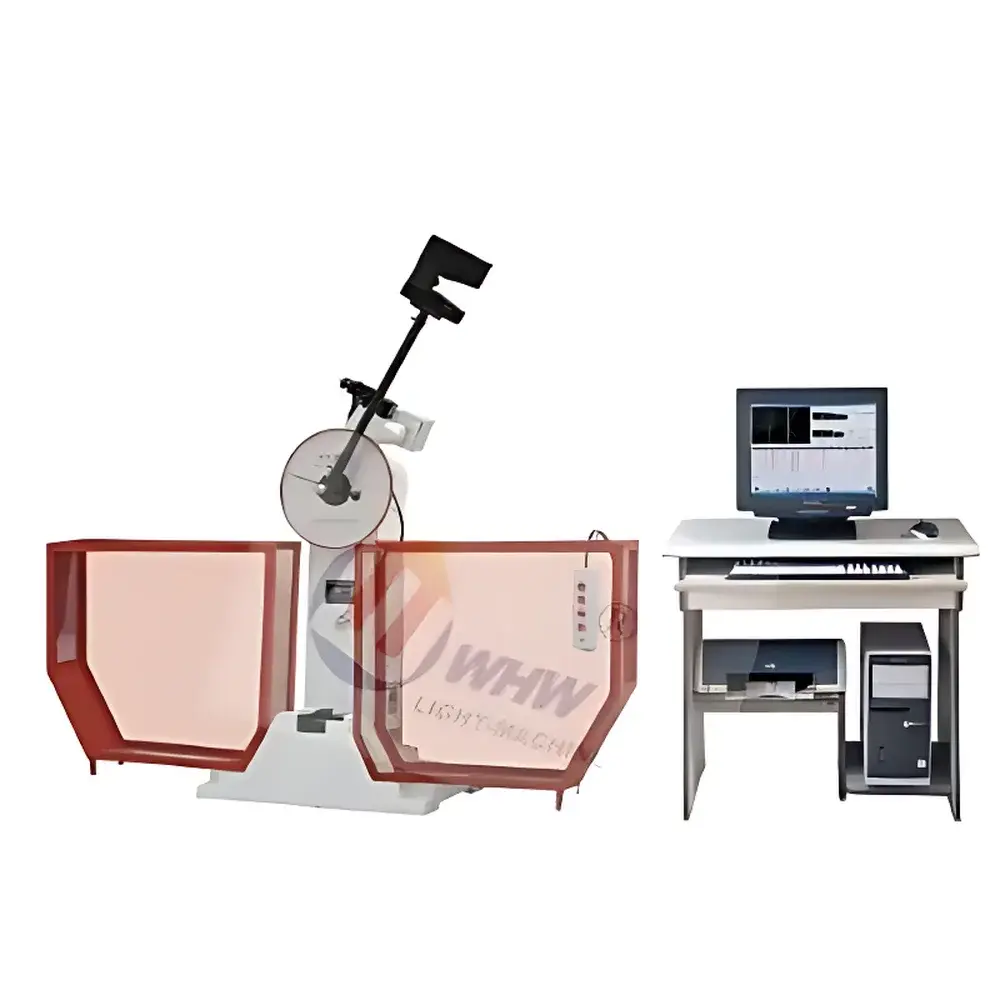
Shanghai Baoji MC009-JB-300W/500W Microcomputer-Controlled Pendulum Impact Testing Machine
| Origin | Shanghai, China |
|---|---|
| Manufacturer Type | Authorized Distributor |
| Origin Category | Domestic (China) |
| Model | MC009-JB-300W / MC009-JB-500W |
| Quotation | Available Upon Request |
| Impact Energy | 150/300 J (JB-300W) / 250/500 J (JB-500W) |
| Distance from Pendulum Axis to Impact Point | 750 mm (JB-300W) / 800 mm (JB-500W) |
| Impact Velocity | 5.2 m/s (JB-300W) / 5.4 m/s (JB-500W) |
| Pre-lift Angle | 150° |
| Specimen Support Span | 40 mm |
| Anvil Radius | R1–R1.5 mm |
| Hammer Knife Radius | R2–R2.5 mm and R8 ± 0.05 mm |
| Specimen Dimensions | 10 (7.5, 5, 2.5) × 10 × 55 mm |
Overview
The Shanghai Baoji MC009-JB-300W/500W Microcomputer-Controlled Pendulum Impact Testing Machine is a precision-engineered Charpy and Izod impact testing system designed for standardized mechanical property evaluation of metallic materials. It operates on the principle of pendulum impact dynamics—measuring the energy absorbed by a notched specimen during fracture under controlled single-blow loading. Compliant with ISO 148-1:2016, ASTM E23-22, GB/T 229-2020 (replacing GB/T 229-1994), and GB/T 3808-2018 (replacing GB/T 3808-2002), this instrument delivers repeatable, traceable results essential for quality control in metallurgy, heavy machinery, aerospace component manufacturing, and third-party testing laboratories.
Key Features
- Microcomputer-integrated control architecture with real-time acquisition of pendulum return energy, swing period, and residual kinetic energy—enabling automatic recalibration of zero-energy baseline prior to each test cycle.
- Motor-driven automatic pendulum repositioning (auto-lift) immediately following specimen fracture, eliminating manual intervention and reducing inter-test interval to under 8 seconds—critical for high-throughput environments such as foundry QC labs or steel mill certification facilities.
- Dual-range impact energy configuration: JB-300W supports 150 J / 300 J full-scale ranges; JB-500W extends capability to 250 J / 500 J—both configured with calibrated hammer assemblies traceable to national metrology institutes.
- High-resolution angular encoder (±0.05° accuracy) and synchronized force-time sampling at ≥10 kHz enable precise calculation of absorbed energy, impact toughness (kJ/m²), and normalized energy absorption per unit cross-section.
- Integrated thermal-stable base frame with vibration-damping rubber mounts ensures mechanical isolation from ambient floor vibrations—maintaining measurement stability across consecutive 100+ test sequences.
Sample Compatibility & Compliance
This impact tester accommodates standard Charpy V-notch (CVN) and U-notch specimens per ISO 148-1 and ASTM E23, including nominal dimensions of 10 × 10 × 55 mm, with optional adaptors for sub-sized specimens (7.5, 5.0, and 2.5 mm thickness). The anvil geometry conforms strictly to R1–R1.5 mm radius tolerance, while the striker knife features dual-radius design: R2–R2.5 mm for general-purpose testing and certified R8 ± 0.05 mm radius for high-accuracy reference-grade validation. All mechanical components—including pendulum shaft, bearing housing, and release mechanism—are manufactured to ISO 2768-mK general tolerances and undergo static load verification at 1.5× maximum rated energy. The system supports GLP-compliant audit trails when paired with validated software (see Software & Data Management section).
Software & Data Management
The embedded Windows-based control software provides full IEC 62304-compliant operation, supporting automated test sequencing, multi-user role management (operator, supervisor, administrator), and electronic signature workflows aligned with FDA 21 CFR Part 11 requirements. Test data—including absorbed energy (J), lateral expansion (mm), fracture surface appearance classification (fibrous/percent crystalline), and calculated toughness values—is stored in encrypted SQLite databases with immutable timestamps and operator ID tagging. Export options include CSV, PDF reports with embedded calibration certificates, and XML files compatible with LIMS platforms (e.g., Thermo Fisher SampleManager, LabVantage). Audit logs record all parameter modifications, calibration events, and user logins—retained for ≥36 months by default.
Applications
- Quality assurance of structural steels (ASTM A36, A572, API 5L), pressure vessel plates (ASME SA-516), and weld metal deposits in pipeline and power generation sectors.
- Low-temperature impact screening per EN 10045-1 for cryogenic service materials (e.g., LNG tank steels operating at −196 °C).
- Routine verification of heat treatment efficacy—particularly temper embrittlement assessment in Cr-Mo alloys via step-cooling protocols.
- Research-grade fracture mechanics studies requiring correlation between Charpy transition curves and crack-tip opening displacement (CTOD) data.
- Accredited testing per ISO/IEC 17025:2017—validated through interlaboratory comparison programs (e.g., NIST SRM 2825, EURAMET.Q-K10).
FAQ
Does this system comply with ISO/IEC 17025 accreditation requirements for accredited testing laboratories?
Yes—the mechanical design, calibration methodology, and software audit trail functionality meet Clause 6.4 (Equipment) and Clause 7.7 (Results Reporting) of ISO/IEC 17025:2017. Full traceability documentation, including uncertainty budgets per GUM (JCGM 100:2008), is provided with each delivery.
Can the JB-300W model be upgraded to 500 J capacity in the field?
No—energy range is determined by pendulum mass distribution and rotational inertia; JB-300W and JB-500W are mechanically distinct platforms requiring separate foundation anchoring and safety enclosure specifications.
What calibration standards are supplied with the instrument?
Each unit ships with NIST-traceable reference specimens (SRM 2825 Level 1 & 2), pendulum moment-of-inertia certificate, and digital level calibration report issued by Shanghai Institute of Measurement and Testing Technology (SIMT).
Is remote diagnostic support available for firmware updates and troubleshooting?
Yes—via secure TLS 1.3-enabled remote desktop session with prior written authorization; all connections require two-factor authentication and are logged in accordance with GDPR Article 32 security obligations.



