
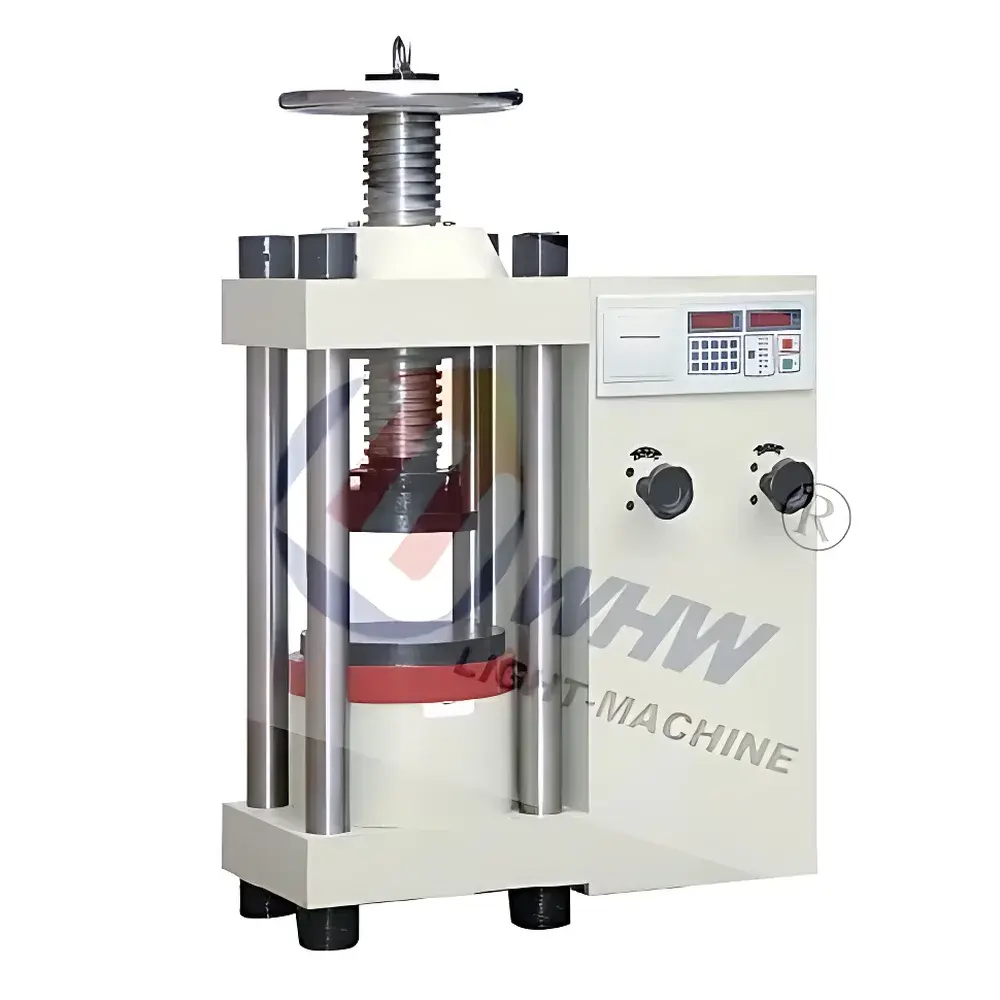
MC009-YES-2000 Digital Display Hydraulic Compression Testing Machine
| Origin | Shanghai, China |
|---|---|
| Manufacturer Type | Authorized Distributor |
| Origin Category | Domestic (PRC) |
| Model | MC009-YES-2000 |
| Quotation | Available Upon Request |
| Max Test Load | 2000 kN |
| Load Range | 4–100% of Full Scale |
| Load Indication Accuracy | ≤ ±1% FS |
| Upper/Lower Platen Diameter | φ220 mm & φ300 mm |
| Max Platen Spacing | 320 mm |
| Piston Stroke | 30 mm |
| Piston Diameter | φ250 mm |
| Hydraulic Pump Rated Pressure | 40 MPa |
| Power Supply | 3-phase, 0.75 kW |
| Dimensions (W×D×H) | 820 × 550 × 1300 mm |
| Net Weight | ~750 kg |
Overview
The MC009-YES-2000 Digital Display Hydraulic Compression Testing Machine is a statically rated, force-controlled mechanical testing system engineered for high-precision uniaxial compression evaluation of rigid construction materials. Operating on the principle of servo-controlled hydraulic actuation coupled with strain-gauged load cell transduction, this machine delivers traceable, repeatable compressive force application in accordance with standardized quasi-static loading protocols defined in ASTM C39/C39M (concrete cylinders), ASTM C109/C109M (mortar cubes), ISO 7500-1 (calibration of force-proving instruments), and GB/T 3159–2008 (Chinese national standard for electronic universal testing machines). Its closed-loop hydraulic architecture ensures stable load ramping and dwell control, while digital signal conditioning enables real-time acquisition of load, displacement, and loading rate—critical for compliance with GLP-aligned laboratory documentation requirements.
Key Features
- Hydraulic loading system with pressure-regulated pump delivering up to 40 MPa, enabling consistent 2000 kN maximum capacity without thermal drift or actuator saturation.
- High-stiffness dual-platen configuration with interchangeable φ220 mm and φ300 mm hardened steel platens—designed to minimize elastic deformation and ensure uniform stress distribution across standard test specimens (e.g., 150 mm concrete cubes, 100 mm brick units).
- Digital load readout with 0.1 kN resolution and ≤ ±1% full-scale accuracy, certified per ISO 376 Class 1 equivalency for force measurement uncertainty.
- Integrated load-rate display and programmable rate control (via manual analog adjustment), supporting ASTM-compliant loading rates such as 0.2–0.5 MPa/s for concrete or 0.1–0.15 MPa/s for masonry units.
- Automatic overload protection circuitry and mechanical safety stop prevent damage during specimen failure or operator error.
- Non-volatile memory retains peak load value and timestamp upon power interruption—essential for audit-ready data integrity in QA/QC environments.
Sample Compatibility & Compliance
The MC009-YES-2000 accommodates standard civil engineering specimens including cement mortar cubes (70.7 mm), concrete cylinders (150 mm Ø × 300 mm), fired clay bricks (240 × 115 × 53 mm), autoclaved aerated concrete (AAC) blocks, and precast concrete elements. Its 320 mm platen separation and 30 mm piston stroke support both as-received and capping-conditioned specimens. The system conforms to mechanical safety requirements outlined in EN 12390-4 (testing hardened concrete) and supports calibration traceability to national metrology institutes via documented force calibration certificates. While not inherently Part 11 compliant, its digital output interface allows integration with validated LIMS or ELN platforms where electronic signatures and audit trails are implemented at the software layer.
Software & Data Management
This model operates in standalone mode with front-panel digital indicators for load, loading rate, and peak-hold value—eliminating dependency on proprietary PC software and reducing validation burden in regulated labs. All displayed parameters are derived directly from calibrated analog-to-digital conversion of the load cell output (mV/V signal), with internal filtering optimized for low-noise static measurement. For laboratories requiring exportable records, optional RS-232 or USB-to-serial interfaces enable connection to third-party data logging applications that support CSV or XML export formats. Raw time-series load data can be captured at ≥10 Hz sampling rate when interfaced externally—sufficient for post-test analysis of fracture onset and post-peak softening behavior.
Applications
- Compressive strength determination of Portland cement concrete per ASTM C39, EN 12390-3, and GB/T 50081.
- Quality assurance testing of load-bearing masonry units including solid clay bricks, concrete blocks, and lightweight aggregate blocks.
- Mechanical characterization of geopolymer binders, stabilized soils, and recycled aggregate concretes in R&D settings.
- Calibration verification of field rebound hammers (Schmidt hammers) using reference specimens tested under identical environmental conditions.
- Educational use in civil engineering laboratories for demonstrating stress–strain response, modulus of elasticity estimation (via initial linear slope), and failure mode analysis (brittle vs. ductile collapse).
FAQ
Is the MC009-YES-2000 suitable for tensile or flexural testing?
No—this machine is configured exclusively for uniaxial compression. Tensile or bending tests require a universal testing frame with appropriate fixtures and load train alignment.
Does it meet ISO/IEC 17025 requirements for accredited testing labs?
Yes—when operated with documented calibration intervals (recommended annually), verified traceable standards, and controlled environmental conditions (23 ± 2°C, 50 ± 5% RH), it satisfies technical competence criteria for compression testing scope.
Can test data be exported to Excel or LIMS?
Yes—via optional serial communication interface; users must implement external logging software compliant with their organization’s data governance policy.
What maintenance is required for long-term accuracy?
Monthly visual inspection of hydraulic fluid level and hose integrity; annual recalibration of load cell and pressure transducer by an ISO/IEC 17025-accredited provider.
Is operator training included with purchase?
Basic operational training is provided remotely or on-site by authorized distributor personnel, covering safety procedures, specimen alignment, load rate selection, and result interpretation per relevant standards.



