
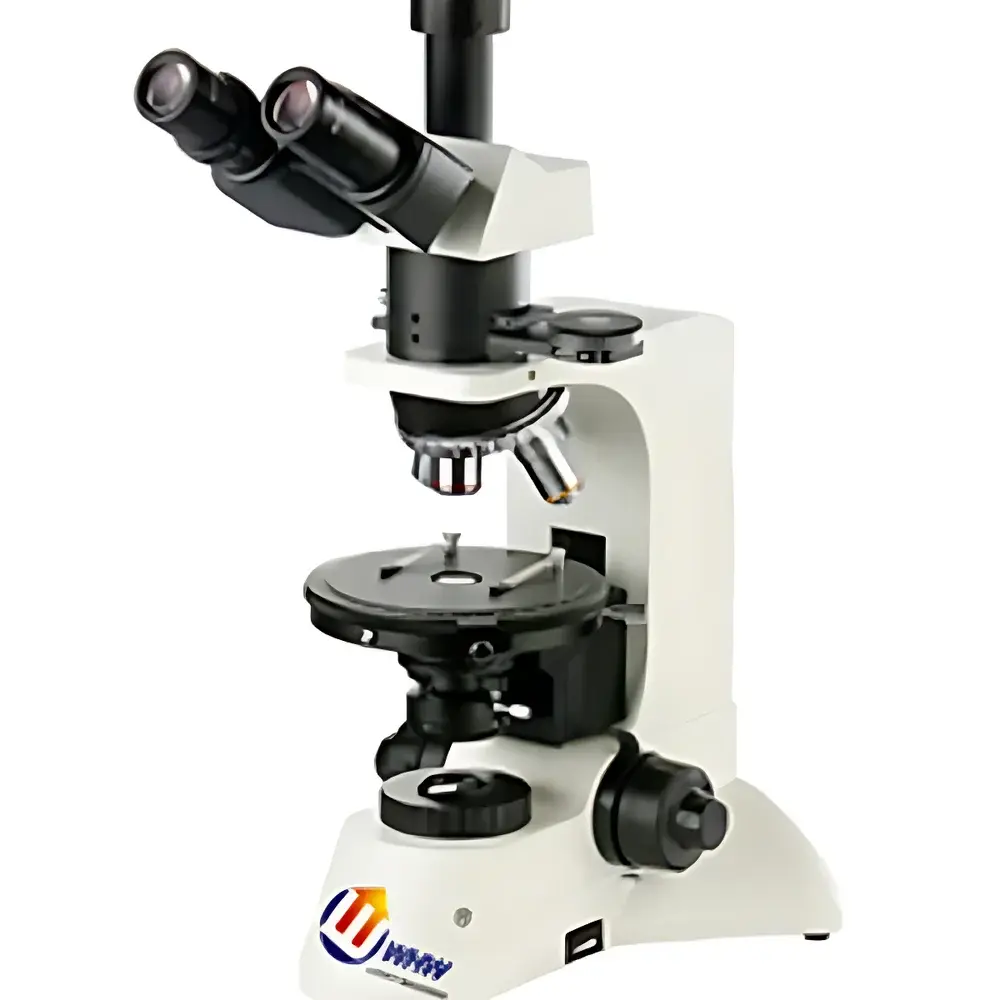
YANRUN PM-13 Infinity-Corrected Transmitted-Light Polarizing Microscope
| Brand | YANRUN |
|---|---|
| Origin | Shanghai, China |
| Manufacturer Type | Direct Manufacturer |
| Origin Category | Domestic (China) |
| Model | PM-13 Infinity-Corrected Transmitted-Light Polarizing Microscope |
| Price | USD 1 (Reference Only) |
Overview
The YANRUN PM-13 is an infinity-corrected, transmitted-light polarizing microscope engineered for high-precision qualitative and quantitative birefringence analysis in geological, materials science, pharmaceutical, and polymer laboratories. It operates on the fundamental principle of polarized light interference—utilizing orthogonal polarizers (polarizer and analyzer) to reveal optical anisotropy, retardation magnitude, and fast/slow axis orientation in crystalline, fibrous, or oriented polymeric specimens. The system integrates a strain-free optical path with fully corrected optics to eliminate intrinsic birefringence from lenses and prisms—a prerequisite for reliable extinction alignment and accurate retardation measurement per ASTM D4101 and ISO 6597. Designed for routine and research-grade work, the PM-13 supports both visual observation and digital documentation under standardized illumination conditions compliant with ISO 10934-1 (microscopy — terminology and definitions) and IEC 61000-4-2 (EMC immunity for lab instrumentation).
Key Features
- Infinity-corrected optical architecture with strain-free plan-apochromatic objectives (PL series), ensuring minimal internal stress-induced birefringence across all magnifications.
- Wide-field eyepieces (WF10×, Ø22 mm field number) with optional reticle (0.10 mm/division) for calibrated linear measurement during extinction angle determination.
- Coaxial coarse/fine focusing mechanism with adjustable coarse-focus tension, mechanical limit stop, and 2 µm fine-focus graduation—optimized for reproducible Z-axis positioning during convergent beam analysis.
- Rotatable polarizer (0°/90°/180°/270° indexed positions) mounted below the aperture diaphragm, enabling precise azimuthal alignment relative to the specimen stage coordinate system.
- Push-in type analyzer with full 360° rotation and vernier scale (12′ resolution), allowing rapid switching between brightfield and crossed-polar modes without optical realignment.
- 360° graduated rotating stage (Ø150 mm) with center-adjustable lock, 6′ vernier reading, and 30 mm vertical working clearance—compatible with heating/cooling stages per ASTM E1987.
- Dual-mode trinocular tube (30° inclination) with 100% light path diversion to camera port, supporting low-light CCD/CMOS imaging without beam splitting loss.
- Adjustable Abbe condenser (NA 1.25), height-variable, with iris diaphragm and centering screws—configured for Köhler illumination and optimized numerical aperture matching per ISO 8578.
Sample Compatibility & Compliance
The PM-13 accommodates standard 26 mm × 76 mm glass slides and 22 mm × 22 mm coverslips (thickness #1.5, 0.17 mm). Its strain-free objective suite (4×/0.10, 10×/0.25, 40×/0.65, 60×/0.80) is optimized for use with immersion oils and mounting media meeting refractive index specifications per USP . The instrument complies with electrical safety standards IEC 61010-1 (Lab Equipment) and electromagnetic compatibility requirements IEC 61326-1. All optical components are certified free of residual birefringence per DIN 58887, and the polarizer/analyzer extinction ratio exceeds 1000:1—satisfying minimum performance thresholds defined in ISO 10934-2 for polarized light microscopy.
Software & Data Management
While the base PM-13 is hardware-focused, its trinocular port and standardized C-mount interface (via optional 0.4×/0.5×/1× adapters) support integration with third-party imaging platforms compliant with TWAIN and GenICam protocols. When paired with validated software (e.g., NIS-Elements, Stream Motion, or open-source Fiji/ImageJ), users may implement audit-trail-enabled workflows aligned with FDA 21 CFR Part 11 requirements—including user authentication, electronic signatures, and immutable metadata logging for GLP/GMP environments. Optional USB/VIDEO output modules enable real-time streaming for remote collaboration or training applications.
Applications
- Mineral identification and optical mineralogy (e.g., determining optic sign, 2V angle, and pleochroism in thin sections).
- Pharmaceutical solid-state characterization: polymorph screening, crystal habit analysis, and stress-induced birefringence in tablet coatings.
- Polymer morphology assessment: spherulite size distribution, lamellar orientation mapping, and phase separation in blends.
- Forensic fiber analysis per SWGMAT guidelines, including refractive index matching and retardation quantification.
- Quality control of liquid crystals, composites, and bioengineered scaffolds where molecular alignment dictates functional performance.
FAQ
Does the PM-13 support quantitative retardation measurement?
Yes—when used with calibrated compensators (λ, λ/4, quartz wedge) and a calibrated analyzer vernier, it enables semi-quantitative to quantitative retardation determination per ISO 10934-3.
Is the microscope compatible with hot-stage accessories?
Yes—the stage design (30 mm vertical clearance, center-locking mechanism, and thermal mass stability) supports commercially available metallurgical or ceramic hot stages rated up to 600 °C.
Can the PM-13 be upgraded to differential interference contrast (DIC)?
No—this model lacks the necessary prism slots and Nomarski-compatible objective threading; DIC capability requires dedicated DIC-configured systems.
What power supply standards does the halogen illuminator meet?
The 6 V / 30 W halogen lamp driver accepts universal AC input (85–265 V, 50/60 Hz), conforming to IEC 60950-1 and CE marking requirements for global laboratory deployment.
Are replacement strain-free objectives available as spares?
Yes—YANRUN supplies certified PL-series strain-free objectives individually, with full traceable calibration certificates upon request for ISO/IEC 17025-accredited labs.





