
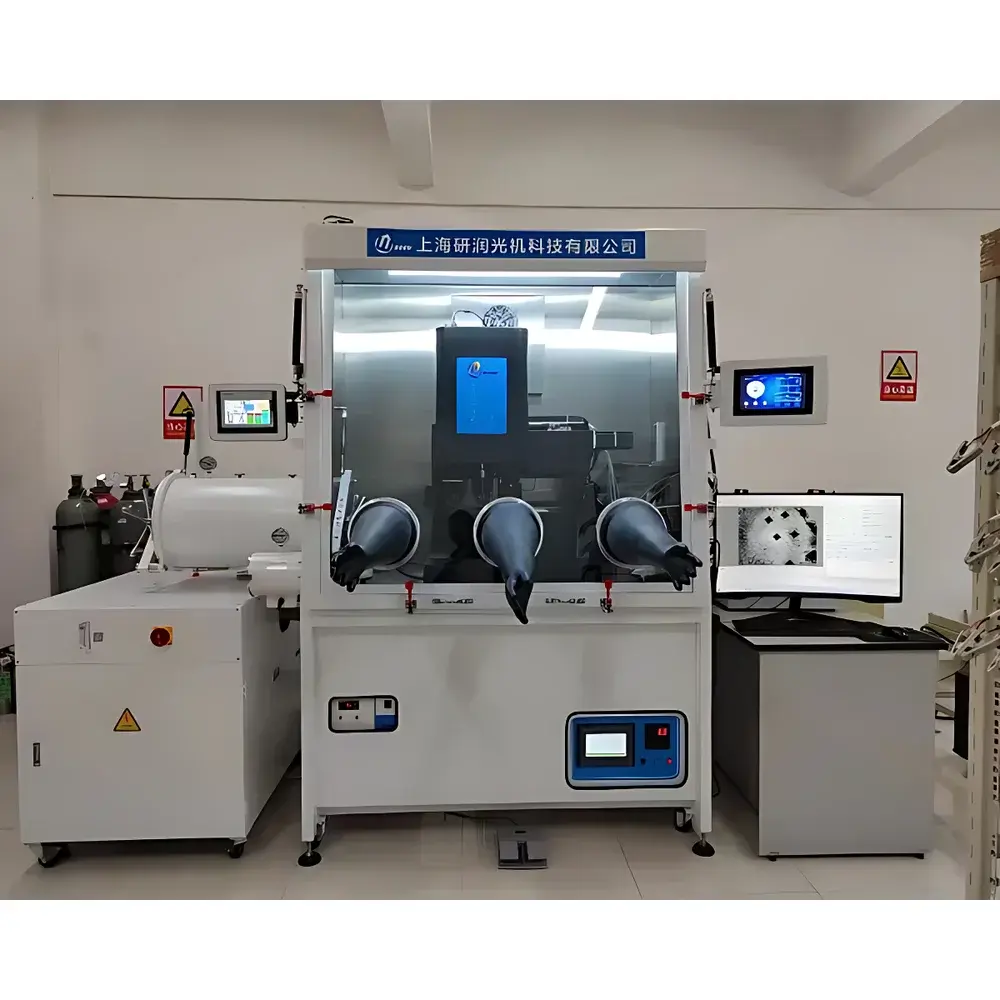
YANRUN IMAS-HT700CM Full-Temperature-Field Dynamic Characterization High-Temperature Indentation Tester
| Brand | YANRUN |
|---|---|
| Origin | Shanghai, China |
| Manufacturer Type | Original Equipment Manufacturer (OEM) |
| Country of Origin | China |
| Model | IMAS-HT700CM |
| Instrument Type | Vickers Hardness Tester |
| Maximum Operating Temperature | 600 °C |
| Optical Observation at 600 °C | 10× or 20× Objective |
| Load Range | 0.1–30 kgf (standard), up to 150 kgf (optional) |
| Force Resolution | 0.01% FS |
| Displacement Resolution | 500 nm (standard), down to <20 nm (laser interferometer option) |
| Temperature Control Accuracy | ±1 °C |
| Temperature Uniformity Gradient | ≤±5 °C across 100×80×80 mm chamber |
| Hold Time Capability | Up to 72 h at constant load and temperature |
| In-situ Imaging & Testing | Yes, within same thermal field |
| Multi-axis Synchronization | Up to 9 axes |
| Sample Exchange Time at 600 °C | ≤50 s |
| Heating Element | HRE high-temperature alloy |
| Thermocouple | Type S |
| Cooling | Purified air or inert gas, ≤5 s cooldown to ≤55 °C |
Overview
The YANRUN IMAS-HT700CM is a full-temperature-field dynamic characterization high-temperature indentation tester engineered for quantitative mechanical property evaluation of advanced materials under controlled thermal environments ranging from ambient to 600 °C. Unlike conventional hardness testers limited to room-temperature operation or post-test ex-situ analysis, the IMAS-HT700CM enables true in-situ, real-time nano/micro-scale indentation within a thermally stable, uniform furnace chamber. Its core measurement principle is based on continuous force–displacement–time (F–δ–t) acquisition during loading, holding, and unloading phases—supporting Vickers hardness, fracture toughness (KIC), elastic modulus (via Oliver–Pharr and related models), creep compliance, scratch resistance, and time-dependent deformation analysis. The system integrates high-temperature optical microscopy (10×/20× objectives rated for continuous 600 °C operation), multi-axis precision motion control, and closed-loop thermal compensation to ensure metrological integrity across extended dwell periods (up to 72 h) and thermal transients (1–40 °C/min ramp rates). Designed for R&D laboratories engaged in aerospace alloys, nuclear ceramics, high-entropy materials, and next-generation thermal barrier coatings, it delivers traceable, reproducible data compliant with ASTM E384, ISO 6507, and USP indentation-based mechanical testing guidelines.
Key Features
- Full-temperature-field operation: Stable, uniform heating from ambient to 600 °C within a 100×80×80 mm chamber (max furnace rating: 700 °C), with ±1 °C temperature control accuracy and ≤±5 °C spatial gradient.
- In-situ high-temperature imaging: 10× objective (1000× system magnification, 1.44 µm resolution) and optional 20× objective (2000× magnification, 1.19 µm resolution), both qualified for uninterrupted operation at 600 °C for up to 50 hours.
- Dynamic load-displacement acquisition: Continuous F–δ–t data capture at user-defined sampling rates; standard 30 kgf load capacity (expandable to 150 kgf); force resolution ≤0.01% full scale; displacement resolution 500 nm (laser interferometer option: <20 nm).
- Multi-mode loading protocols: Position-controlled, force-controlled, and rate-controlled indentation; programmable hold times from milliseconds to 72 hours; pre-heating of indenter tip up to 600 °C for thermal equilibration.
- High-throughput thermal-field testing: Manual or automated sample exchange completed in ≤50 seconds at 600 °C; integrated glovebox option (H2O/O2 ≤1 ppm) for oxygen-sensitive specimens.
- Nine-axis synchronized motion control: Precision positioning (≤±1 µm accuracy, ≤0.1 µm resolution) across X, Y (dual-objective paths), Z (sample lift), R (rotation), and auxiliary axes for coordinated indenter approach, focus adjustment, and stage translation.
Sample Compatibility & Compliance
The IMAS-HT700CM accommodates disk-shaped specimens up to φ30×30 mm and supports a broad spectrum of high-performance materials—including Ni-based superalloys, SiC/Si3N4 ceramics, refractory metals (Mo, W, Nb), CMCs, and functionally graded composites. All high-temperature components—including the indenter (cubic boron nitride tip with Inconel 718 shank), optical train, load train, and displacement sensors—are validated for structural stability and metrological fidelity at 600 °C. The system meets mechanical safety requirements per ISO 12100 and electrical safety standards IEC 61000-6-2/6-4. Optional glovebox integration complies with ISO 10648-2 for inert-atmosphere handling. Data acquisition and audit trails support GLP/GMP workflows and are compatible with FDA 21 CFR Part 11–compliant electronic signature modules when deployed with validated software configurations.
Software & Data Management
IMAS-V7.0 control and analysis software provides a unified interface for experiment design, real-time monitoring, and post-processing. It supports script-based test sequencing, multi-parameter synchronization (temperature, force, displacement, image capture), and automated curve fitting (e.g., power-law creep modeling, bilinear unloading stiffness extraction). Raw F–δ–t datasets are exported in ASCII and HDF5 formats for third-party analysis (MATLAB, Python, Origin). Built-in modules generate standardized reports conforming to ASTM E384 Annex A3 (high-temperature hardness correction) and ISO 14577-1:2015 (instrumented indentation testing). Audit trail logging records all operator actions, parameter changes, and calibration events with timestamps and user IDs—enabling full traceability for regulatory submissions and inter-laboratory comparisons.
Applications
- Temperature-dependent hardness mapping of turbine blade coatings across 25–600 °C gradients.
- In-situ creep–stress–temperature response quantification in additively manufactured Inconel 718.
- Fracture toughness evolution in ZrO2-Y2O3 thermal barrier coatings under thermal cycling.
- Elastic–plastic transition analysis in ultra-high-temperature ceramics (UHTCs) such as HfC and TaC.
- Time-resolved indentation recovery kinetics in shape-memory alloys (NiTi) during constrained heating.
- High-throughput screening of intermetallic diffusion couples under isothermal hold conditions.
FAQ
What is the maximum continuous operating temperature for optical observation?
The 10× and 20× objectives are rated for uninterrupted use at 600 °C for up to 50 hours.
Can the system perform hardness measurements per ASTM E384 at elevated temperatures?
Yes—software includes temperature-correction algorithms aligned with ASTM E384 Annex A3 and supports reporting of load-corrected hardness values referenced to standard test temperatures.
Is the instrument suitable for GMP-regulated environments?
When configured with Part 11–compliant electronic signatures, audit trail logging, and IQ/OQ documentation packages, it meets baseline requirements for regulated material qualification studies.
What indenter geometries are supported beyond standard Vickers?
Custom tips include spherical (R = 5–50 µm), conical (120°, 90°), cylindrical (φ10–100 µm), and Berkovich configurations—compatible with high-temperature mounting and thermal expansion compensation.
How is thermal drift compensated during long-duration holds?
Real-time displacement feedback from high-stability laser interferometers (optional) and dual-stage thermal compensation algorithms actively correct for furnace-induced drift, maintaining positional fidelity within ±1 µm over 72-hour tests.



