
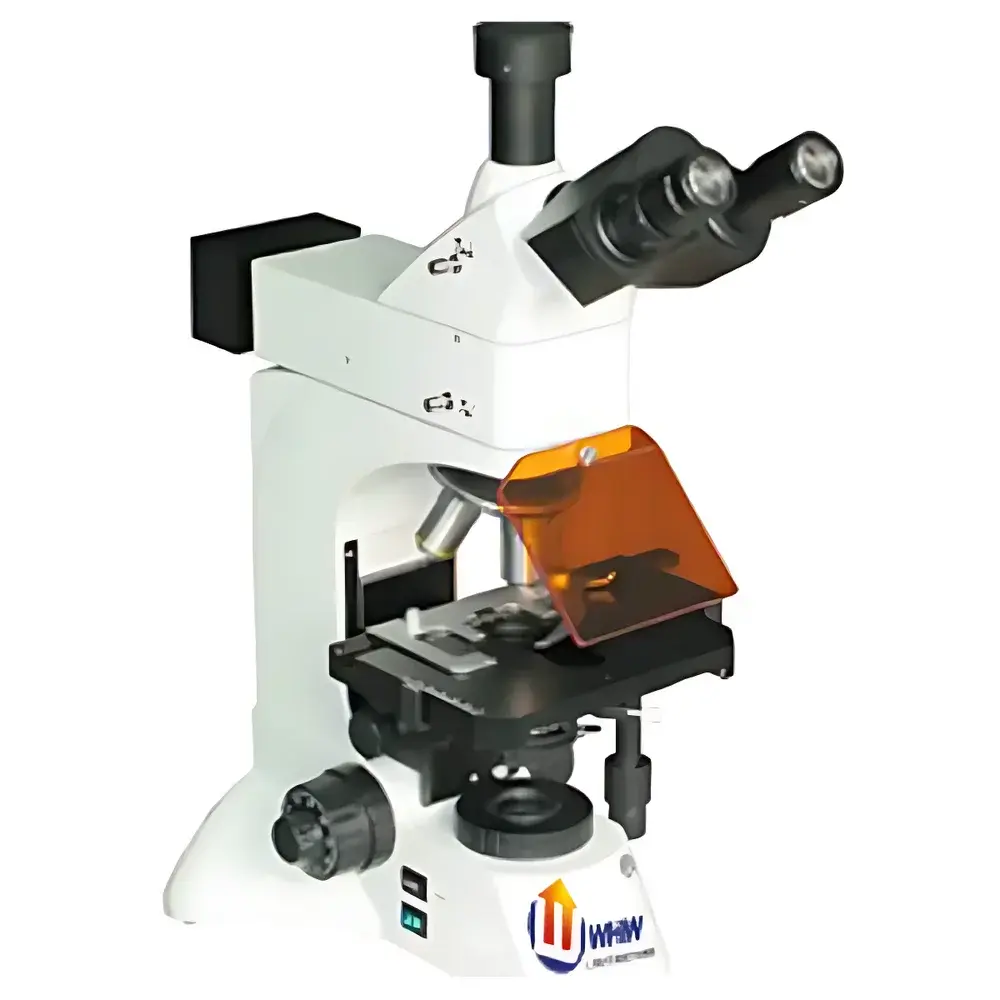
YANRUN FM-500 Upright Infinity-Corrected Epi-Fluorescence Microscope
| Brand | YANRUN |
|---|---|
| Origin | Shanghai, China |
| Manufacturer Type | Direct Manufacturer |
| Country of Origin | China |
| Model | FM-500 Upright Infinity-Corrected Epi-Fluorescence Microscope |
| Price | USD 1 (Contact for Quotation) |
Overview
The YANRUN FM-500 is an upright, infinity-corrected epi-fluorescence microscope engineered for high-fidelity fluorescence imaging in life science research, histopathology, and materials characterization. It employs Köhler illumination principles for both transmitted-light (brightfield and phase contrast) and reflected-light (epi-fluorescence) modalities, ensuring uniform illumination, minimal optical aberration, and optimal signal-to-noise ratio across magnifications from 40× to 1000×. The system’s infinity-corrected optical path accommodates modular add-ons—including optional phase contrast sliders, DIC prisms, and filter cubes—without compromising parfocality or image flatness. Designed for routine laboratory use, the FM-500 integrates a rigid mechanical stage, coaxial coarse/fine focusing with 2 µm fine-focus graduation, and ergonomic 30° inclined trinocular head compatible with digital imaging systems.
Key Features
- Ergonomic trinocular observation tube with 30° inclination and adjustable interpupillary distance; equipped with wide-field WF10X/22 mm eyepieces for extended viewing comfort and reduced eye strain during prolonged sessions.
- Five-position objective turret with inward-rolling ball-bearing positioning for precise, repeatable alignment and minimal vibration-induced drift during objective switching.
- Dual-illumination architecture: (1) Reflected epi-fluorescence illumination powered by a 100 W mercury arc lamp (110 V / 220 V switchable power supply), featuring four standardized excitation/emission filter sets—UV (320–380 nm ex / 435 nm em), V (380–415 nm ex / 475 nm em), B (450–490 nm ex / 515 nm em), and G (495–555 nm ex / 595 nm em); all with center-adjustable field diaphragms.
- Transmitted-light illumination system with Abbe condenser (NA 1.25, height-adjustable), 6 V / 20 W halogen lamp (intensity continuously variable), blue filter, ground glass diffuser, and dedicated collector optimized for tungsten-halogen spectral output.
- Mechanical stage (210 × 140 mm) with 75 × 50 mm travel range, calibrated vernier scales, and low-profile design for unobstructed access to specimen slides and coverslips.
- Coaxial focusing mechanism with dual-scale coarse/fine adjustment, built-in tension control, upper/lower limit stops, and locking function for stable high-magnification imaging—especially critical when using oil-immersion objectives (e.g., PL100X/1.25 Oil).
Sample Compatibility & Compliance
The FM-500 supports standard 1–3 mm thick glass microscope slides and 22 × 22 mm or 24 × 50 mm coverslips. Its transmitted-light path is fully compatible with phase contrast techniques via optional phase sliders and annuli, enabling label-free visualization of unstained biological specimens. The epi-fluorescence module meets basic alignment requirements per ISO 8578:2017 (Microscopes — Requirements for fluorescence microscopes) for excitation band separation and emission isolation. While not certified for clinical diagnostics under IVD directives, the instrument conforms to general safety standards IEC 61010-1 (Electrical Safety for Laboratory Equipment) and electromagnetic compatibility per CISPR 11. All optical components are coated with anti-reflective multilayer films to minimize stray light and maximize transmission efficiency across UV–visible spectrum (320–700 nm).
Software & Data Management
The FM-500 is designed for seamless integration with third-party imaging platforms. Optional USB/VIDEO and digital camera adapters (0.4X, 0.5X, 1X, and 0.5X with reticle scale: 0.1 mm/div) support real-time capture and quantitative analysis using industry-standard software such as ImageJ, NIS-Elements (Nikon), or ZEN (Zeiss). When paired with compliant digital acquisition hardware, the system supports audit-trail-enabled workflows aligned with GLP and GMP documentation practices. Metadata embedding (objective ID, magnification, exposure time, filter set) is preserved in TIFF and JPEG formats. No proprietary firmware or closed-source drivers are required—ensuring long-term interoperability and IT infrastructure compatibility.
Applications
- Cellular localization studies using fluorescent protein tags (e.g., GFP, mCherry) and immunofluorescent labeling (FITC, TRITC, DAPI).
- Fixed-tissue histology and frozen-section evaluation in academic and preclinical research laboratories.
- Material science applications including semiconductor wafer defect inspection, polymer phase segregation analysis, and mineral identification via fluorescence response under UV excitation.
- Phase contrast imaging of live, unstained cells (e.g., fibroblasts, epithelial monolayers) without phototoxicity concerns inherent to fluorescence excitation.
- Teaching laboratories requiring robust, serviceable instrumentation capable of multi-modal instruction across microscopy fundamentals.
FAQ
Is the FM-500 compatible with DIC or polarization accessories?
Yes—the infinity-corrected optical train and available mounting ports allow integration of Nomarski DIC sliders and polarizing filter sets, subject to mechanical clearance verification.
Can the mercury lamp be replaced with an LED fluorescence light source?
The lamp housing is mechanically and electrically configured for 100 W Hg arc lamps. Retrofitting with LED modules requires third-party adapter solutions and may necessitate recalibration of excitation intensity profiles.
What is the maximum working distance supported by the standard objective set?
The PL4X/0.10 objective provides a working distance of 21.5 mm—suitable for thick specimens and inverted-stage-compatible sample holders.
Does the system include FDA 21 CFR Part 11-compliant software?
No—the FM-500 itself is hardware-only. Compliance depends on the selected imaging software and associated validation protocols implemented by the end user.
Are replacement filter cubes available for custom fluorophore combinations?
Standard cubes follow ANSI/NEMA filter nomenclature (e.g., B-2E/C for blue excitation). Custom cubes can be ordered separately with specified dichroic mirrors and bandpass filters upon request.



