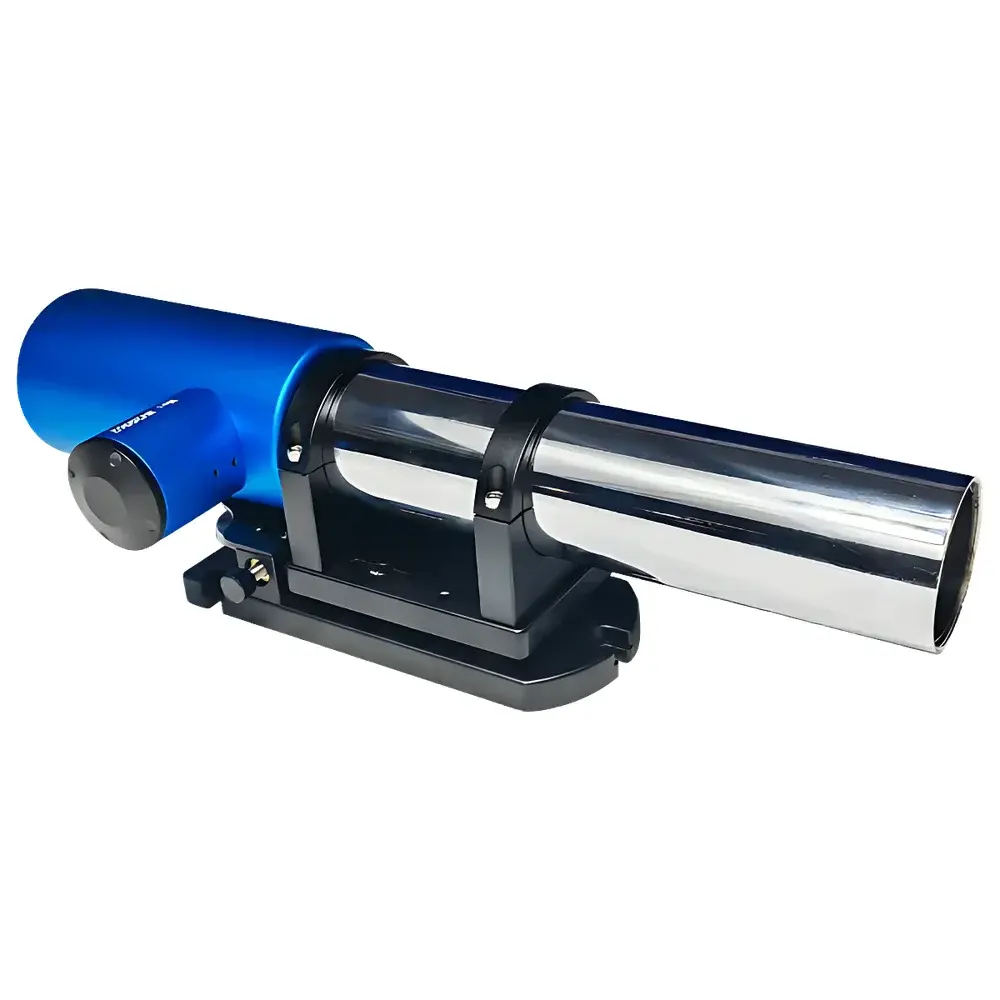
YANRUN MC030-ZJUH3000 Photoelectric Autocollimator
| Brand | YANRUN |
|---|---|
| Origin | Shanghai, China |
| Manufacturer Type | Manufacturer |
| Model | MC030-ZJUH3000 |
| Dimensions | 385 × 125 × 115 mm |
Overview
The YANRUN MC030-ZJUH3000 is a high-precision photoelectric autocollimator engineered for non-contact angular metrology in industrial metrology, optical alignment, and precision mechanical verification. It operates on the fundamental principle of optical autocollimation: a collimated beam—generated by projecting a reticle located at the focal plane of a high-stability objective lens—is directed toward a reflective surface (e.g., a mirror or polished workpiece). Upon reflection, the beam retraces its path and reimages the reticle onto a calibrated photodetector array positioned at the same focal plane. Angular deviations (α) of the reflecting surface induce a linear displacement (ΔS) on the detector, governed by the relation ΔS ≈ 4f·α (where f is the effective focal length), enabling sub-arcsecond resolution in angular measurement. Unlike traditional visual autocollimators requiring manual eyepiece alignment, the MC030-ZJUH3000 integrates real-time electronic imaging and digital centroid detection to eliminate parallax and observer-induced bias—critical for GLP-compliant calibration workflows and ISO/IEC 17025-accredited laboratories.
Key Features
- Simultaneous dual-axis (X & Y) angular measurement with independent signal processing channels, supporting vectorial error decomposition for comprehensive flatness and perpendicularity analysis.
- Real-time electronic viewfinder with high-frame-rate CMOS sensor and on-board image enhancement algorithms—reducing human aiming uncertainty and enabling dynamic alignment monitoring during machine tool setup or thermal drift studies.
- High-resolution quadrant photodiode array (QPD) or position-sensitive detector (PSD), optimized for linearity (<0.05% FS) and repeatability (≤0.1 arcsec over 24 h under controlled ambient conditions).
- Long-life, temperature-stabilized LED light source (635 nm nominal wavelength) with integrated intensity feedback control—ensuring consistent illumination stability across extended operational cycles (>20,000 h MTBF).
- Modular hardware architecture: compatible with interchangeable measurement modules including rotary stage adapters, multi-mirror arrays, and retroreflector mounts—enabling configuration for straightness, squareness, or multi-point tilt mapping per ASTM E1316 and ISO 10360 standards.
- Multi-language UI (English, Chinese, Russian, Korean) with intuitive icon-based navigation—designed for international engineering teams operating in multinational manufacturing or R&D facilities.
Sample Compatibility & Compliance
The MC030-ZJUH3000 supports measurement of any optically reflective surface with a minimum reflectivity ≥40% at 635 nm—including polished steel, silicon wafers, fused silica optics, and anodized aluminum reference flats. Its compact form factor (385 × 125 × 115 mm) facilitates integration into cleanroom environments, coordinate measuring machine (CMM) auxiliary stations, and aerospace assembly jigs. The instrument complies with electromagnetic compatibility requirements per EN 61326-1:2013 and meets mechanical safety standards under ISO 12100. Data integrity protocols align with FDA 21 CFR Part 11 expectations for audit trail generation, user access control, and electronic signature support when used with optional compliant software packages.
Software & Data Management
Bundled YANRUN AutoAlign Suite v3.x provides full instrument control, real-time waveform visualization, and automated report generation. Measurement data—including raw pixel displacement, calculated angular deviation (in arcsec or µrad), statistical summaries (mean, SD, max/min), and trend charts—are exportable in native .CSV and standardized Excel (.xlsx) formats. The software supports batch processing of multi-point datasets, customizable pass/fail thresholds per ASME B89.3.7 and ISO 230-1, and direct integration with enterprise quality management systems (QMS) via OPC UA or RESTful API interfaces. All measurement sessions are timestamped, user-logged, and archived with SHA-256 checksums to satisfy traceability requirements under ISO/IEC 17025 Clause 7.7.
Applications
- Precision installation and alignment of CNC machine tools, laser interferometer bases, and air-bearing spindles.
- Verification of geometric tolerances—straightness, flatness, perpendicularity, parallelism, and angularity—per ISO 1101 and GD&T specifications.
- Calibration of precision rotary tables and goniometers used in semiconductor lithography equipment.
- Aerospace component assembly: wing spar alignment, turbine blade pitch verification, and inertial sensor platform leveling.
- Optical system integration: collimator alignment in telescope mounts, laser cavity fine-tuning, and fiber optic coupler positioning.
- Academic and national metrology research: gravitational wave detector mirror suspension characterization, adaptive optics wavefront sensor validation, and nanometrology reference frame establishment.
FAQ
What is the typical angular resolution achievable with the MC030-ZJUH3000?
Resolution depends on focal length, detector pixel pitch, and signal-to-noise ratio; typical system resolution is ≤0.2 arcsec for standard configurations (f = 300 mm), verified using NIST-traceable angle artifacts.
Can the instrument measure dynamic angular motion?
Yes—sampling rates up to 100 Hz are supported in burst mode, suitable for vibration-induced tilt monitoring and servo-loop feedback applications.
Is external calibration required before use?
The unit ships with factory calibration certificate (ISO/IEC 17025 accredited); users may perform field verification using included reference mirrors and optional angle calibrators (e.g., YANRUN AC-KIT-100).
Does the software support automated compliance reporting for ISO 9001 audits?
Yes—predefined templates generate inspection records aligned with ISO 9001 Clause 8.6, including operator ID, environmental conditions, equipment ID, and measurement uncertainty statements.
How is thermal drift compensated during long-duration measurements?
Internal temperature sensors feed real-time compensation coefficients to the angular calculation engine; drift correction is active within ±0.5 °C of calibration temperature (20 ± 2 °C).