
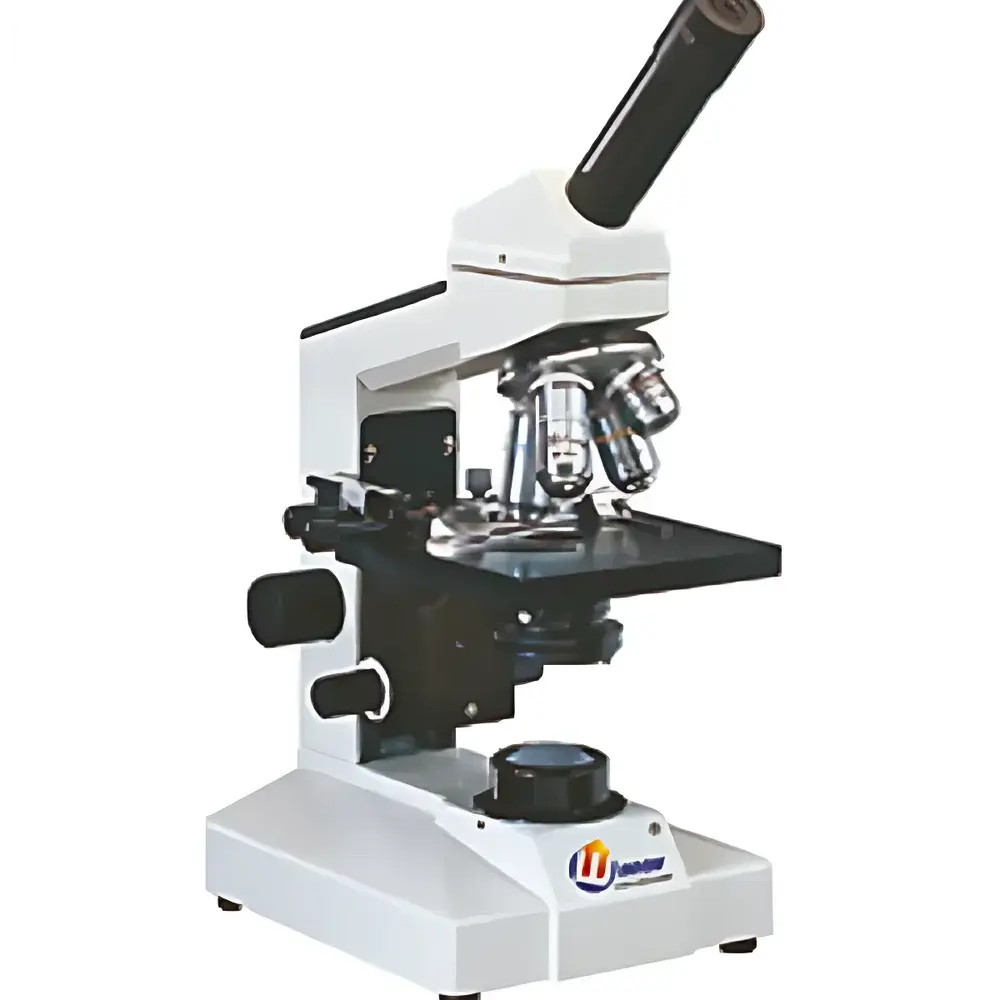
YANRUN BI-13 Biological Inverted Microscope
| Brand | YANRUN |
|---|---|
| Origin | Shanghai, China |
| Manufacturer Type | Original Equipment Manufacturer (OEM) |
| Product Category | Domestic |
| Model | BI-13 Biological Inverted Microscope |
| Instrument Type | Inverted Microscope |
| Eyepiece | Wide-Field WF10X (Φ18 mm) |
| Objective Lenses | Achromatic 4X/0.10, 10X/0.25, 40X/0.65 (spring-loaded), 100X/1.25 (spring-loaded, oil immersion) |
| Magnification Range | 40X–1000X (standard) |
| Focusing Mechanism | Coaxial or separate coarse/fine focus |
| fine focus graduation | 4 µm |
| Stage | Dual-layer mechanical stage (125 mm × 115 mm) |
| travel range | 70 mm × 30 mm |
| Condenser | Abbe condenser, N.A. 1.25, height-adjustable |
| Illumination | 20 W tungsten-halogen lamp, dual-voltage (110 V / 220 V, 50/60 Hz) |
| Optional Light Sources | 5 W fluorescent lamp |
| Optional Accessories | WF16X eyepiece, pointer eyepiece, 3-position turret, green/yellow filters, plano-concave mirror with stand, USB/VIDEO photo-eyepiece |
Overview
The YANRUN BI-13 Biological Inverted Microscope is engineered for routine and advanced life science applications requiring stable observation of living cells, adherent cultures, and tissue specimens in standard Petri dishes, flasks, and multi-well plates. Unlike upright microscopes, its inverted optical configuration places the objective lenses beneath the specimen stage and the condenser above—enabling unobstructed access to culture vessels while maintaining optimal working distance and minimizing mechanical interference during manipulation or long-term time-lapse imaging. The system operates on classical brightfield microscopy principles, utilizing Köhler illumination geometry to deliver uniform, glare-free contrast across the full field of view. Its achromatic objective suite corrects for chromatic aberration at key wavelengths (486 nm, 546 nm, and 656 nm), ensuring faithful color fidelity and sharp edge resolution critical for morphological assessment and basic quantitative analysis.
Key Features
- Wide-field optical path with 10X wide-field (WF) eyepieces (Φ18 mm field number) for extended visual comfort and reduced eye strain during extended observation sessions.
- Achromatic objective set including spring-loaded 40X (NA 0.65) and oil-immersion 100X (NA 1.25) objectives, optimized for high-resolution imaging of fixed and live-cell preparations.
- Dual focusing configurations: users may select either coaxial coarse/fine focus (BI-13B/C variants) or independent coarse and fine focus mechanisms (BI-13A), both calibrated to a precise 4 µm fine-focus graduation for reproducible Z-axis positioning.
- Adjustable Abbe condenser (N.A. 1.25) with centering screws and rack-and-pinion height control, enabling accurate alignment and optimal numerical aperture matching across magnifications.
- Robust dual-layer mechanical stage (125 mm × 115 mm) with 70 mm × 30 mm travel range and vernier scale for repeatable specimen repositioning—essential for serial sectioning, grid-based mapping, or multi-site acquisition workflows.
- Dual-voltage (110 V / 220 V) tungsten-halogen illumination system (20 W) with integrated blue filter and ground-glass diffuser for consistent, low-heat illumination suitable for non-fluorescent live-cell observation.
Sample Compatibility & Compliance
The BI-13 accommodates standard cell culture formats including 35 mm, 60 mm, and 100 mm Petri dishes; T-25, T-75, and T-175 flasks; and 6-, 12-, 24-, 48-, and 96-well plates—without requiring specialized holders or stage adapters. Its inverted architecture inherently supports phase contrast compatibility via optional annuli and phase objectives (not included). While the base configuration does not include fluorescence capability, the modular design permits integration of external LED or mercury arc sources with appropriate excitation/emission filter sets. All mechanical and optical components comply with ISO 8578:2017 (microscopes — requirements and test methods) and meet general laboratory safety standards per IEC 61010-1 for electrical equipment. Firmware-free operation ensures full auditability for GLP environments where software validation is not required.
Software & Data Management
The BI-13 functions as a hardware platform compatible with third-party digital imaging systems. An optional USB/VIDEO photo-eyepiece enables direct connection to Windows/macOS/Linux-based acquisition software (e.g., ImageJ/Fiji, NIS-Elements, or MicroManager) without proprietary drivers. Video output supports real-time streaming at up to 30 fps (720p), facilitating documentation, teaching, and remote collaboration. No embedded firmware or cloud connectivity is present—ensuring data sovereignty and eliminating cybersecurity concerns associated with networked instruments. All image metadata (magnification, objective used, illumination mode) must be manually logged per institutional SOPs, supporting traceability under FDA 21 CFR Part 11 when paired with compliant electronic lab notebook (ELN) systems.
Applications
- Routine quality control of mammalian and insect cell lines in biomanufacturing and academic core facilities.
- Morphological monitoring of primary neuron cultures, stem cell differentiation, and organoid development over multi-day intervals.
- Pre-screening of transfection efficiency and cytotoxicity assays prior to downstream flow cytometry or qPCR.
- Teaching laboratories for introductory histology, microbiology, and developmental biology courses—leveraging its mechanical simplicity and robustness.
- Supporting manual micromanipulation tasks such as oocyte injection, embryo handling, and patch-clamp electrode positioning when mounted on vibration-damped optical tables.
FAQ
Is the BI-13 compatible with phase contrast or fluorescence imaging?
The standard BI-13 configuration supports brightfield only. Phase contrast requires optional phase objectives and an annular diaphragm-equipped condenser. Fluorescence imaging is possible only with externally mounted light sources and filter cubes; no built-in fluorescence optics are provided.
What is the maximum usable magnification with oil immersion?
With the 100X/1.25 oil-immersion objective and WF10X eyepiece, total magnification is 1000X. Using the optional WF16X eyepiece increases this to 1600X, though resolution remains limited by the objective’s NA and visible-light wavelength constraints.
Can the microscope be operated safely in a CO₂ incubator environment?
No—the BI-13 is designed for ambient laboratory use only. It lacks environmental sealing, temperature-rated electronics, or humidity-resistant optics required for incubator integration.
Does the BI-13 meet regulatory requirements for GMP manufacturing environments?
As a Class I electrical device with no software-controlled functions, it satisfies basic safety and electromagnetic compatibility (EMC) requirements per IEC 61010-1. However, formal GMP qualification depends on site-specific IQ/OQ protocols and documented calibration against traceable standards.
Are replacement parts and service support available internationally?
YANRUN provides OEM spare parts (objectives, eyepieces, bulbs, fuses) through authorized regional distributors. Technical documentation, mechanical schematics, and calibration procedures are supplied in English upon request for qualified institutions.
Related Products




