
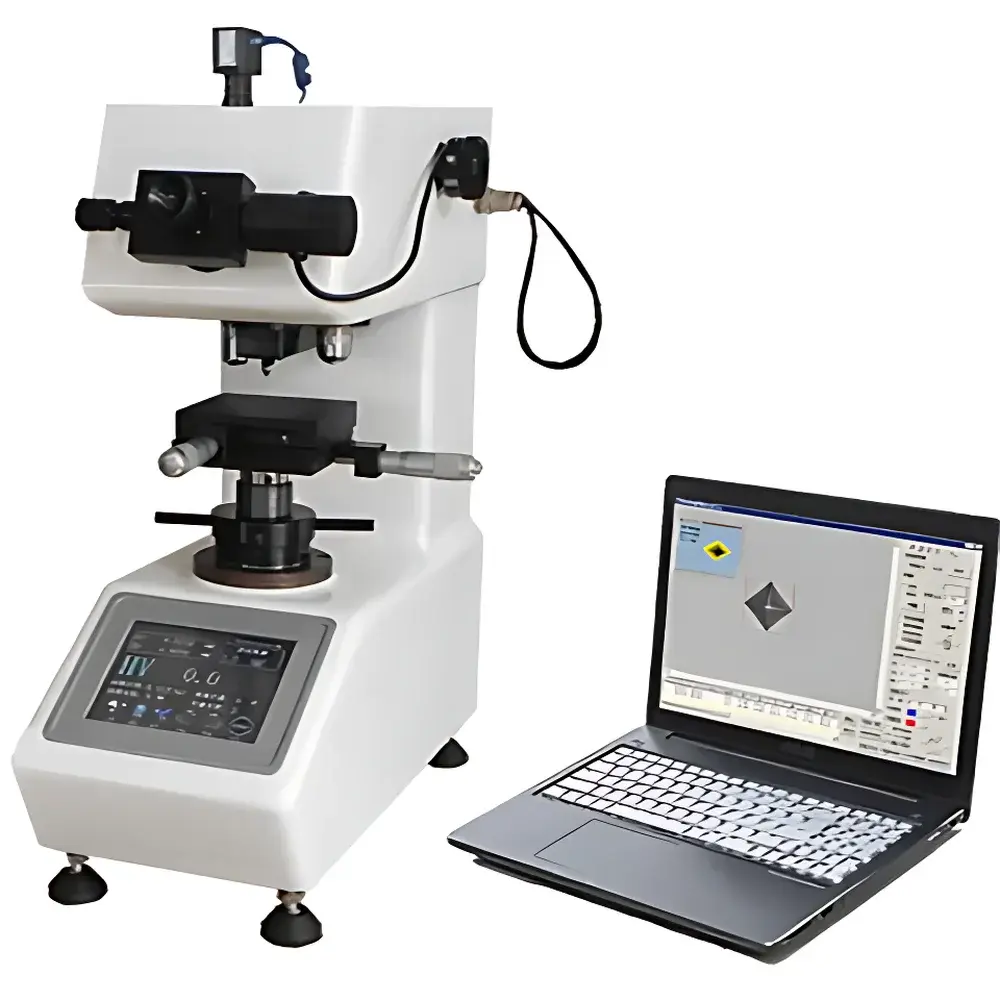
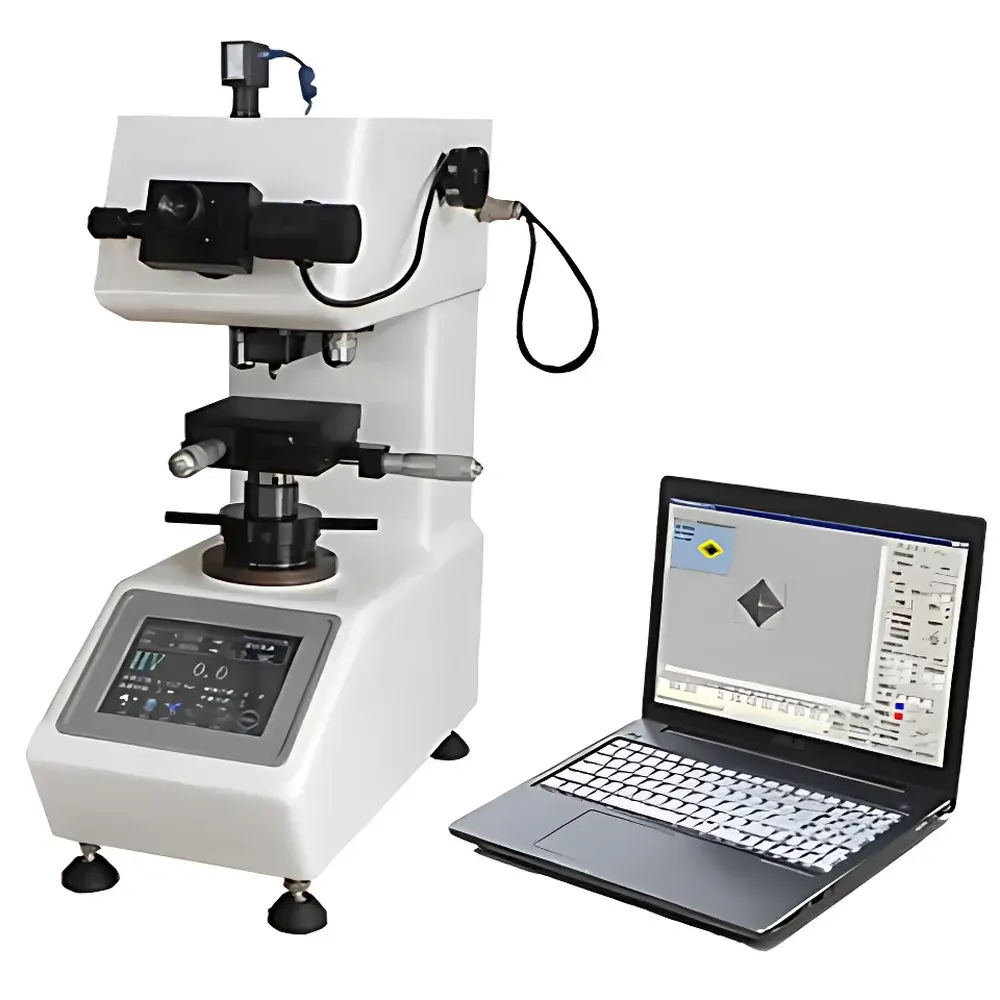
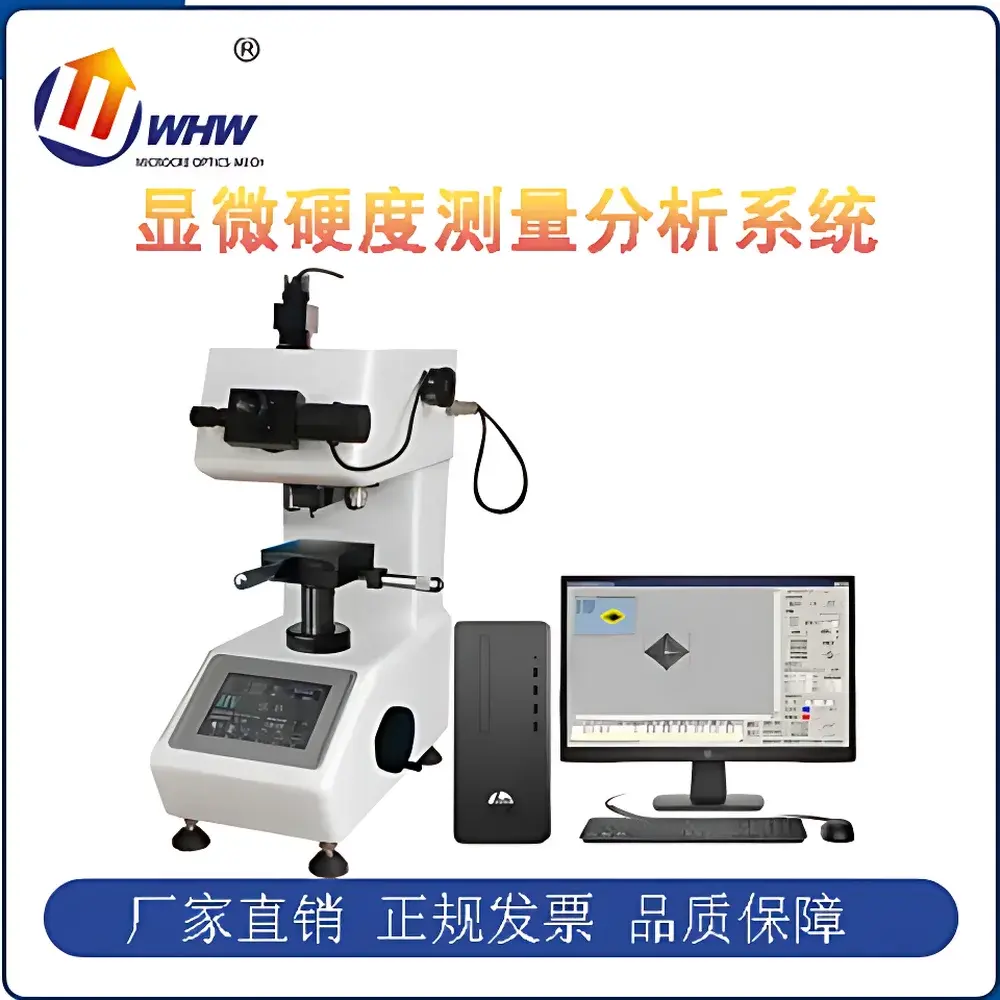
YANRUN HMAS-D1000SM/SMZ Automated Microhardness Testing & Analysis System
| Brand | YANRUN |
|---|---|
| Origin | Shanghai, China |
| Manufacturer Type | Direct Manufacturer |
| Instrument Type | Automatic Microhardness Tester |
| Measurement Range | 0–6000 HV |
| Test Forces (8-step) | 0.098 N, 0.245 N, 0.490 N, 0.981 N, 1.961 N, 2.942 N, 4.903 N, 9.807 N |
| Equivalent in gf | 10 gf, 25 gf, 50 gf, 100 gf, 200 gf, 300 gf, 500 gf, 1000 gf |
| Test Force Duration | 0–60 s (1 s increment) |
| Specimen Height Capacity | 55 mm |
| Distance from Indenter Axis to Chamber Wall | 110 mm |
| X–Y Stage Travel | 25 mm × 25 mm |
| Optical Magnification | 100× (observation), 400× (measurement), ~1600× via CCD + software interpolation |
| Minimum Detectable Indentation Resolution | 0.0318 µm |
| Compliance Standard | GB/T 4340.1–2009 (equivalent to ISO 6507-1 and ASTM E384) |
Overview
The YANRUN HMAS-D1000SM/SMZ is an integrated automated microhardness testing and analysis system engineered for high-precision Vickers hardness evaluation of metallic, ceramic, thin-film, and case-hardened materials. It operates on the principle of optical indentation metrology: a diamond pyramidal indenter (136° apex angle) is applied under controlled static load to the specimen surface; following unloading, the diagonals of the resulting square impression are measured optically using calibrated high-magnification imaging. The system combines a rigid aluminum alloy frame, precision-ground mechanical components—including a gear-driven loading mechanism and micrometer-accurate Z-axis elevation—ensuring minimal mechanical drift and long-term repeatability. Its dual-path optical architecture supports simultaneous visual observation through a 10× eyepiece and digital acquisition via a high-resolution CCD sensor, enabling both real-time operator verification and traceable digital measurement.
Key Features
- Fully automated test cycle: programmable force application, dwell time (0–60 s in 1 s increments), and unloading—compliant with ISO 6507-1 and ASTM E384 requirements for static load control.
- Motorized or manual turret selection (configurable per model variant) with dual-objective capability: 10× for rapid field navigation and 40× for precise indentation measurement.
- HMAS-D proprietary analysis software featuring real-time image capture, auto-indent detection, sub-pixel diagonal measurement, and dynamic focus simulation—enhancing edge contrast without physical refocusing.
- Three-dimensional indentation modeling: reconstructs depth, width, and aspect ratio from 2D projection data using empirical geometric calibration, supporting quantitative assessment of plastic deformation behavior.
- SPC-ready data pipeline: automatic statistical process control calculation (X̄, R, Cpk, Ppk), histogram generation, trend charting, and outlier identification aligned with IATF 16949 and ISO 9001 quality management frameworks.
- Multi-standard hardness conversion: outputs HV alongside HRA, HRB, HRC, HRD, HEF, HK, HBW, and superficial Rockwell scales (HR15N–HR45T), traceable to NIST-traceable reference blocks.
- Twelve user-selectable background color modes optimized for contrast enhancement across diverse material surfaces—e.g., oxidized steels, anodized aluminum, nitrided layers, and polished ceramics.
Sample Compatibility & Compliance
The HMAS-D1000SM/SMZ accommodates specimens up to 55 mm in height and 110 mm laterally from the indenter axis, supporting standard metallurgical mounts, cross-sectioned coatings, heat-treated gears, turbine blades, and semiconductor substrates. Its 25 mm × 25 mm motorized XY stage enables grid-based mapping of hardness gradients—critical for evaluating carburized case depth, nitrided layer uniformity, or thermal spray bond integrity. All measurements adhere to GB/T 4340.1–2009, which is technically harmonized with ISO 6507-1:2018 and ASTM E384–22. The system’s software includes audit trail logging (user ID, timestamp, parameter set, raw image hash), satisfying FDA 21 CFR Part 11 requirements for electronic records when configured with password-protected user roles and digital signature support.
Software & Data Management
The HMAS-D software suite provides a validated, Windows-based interface for acquisition, analysis, reporting, and archival. Core modules include: (1) Real-time image processing with adaptive thresholding and sub-pixel centroid detection; (2) SPC dashboard with control charting, capability indices, and assignable cause tagging; (3) Depth profiling engine that correlates sequential indentations along a linear traverse to generate hardness vs. depth curves; (4) Report generator exporting to PDF (ISO-compliant), Word (.docx), and Excel (.xlsx) formats—including embedded images, metadata, calibration logs, and uncertainty statements. All measurement data is stored locally with optional network backup; image files retain EXIF metadata (force, dwell time, objective, magnification, operator ID). Software updates are delivered via secure HTTPS channel with SHA-256 integrity verification.
Applications
This system is routinely deployed in R&D laboratories for phase-specific hardness mapping of multiphase alloys (e.g., austenite/ferrite in duplex stainless steels), quality assurance labs for verifying case depth compliance per SAE AMS 2750 or ASTM A956, and failure analysis centers assessing hydrogen embrittlement susceptibility via localized hardness depression near crack tips. It supports thin-film characterization down to 100 nm thickness (using 10 gf loads), intermetallic compound hardness in battery electrode interfaces, and residual stress estimation via indentation size effect (ISE) modeling. In academic settings, it serves as a platform for validating constitutive models in plasticity theory and calibrating finite element simulations of contact mechanics.
FAQ
Does the system support GLP/GMP-compliant documentation?
Yes—when operated with enabled audit trail, electronic signatures, and role-based access control, the HMAS-D software meets core GLP (OECD 1998) and GMP (ICH Q7) data integrity expectations.
Can the software calculate case depth according to ASTM E384 Annex A3?
Yes—the built-in depth profiling module implements the 50% hardness drop method and gradient-based interpolation per ASTM E384–22 Annex A3 and ISO 2639:2002.
Is the CCD resolution sufficient for measuring sub-5 µm indentations?
At 400× optical magnification and 1600× digital interpolation, the system achieves effective resolution ≤0.032 µm/pixel, enabling reliable measurement of 2–3 µm diagonal lengths with <±0.5% relative uncertainty.
What calibration standards are recommended for routine verification?
NIST-traceable Vickers hardness reference blocks (e.g., Wilson/Instron SRM 2820 series) covering HV 100–1000 range should be used weekly; daily verification may employ certified secondary standards per ISO 6507-3.
Is remote diagnostics or firmware update supported?
Yes—via encrypted remote desktop session (customer-authorized) or offline firmware package deployment with version-controlled checksum validation.



