
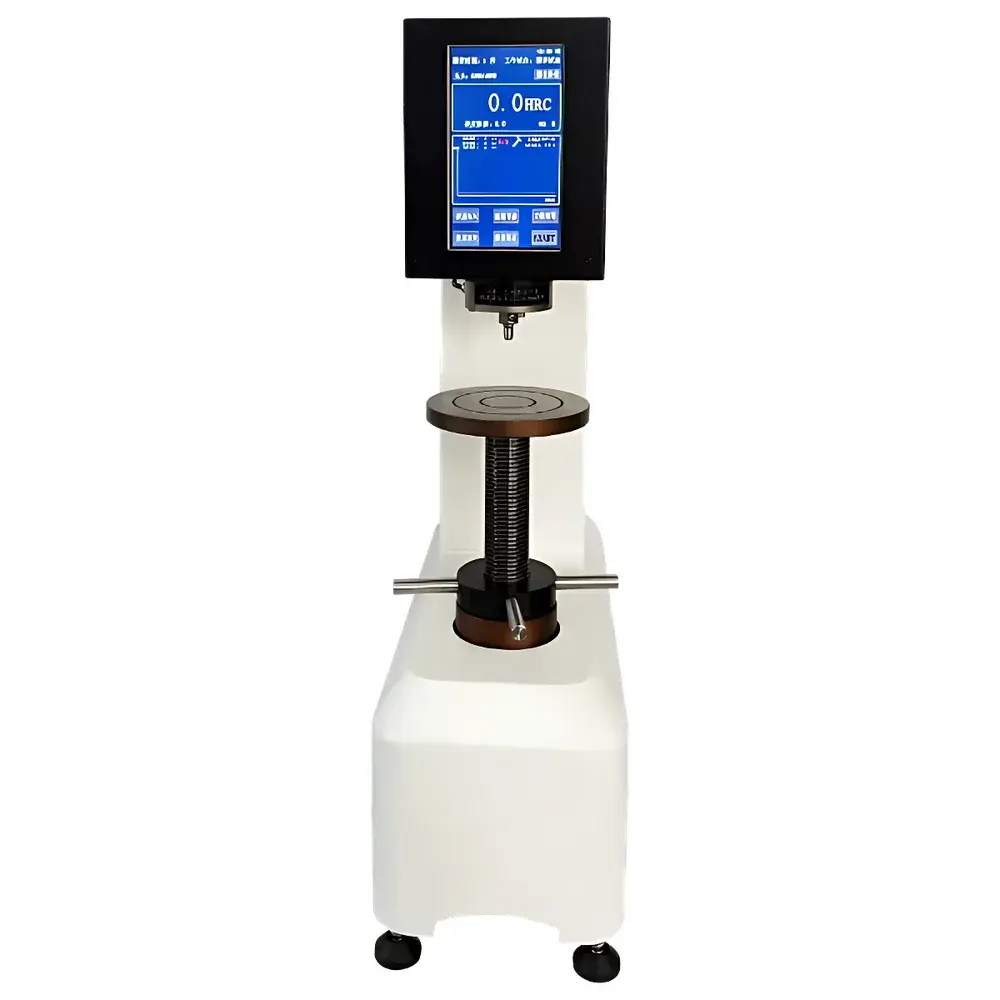
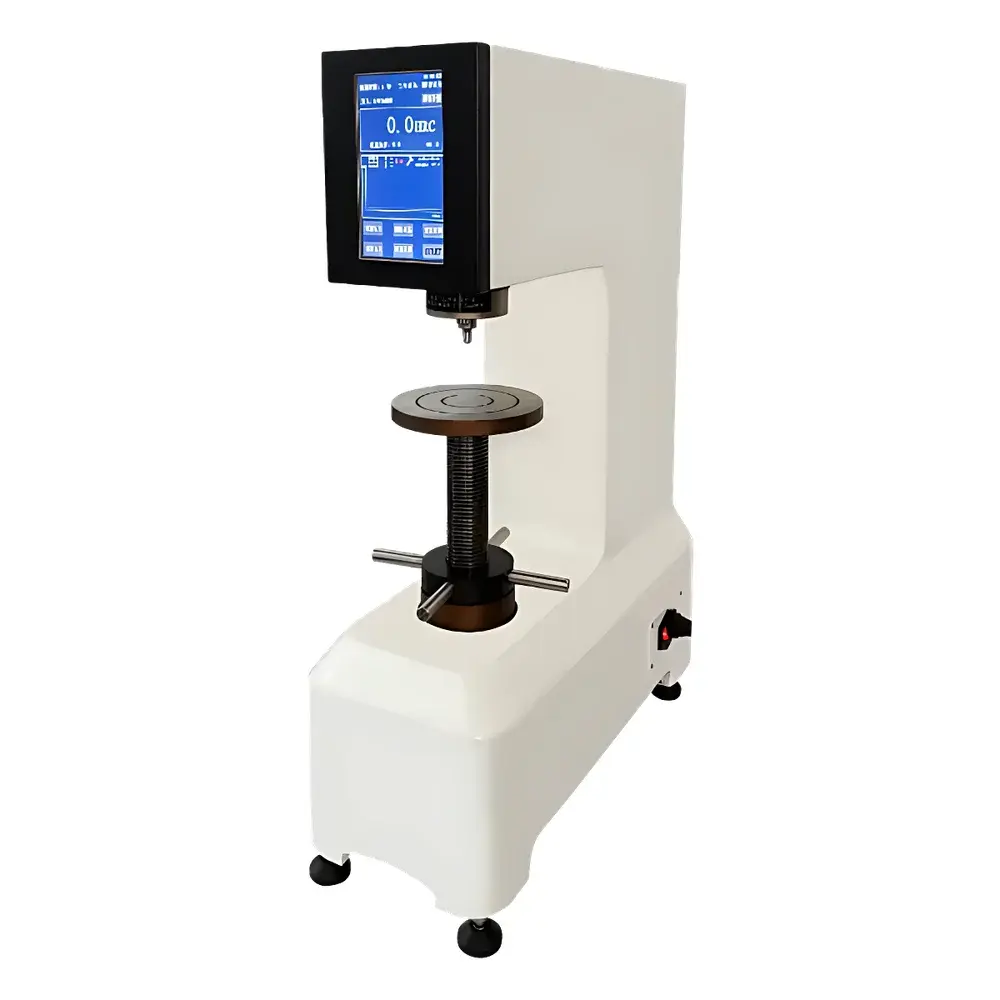
YANRUN HRS-150F Digital Rockwell Hardness Tester
| Brand | YANRUN |
|---|---|
| Origin | Shanghai, China |
| Manufacturer Type | Direct Manufacturer |
| Product Category | Domestic |
| Model | HRS-150F |
| Instrument Type | Rockwell Hardness Tester |
| Hardness Range | HRA: 20–88, HRB: 20–100, HRC: 20–70 |
| Total Test Forces | 588.4 N (60 kgf), 980.7 N (100 kgf), 1471 N (150 kgf) |
| Preliminary Test Force | 98.07 N (10 kgf) |
| Indentation Depth Resolution | 0.1 HR |
| Maximum Specimen Height | 190 mm |
| Anvil-to-Indenter Distance | 160 mm |
| Test Force Dwell Time | 0–60 s (adjustable in 1 s increments) |
| Compliance | GB/T 230.2, JJG 112 |
| Power Supply | AC 220 V / 50 Hz |
| Dimensions (L×W×H) | 540 × 225 × 755 mm |
| Net Weight | 90.5 kg |
| Gross Weight | 110.5 kg |
| Display | 7-inch color TFT touchscreen |
| Data Output | Integrated thermal printer |
| Hardness Scale Conversion | Automatic conversion across 15 Rockwell scales (HRA, HRBW, HRC, HRD, HRE, HRF, HRG, HRH, HRK, HRL, HRM, HRP, HRR, HRS, HRV) and cross-scale equivalents (HBW, HV, HK, HR15N, HR30N, HR45N, HR15T, HR30T, HR45T) |
Overview
The YANRUN HRS-150F Digital Rockwell Hardness Tester is a fully automated, microprocessor-controlled hardness testing system engineered for precision, repeatability, and operational efficiency in industrial quality control and metallurgical laboratories. It operates on the principle of depth-sensing indentation, in accordance with ASTM E18 and ISO 6508 standards—measuring the permanent depth increment of an indenter under defined major and minor loads. The instrument applies standardized preliminary (98.07 N) and total test forces (588.4 N, 980.7 N, or 1471 N) using a robust mechanical gear-driven loading mechanism, ensuring high force stability and minimal hysteresis. Designed for routine verification of heat-treated steels, case-hardened components, aluminum alloys, brass, and polymer composites, the HRS-150F delivers consistent Rockwell hardness values across all 15 standard Rockwell scales—including superficial (N- and T-series) and conventional (A, B, C, D, F, G, etc.) scales—enabling broad material coverage without manual recalibration.
Key Features
- 7-inch full-color TFT touchscreen interface with intuitive menu navigation and real-time visual guidance for test setup, minimizing operator error.
- Automatic load application, dwell, and卸荷 (unloading) sequence—fully programmable dwell time from 1 to 60 seconds in 1-second increments.
- Dual-load capability supporting all major Rockwell configurations: 60 kgf, 100 kgf, and 150 kgf total forces, paired with 10 kgf preliminary force.
- Integrated thermal printer for immediate hard-copy output of test results, including date/time stamp, scale used, test number, and hardness value.
- High-resolution depth sensing with 0.1 HR resolution, meeting the repeatability requirements specified in GB/T 230.2 and JJG 112.
- Mechanically stable frame with φ40 mm precision lead screw and reinforced base structure, optimized to suppress vibration-induced measurement drift.
- Multi-scale automatic conversion engine compliant with ASTM E140, enabling seamless reporting in HBW, HV, HK, and superficial Rockwell equivalents.
Sample Compatibility & Compliance
The HRS-150F accommodates specimens up to 190 mm in height and supports flat, cylindrical, and irregular geometries via interchangeable anvil platforms (φ150 mm large stage, φ55 mm medium stage, and φ35 mm V-block). Its 160 mm anvil-to-indenter clearance allows testing of larger workpieces without repositioning. All hardness measurements adhere to national and international metrological standards: GB/T 230.2–2012 (Chinese standard for Rockwell hardness testing—verification of testing machines), JJG 112–2013 (verification regulation for Rockwell hardness testers), and aligned with ISO 6508-2:2015 and ASTM E18–23 for machine performance validation. Calibration traceability is maintained through certified reference blocks (e.g., NIST-traceable SRMs) and periodic verification per ISO/IEC 17025–compliant internal procedures.
Software & Data Management
While the HRS-150F operates as a standalone instrument with embedded firmware, its touchscreen interface logs all test parameters—including applied force, dwell time, scale selection, and environmental timestamp—in non-volatile memory. Data export is limited to printed reports; however, the system architecture supports optional RS-232 or USB-to-PC connectivity for integration into centralized LIMS or QA databases (custom driver development available upon request). All hardness calculations follow the fundamental Rockwell equation: HR = 100 − (h / 0.002), where h is the plastic indentation depth in millimeters. Audit trails are manually documented per GLP/GMP requirements; for full 21 CFR Part 11 compliance, external electronic record systems must be deployed.
Applications
- Quality assurance of hardened tool steels, bearing races, and automotive transmission components (HRC, HRA).
- Verification of surface treatments including carburizing, nitriding, and induction hardening (HR15N, HR30N, HR45N).
- Non-destructive evaluation of aluminum extrusions and copper alloys in aerospace and electronics manufacturing (HRB, HRF, HRH).
- In-process inspection in forging and casting foundries where rapid pass/fail decisions are required.
- Educational use in materials science labs for comparative hardness studies across alloy families and heat treatment conditions.
FAQ
What Rockwell scales does the HRS-150F support?
It supports all 15 standard Rockwell scales: HRA, HRBW, HRC, HRD, HRE, HRF, HRG, HRH, HRK, HRL, HRM, HRP, HRR, HRS, and HRV—as well as automatic conversion to HBW, HV, HK, and superficial scales (HR15N/30N/45N, HR15T/30T/45T).
Is the instrument suitable for testing thin sheet metal?
Yes—when configured with appropriate superficial scales (e.g., HR15T or HR30N) and verified using thickness-appropriate reference blocks per ASTM E18 Annex A3.
Does the HRS-150F meet ISO/IEC 17025 calibration requirements?
The instrument itself is designed to comply with GB/T 230.2 and JJG 112; formal ISO/IEC 17025 accreditation requires third-party verification of the entire testing process—including operator competence, environmental controls, and uncertainty budgeting.
Can test data be exported digitally?
Built-in thermal printing provides immediate documentation; digital export requires optional serial or USB interface and custom host software—not included as standard.
What maintenance is required for long-term accuracy?
Daily verification with certified reference blocks, annual mechanical inspection of the gear train and load train, and biannual recalibration of the depth transducer per manufacturer-recommended intervals.



