
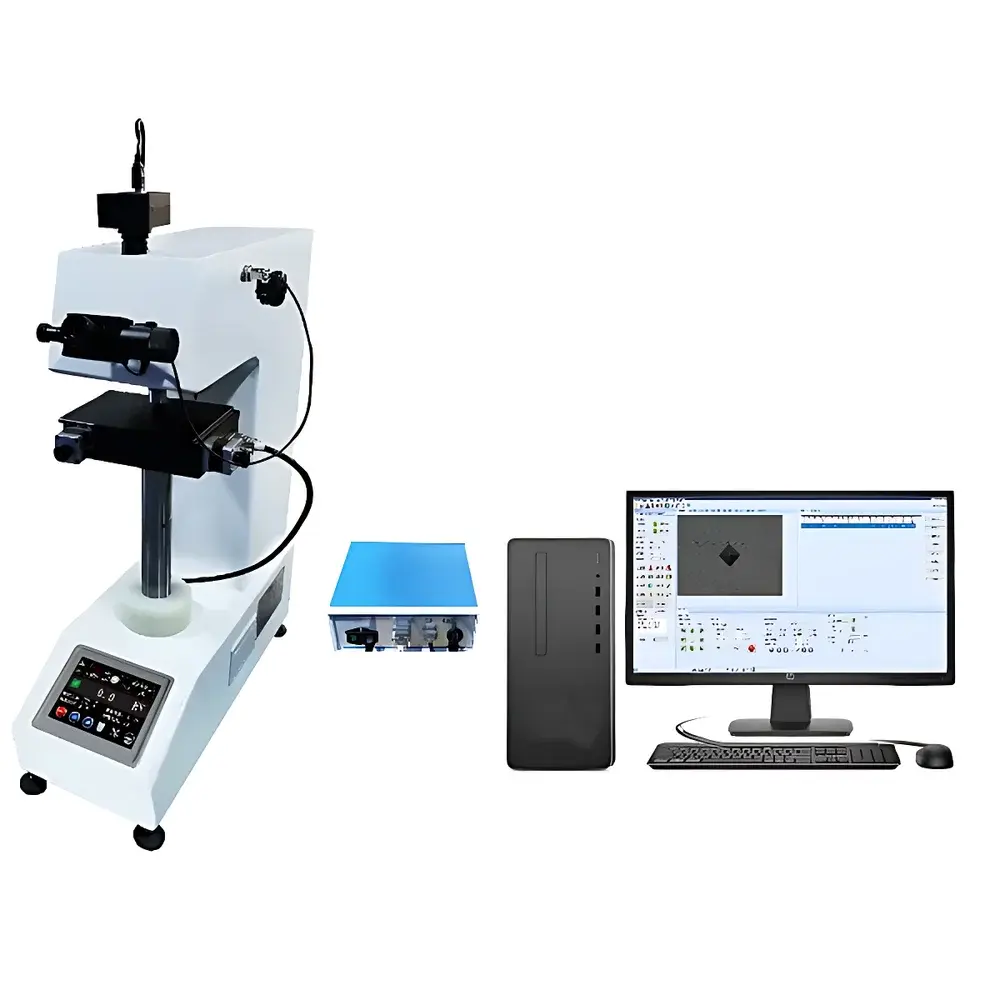
YANRUN HMAS-D1000SMZA Fully Automated Vickers Hardness Measurement and Analysis System
| Brand | YANRUN |
|---|---|
| Origin | Shanghai, China |
| Manufacturer Type | Manufacturer |
| Product Category | Domestic |
| Model | HMAS-D1000SMZA |
| Instrument Type | Vickers Hardness Tester |
| Measurement Range | 0.001–6000 HV |
| Total Test Forces | 10, 25, 50, 100, 200, 300, 500, 1000 gf |
Overview
The YANRUN HMAS-D1000SMZA Fully Automated Vickers Hardness Measurement and Analysis System is an integrated metrology platform engineered for precision microhardness characterization in R&D laboratories, quality control environments, and metallurgical testing facilities. Based on the standardized Vickers indentation principle—where a diamond pyramid indenter (136° apex angle) is applied under controlled static load to produce a geometrically reproducible square impression—the system delivers traceable hardness values expressed in HV (Vickers Hardness Number), calculated from the two diagonal lengths of the residual impression measured optically. Unlike manual or semi-automated testers, the HMAS-D1000SMZA integrates closed-loop motion control, high-resolution digital imaging, and algorithm-driven image analysis to eliminate operator-dependent variability. Its architecture complies with the fundamental requirements of ISO 6507-1, ASTM E384, GB/T 4340.2, and JJG 151, ensuring measurement validity across international regulatory and accreditation frameworks including ISO/IEC 17025-compliant labs.
Key Features
- Fully motorized XYZ stage with 50 × 50 mm travel range, 50 kg load capacity, and sub-micron repeatability—enabling precise positioning for single-point, multi-point, and gradient hardness profiling.
- Automated turret with programmable selection of dual objective lenses (standard 10× and 40×; optional 20×, 50×, or 100×) and interchangeable Vickers diamond indenter—ensuring optimal magnification and depth-of-field for both low-load microhardness and high-load macrohardness testing.
- Dual-path optical observation: simultaneous viewing via eyepiece and real-time 5 MP CCD video feed to host PC—supporting concurrent visual verification and digital capture without interruption.
- Intelligent auto-focusing algorithm optimized for post-indentation focus stabilization—critical for accurate diagonal measurement at high magnifications (up to 1600× digitally).
- Comprehensive mechanical calibration suite: includes indenter–objective axis offset correction, lens distortion mapping, and pixel-to-micron scaling validation via optical and reference block calibration modes.
- Real-time instrument status monitoring: software displays active test force, dwell time, selected objective, indenter type, and loading/unloading phase—fully auditable per GLP/GMP data integrity requirements.
Sample Compatibility & Compliance
The HMAS-D1000SMZA accommodates specimens up to 180 mm in height and 130 mm from indenter center to chamber wall, supporting standard metallographic mounts, as-received coupons, heat-treated components, thin coatings (with appropriate load selection), and curved surfaces (spheres, rods). Curvature correction algorithms adhere to ASTM E384 Table I and Table II, applying geometric compensation for radius-induced diagonal distortion. All hardness measurements are traceable to national standards through certified reference blocks (high- and low-range supplied), and calibration routines satisfy ISO/IEC 17025 clause 6.6 and FDA 21 CFR Part 11 requirements for electronic records—including full audit trail, user authentication, and immutable result logging. The system supports routine verification per JJG 151 verification procedures and conforms to GB/T 4340.2 for repeatability (≤3% RSD for homogeneous materials) and reproducibility (≤5% RSD across laboratories).
Software & Data Management
The embedded analysis software provides dual-language UI (English, Chinese, German, Spanish, Russian) and operates under Windows OS with TLS-secured local network deployment options. It implements role-based access control (RBAC) with configurable permissions—e.g., operator-level users execute pre-approved test protocols, while administrator accounts manage calibration, report templates, and system configuration. Measurement data is stored in ACID-compliant SQLite databases with automatic timestamping, user ID tagging, and version-controlled report generation. Export formats include ISO-compliant PDF reports, editable Word documents, and Excel-compatible CSV/ XLSX files containing raw diagonals (µm), calculated HV/HK, statistical summaries (mean, SD, min/max), and annotated images. All conversions among HV, HK, HRC, HRB, HRA, HR15N–HR45T, HBW, and HBS follow ASTM E140 and ISO 18265 lookup tables—applied dynamically based on material class and test load. Software-generated hardness-depth profiles (e.g., case depth analysis) include automatic curve fitting, inflection point detection, and ISO 2639-defined effective case depth annotation.
Applications
This system is routinely deployed for: case depth evaluation of carburized, nitrided, or induction-hardened steel components; interfacial hardness mapping across weld zones and clad layers; thin-film and PVD/CVD coating hardness assessment (using ≤100 gf loads); grain-scale hardness variation in duplex stainless steels and superalloys; quality assurance of aerospace turbine blades and medical implant alloys; and failure analysis of brittle ceramics and composites. Its panoramic stitching capability enables full-surface hardness surveys of large-area samples (e.g., rail sections, extruded profiles), while edge-scanning and contour-following functions support non-rectangular geometries. In academic research, it supports nanostructure–property correlation studies when coupled with SEM-EDS or EBSD datasets via common coordinate referencing.
FAQ
Does the system support ASTM E384-compliant ultra-low-load testing?
Yes—test forces down to 10 gf are fully supported, with calibrated force transduction and dwell time control (1–60 s in 1 s increments), satisfying E384 Annex A1 for microhardness applications.
Can the software import external calibration certificates?
Yes—users may upload PDF or XML-formatted calibration reports from accredited third-party labs; the system cross-references certificate expiry dates and applies associated uncertainty corrections automatically.
Is remote diagnostics and firmware update capability available?
Firmware updates are delivered via secure HTTPS download with SHA-256 signature verification; remote diagnostic mode (enabled by admin) allows authorized service engineers to view real-time hardware status logs without accessing measurement data.
What video acquisition standards does the 5 MP camera meet?
The camera complies with USB3 Vision v2.0 and GenICam SFNC 2.4, delivering uncompressed 2592 × 1944 @ 15 fps with 12-bit dynamic range and programmable ROI—optimized for high-contrast indentation edge detection.
How is data integrity ensured during power interruption?
All critical operations (load application, image capture, calculation) are transaction-locked; unsaved results are cached in non-volatile RAM and restored upon reboot, with no loss of intermediate state or metadata.



