
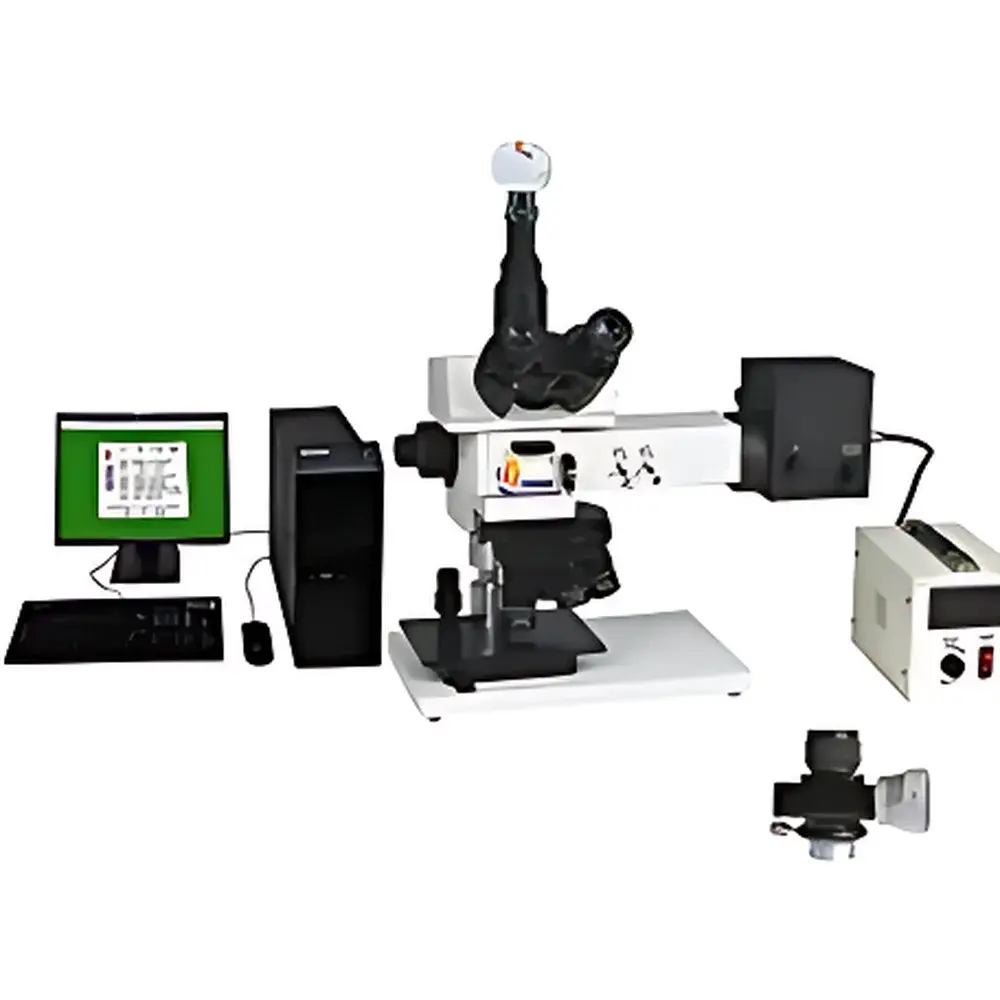
YANRUN 102XB-PC Industrial Upright Metallurgical Microscope with Brightfield, Darkfield and Polarizing Capabilities
| Brand | YANRUN |
|---|---|
| Origin | Shanghai, China |
| Manufacturer Type | Direct Manufacturer |
| Origin Category | Domestic (China) |
| Model | 102XB-PC |
| Microscope Type | Upright |
| Image Analysis System | Not Included |
| Eyepieces | Widefield 10×/25 mm and 10×/20 mm with 0.1 mm reticle scale |
| Objectives | 5×/0.15 (WD 35 mm), 10×/0.28 (WD 35 mm), 20×/0.40 (WD 20 mm), 50×/0.55 (WD 13 mm) |
| Eyepiece Tube | 30° inclined trinocular head (interpupillary adjustment 50–75 mm) |
| Nosepiece | Four-position revolving nosepiece with centering adjustment |
| Stage | 190 × 140 mm mechanical stage, 50 × 40 mm travel range |
| Focus Mechanism | Coaxial coarse/fine focusing with rack-and-pinion drive |
| fine focus graduation | 2 µm |
| Filters | Slide-in green, blue, and neutral density filters |
| Illumination | 12 V / 50 W halogen lamp (AC 85–230 V), adjustable brightness, equipped with aperture and field diaphragms |
| Polarization System | Rotatable analyzer (0–360°), polarizer and analyzer both removable from optical path |
| Calibration Tool | 0.01 mm stage micrometer |
Overview
The YANRUN 102XB-PC is an industrial-grade upright metallurgical microscope engineered for high-precision microstructural analysis of polished metallographic specimens, ceramics, composites, and other opaque materials. Designed around an infinite-conjugate optical pathway, it integrates brightfield (BF), darkfield (DF), and polarized light (POL) observation modes into a single robust platform—enabling comprehensive phase identification, grain boundary delineation, inclusion characterization, and crystallographic orientation assessment. Its modular architecture supports routine QC inspection in foundries, heat treatment facilities, and failure analysis labs, as well as research-grade material evaluation in academic and industrial R&D environments. The system complies with core optical design principles defined in ISO 8578 (microscopes — terminology and definitions) and aligns with ASTM E3-22 (Standard Guide for Preparation of Metallographic Specimens) for specimen illumination and contrast optimization.
Key Features
- Upright configuration optimized for large, heavy, or mounted specimens—ideal for production floor integration and long-term stability during extended imaging sessions.
- Trinocular head with 30° inclination and interpupillary adjustment (50–75 mm) ensures ergonomic viewing and seamless integration with optional digital imaging devices via C-mount adapter (0.5× included).
- Four-position objective turret with centering capability accommodates standardized DIN 295 (M25 × 0.75) objectives; pre-aligned infinity-corrected achromat objectives deliver flat-field, color-corrected images across the full field of view.
- High-precision mechanical stage (190 × 140 mm) with 50 × 40 mm travel range and vernier-scale positioning enables repeatable navigation across multi-site samples—critical for ASTM E112 grain size analysis and serial sectioning workflows.
- Dual-diaphragm Köhler illumination system (aperture + field) ensures uniform, glare-free BF/DF illumination; halogen source (12 V / 50 W) provides stable CCT (~3200 K) and consistent luminance over time, meeting ISO 9241-307 requirements for visual task lighting.
- Full polarization module: rotatable analyzer (0–360° calibrated scale), removable polarizer/analyzer, and strain-free optical path support quantitative birefringence assessment per ISO 10110-5 and ASTM E407 for etched microstructures.
Sample Compatibility & Compliance
The 102XB-PC accepts standard 1″ × 3″ (25 × 75 mm) metallographic mounts, wafer fragments up to 50 mm diameter, and thick-sectioned geological or ceramic samples. Its long-working-distance objectives (WD up to 35 mm) accommodate specimens with elevated surface topography or protective coatings without risk of lens collision. The system supports compliance-driven workflows: BF/DF contrast modes satisfy ISO 4497 (powder metallurgy — metallographic examination), while polarized light functionality enables conformance with ASTM E112 (grain size), ASTM E45 (inclusion rating), and ISO 643 (steel microstructure classification). All optical components are strain-free and certified free of residual birefringence—essential for GLP-regulated metallurgical reporting.
Software & Data Management
While the base configuration excludes proprietary image analysis software, the trinocular port and integrated C-mount interface (0.5× reduction lens) are fully compatible with third-party machine vision platforms compliant with GenICam and USB3 Vision standards. Users may integrate validated software solutions supporting FDA 21 CFR Part 11 audit trails (e.g., Olympus cellSens, Zeiss ZEN Blue, or open-source Fiji/ImageJ with documented validation protocols). Raw image capture preserves metadata including objective ID, magnification, illumination mode, and stage coordinates—facilitating traceability in ISO/IEC 17025-accredited laboratories.
Applications
- Metallurgical QC: Grain size measurement (ASTM E112), inclusion rating (ASTM E45), decarburization depth assessment, and heat-affected zone (HAZ) characterization in weldments.
- Fatigue & Fracture Analysis: Crack path mapping, secondary cracking evaluation, and cleavage vs. ductile fracture morphology differentiation under polarized illumination.
- Coating & Plating Inspection: Thickness uniformity verification, interfacial delamination detection, and porosity quantification using darkfield contrast.
- Advanced Materials: Phase distribution analysis in Ni-based superalloys, Ti-aluminides, and additive-manufactured (AM) metal parts; crystal orientation mapping when coupled with rotating-stage accessories.
- Failure Investigation: Root cause determination in component failures—e.g., identifying temper embrittlement, sigma phase precipitation, or hydrogen-induced cracking via birefringence contrast.
FAQ
Is the 102XB-PC suitable for automated image acquisition and stitching?
Yes—the trinocular port, motorized stage compatibility (via optional precision XY stage with 0.1 µm resolution), and standardized C-mount interface enable integration with tiling and focus-stacking software suites used in automated metallography workflows.
Can the microscope be upgraded to support fluorescence observation?
No—this model lacks epi-illumination capability and filter cube slots required for fluorescence; it is strictly configured for transmitted illumination modes (BF/DF/POL) on reflective specimens.
What calibration documentation is provided?
Each unit ships with a factory-verified stage micrometer (0.01 mm division), objective magnification verification report, and optical alignment certificate conforming to ISO 10110-5 tolerances for polarization optics.
Does the system meet CE or UL safety standards?
The 102XB-PC complies with IEC 61010-1:2010 for electrical safety in laboratory equipment and carries CE marking for EMC and low-voltage directive compliance; UL listing is available upon request for North American deployment.
Are replacement halogen lamps and fuses supplied with the instrument?
One spare 12 V / 50 W halogen lamp and two certified fuses are included in the standard kit; all consumables adhere to IEC 60855 specifications for rated life and thermal stability.



