YANRUN YR-C3020 Heavy-Duty Automated Vision Measuring System
| Brand | YANRUN |
|---|---|
| Origin | Shanghai, China |
| Manufacturer Type | Direct Manufacturer |
| Model | YR-C3020 |
| Operation Mode | Fully Automatic |
| Metal Table Size (mm) | 510 × 290 |
| Glass Table Size (mm) | 360 × 260 |
| Motion Travel (mm) | 300 × 200 |
| Instrument Weight (kg) | 100 |
| Overall Dimensions (mm) | 650 × 800 × 1600 |
| Z-Axis Vertical Travel (mm) | 150 |
| Working Distance (mm) | 108 |
| X/Y/Z Digital Readout Resolution | 1 µm |
| X/Y Axis Accuracy | ≤ (3 + L/200) µm |
| Imaging System | Color 1/3″ CCD Camera |
| Zoom Objective Magnification | 0.7×–4.5× |
| Total Video Magnification | 30×–230× |
| Object Field of View | 7 mm–1.1 mm |
| Illumination | Adjustable LED Surface & Transmission Light Sources |
| Optional Accessories | Interchangeable Lenses, Sony 1/2″ CCD Sensor |
| Power Supply | AC 180–260 V, 50 Hz |
| Measurement Software | Standard Auto-Measurement Suite with Edge Detection, Deburring Algorithm, Geometric Feature Recognition (Points, Lines, Circles, Angles, Center-to-Center Distances), and Coordinate System Alignment |
Overview
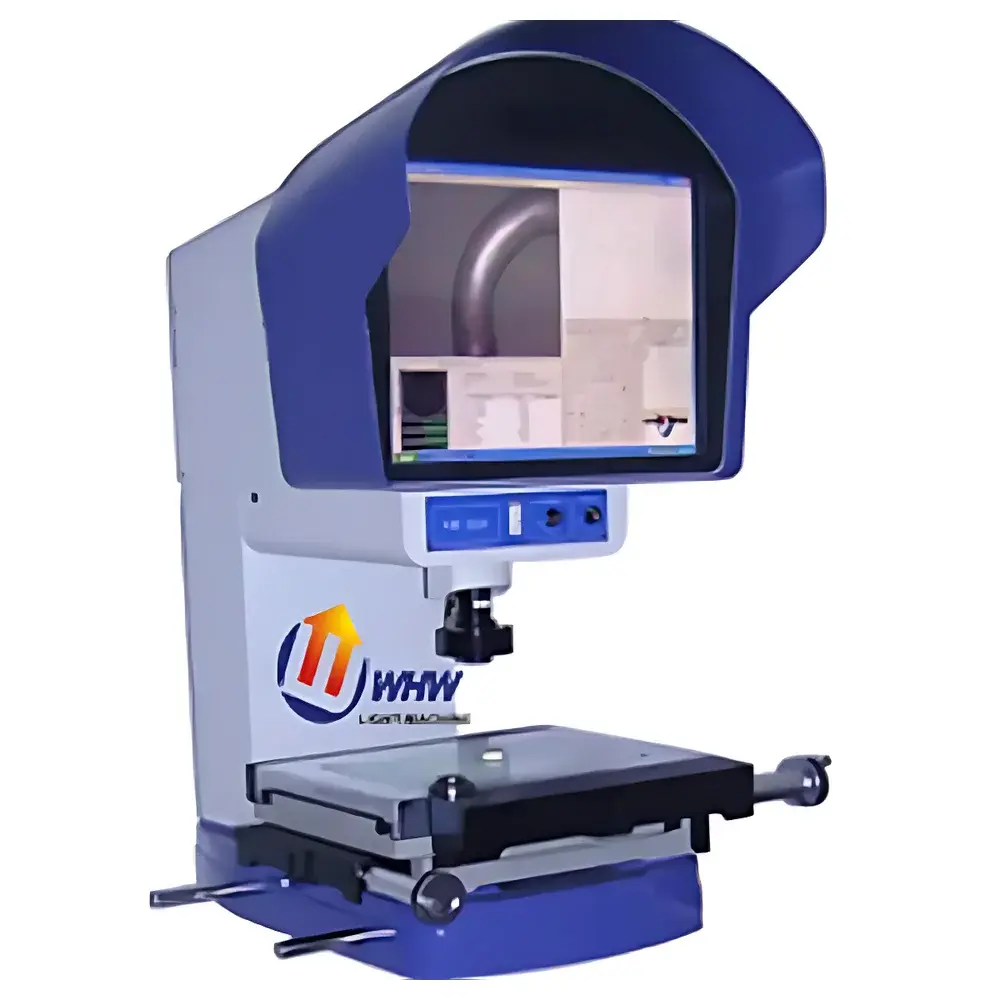
The YANRUN YR-C3020 Heavy-Duty Automated Vision Measuring System is an industrial-grade coordinate metrology platform engineered for high-precision 2D and 2.5D geometric measurement of machined parts, stamped components, PCBs, precision molds, and small mechanical assemblies. Operating on the principle of non-contact optical imaging metrology, the system captures high-resolution video frames via a calibrated zoom optical path and computes dimensional features using sub-pixel edge detection algorithms. Its rigid granite base, reinforced metal stage (510 × 290 mm), and 100 kg structural mass ensure thermal stability and vibration damping—critical for repeatable measurements under workshop conditions. The 300 × 200 mm XY travel range and 150 mm Z-axis lift accommodate tall or stacked workpieces while maintaining a consistent 108 mm working distance—optimized for both surface and through-transmission illumination without refocusing.
Key Features
- Robust mechanical architecture with heavy-duty cast-aluminum frame and precision-ground granite baseplate to minimize thermal drift and mechanical hysteresis.
- Fully automated motion control via servo-driven linear stages, synchronized with real-time image acquisition and feature extraction.
- High-fidelity optical train featuring a 0.7×–4.5× parfocal zoom objective paired with a 1/3″ color CCD sensor (upgradable to Sony 1/2″ for enhanced SNR and dynamic range).
- Dual LED illumination system: independently adjustable coaxial surface lighting for reflective features and bottom-mounted transmitted lighting for transparent or translucent profiles (e.g., gaskets, thin films, glass substrates).
- Micrometer-level resolution: 1 µm digital encoder feedback on all three axes, supporting traceable calibration per ISO 10360-7 and VDI/VDE 2617 Part 6.
- Integrated environmental compensation: software-based correction for minor ambient temperature fluctuations during extended measurement sequences.
Sample Compatibility & Compliance
The YR-C3020 accommodates parts ranging from micro-electromechanical systems (MEMS) components (<5 mm) to large die-cast housings (up to 300 mm in XY footprint). Its 360 × 260 mm optical glass stage enables high-transparency transmission measurements—ideal for semiconductor wafers, optical filters, and precision masks. The system complies with fundamental metrological standards including ISO 14253-1 (Geometrical Product Specifications), GB/T 16857.1–2002 (Chinese national standard equivalent to ISO 10360), and supports audit-ready documentation for ISO 9001, IATF 16949, and AS9100 quality management systems. While not inherently FDA 21 CFR Part 11 compliant, its measurement software architecture allows integration with third-party electronic signature and audit trail modules for regulated manufacturing environments.
Software & Data Management
The embedded auto-measurement software provides deterministic, scriptable workflows for routine inspection tasks. Core capabilities include automatic edge detection with adaptive thresholding, noise-resistant deburring logic, and iterative least-squares fitting for circles, arcs, and lines. Users define GD&T callouts—including true position, concentricity, and profile tolerances—directly within the interface. All measurement results are timestamped, user-logged, and exportable in CSV, DXF, and XML formats compatible with statistical process control (SPC) platforms such as Minitab and InfinityQS. Raw images and coordinate data are stored with embedded calibration metadata, enabling full traceability from measurement to certificate of calibration.
Applications
- Quality assurance of injection-molded plastic housings: wall thickness verification, gate location analysis, and draft angle quantification.
- PCB and flex-circuit inspection: pad geometry, solder mask opening accuracy, drill hole centering, and fiducial alignment validation.
- Tooling and mold shop metrology: electrode wear assessment, cavity depth profiling, and EDM spark erosion uniformity evaluation.
- Aerospace fastener verification: thread pitch, head diameter, shank straightness, and countersink angle against ASME B1.1 and NASM standards.
- Medical device component inspection: stent strut width, catheter tip concentricity, and laser-cut mesh aperture consistency per ISO 13485 requirements.
FAQ
What is the maximum part height that can be measured with full Z-axis travel?
The 150 mm Z-axis stroke permits measurement of parts up to approximately 140 mm tall when using standard lens configurations and maintaining the 108 mm working distance.
Does the system support multi-view stitching for large-area measurements?
No—the YR-C3020 performs single-field-of-view measurements only; panoramic stitching requires optional add-on modules not included in the base configuration.
Can measurement programs be password-protected or version-controlled?
Yes—user access levels (Operator, Programmer, Administrator) are configurable, and program files support manual revision tagging and external backup via network share or USB storage.
Is NIST-traceable calibration certification available?
Factory calibration is performed using certified gauge blocks and step gauges; optional NIST-traceable calibration certificates with uncertainty budgets are available upon request.
What maintenance intervals are recommended for long-term accuracy retention?
Biannual verification of axis linearity and optical magnification calibration is advised; annual cleaning of optical surfaces and re-lubrication of linear guide rails ensures optimal performance over 10+ years of continuous operation.