
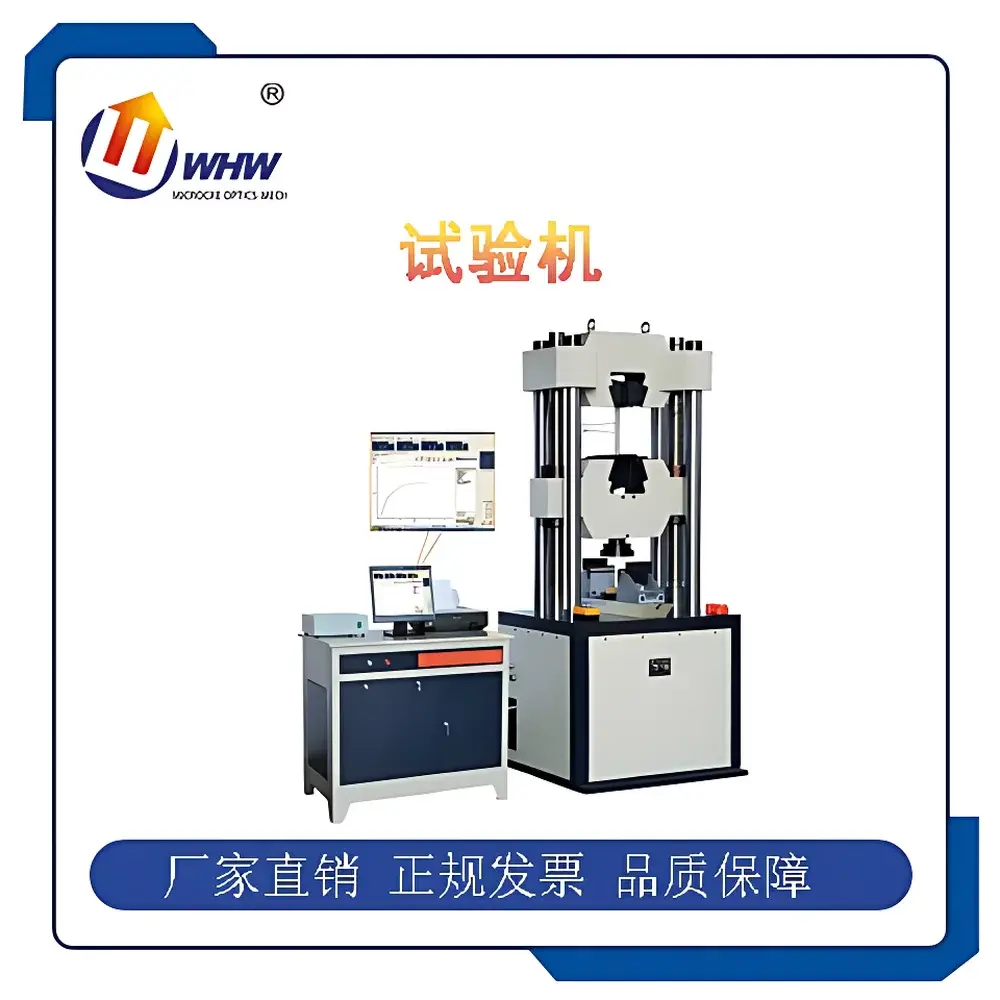
YANRUN MC009-WAW-1000 Microcomputer-Controlled Electro-Hydraulic Servo Universal Testing Machine
| Brand | YANRUN |
|---|---|
| Origin | Shanghai, China |
| Manufacturer Type | Direct Manufacturer |
| Country of Origin | China |
| Model | MC009-WAW-1000 |
| Load Capacity Range | 20–1000 kN |
| Load Accuracy | ±1% or ±0.5% FS |
| Test Classification | Electro-Hydraulic Servo UTM |
| Accuracy Class | ISO 7500-1 Class 0.5 / Class 1 compliant |
| Control Mode | Four-Closed-Loop (Force, Displacement, Strain, Process) |
| Force Resolution | 1/500,000 full scale,不分档 (no range switching) |
| Force Measurement Range | 2–100% FS |
| Stroke | 200 mm |
| Max Piston Speed | 50 mm/min |
| Tensile Space | 700 mm |
| Compression Space | 600 mm |
| Flat Specimen Clamping Thickness | 0–30 mm |
| Round Specimen Clamping Diameter | Φ13–Φ60 mm |
| Bend Span | 350 mm |
| Bend Roller Width | 140 mm |
| Bend Roller Diameter | Φ30 mm |
| Max Deflection | 150 mm |
| Host Dimensions (W×D×H) | 1050 × 660 × 2250 mm |
| Oil Source Dimensions | 950 × 700 × 1150 mm |
| Weight | 3250 kg |
Overview
The YANRUN MC009-WAW-1000 is a high-capacity, microcomputer-controlled electro-hydraulic servo universal testing machine engineered for precision mechanical property evaluation of metallic and non-metallic materials under tension, compression, bending, and shear loading conditions. It operates on the principle of closed-loop hydraulic actuation, where a servo-controlled proportional valve regulates high-pressure oil flow into a bottom-mounted piston-cylinder assembly, enabling accurate force and displacement control in accordance with ISO 7500-1 (Class 0.5 or Class 1), ASTM E4, and ASTM E8/E21 standards. The system features a rigid, two-column, lower-acting frame architecture with upward tensile space (700 mm) and downward compression/bending zones between the moving crosshead and fixed platen—optimized for structural stability and thermal-mechanical isolation during long-duration tests. Its dual-mode load cell calibration (±0.5% or ±1% FS) supports both routine QC verification and high-fidelity R&D characterization across industries including aerospace component validation, civil infrastructure material certification, and advanced alloy development.
Key Features
- Bottom-mounted hydraulic actuator with gap-seal cylinder design ensures minimal internal leakage and long-term pressure stability over extended duty cycles.
- Four-closed-loop digital control system synchronously manages test force, crosshead displacement, extensometer-derived strain, and test progression—enabling complex multi-stage protocols such as cyclic loading, creep, and stress relaxation.
- High-resolution data acquisition: 24-bit A/D conversion with effective resolution up to 1 part in 500,000 full scale, eliminating range-switching artifacts and ensuring linearity across the entire 20–1000 kN operational envelope.
- Dual protection architecture: hardware-based overload cutoff (triggered at >103% FS) and software-enforced stroke limit (upper/lower mechanical end-stop detection) safeguard both equipment integrity and operator safety per ISO 12100 and EN 61800-5-2.
- Modular hydraulic power unit includes high-efficiency AC motor-driven variable-displacement pump, pressure-compensated servo valve, differential pressure monitoring filter, and thermally stabilized reservoir—designed for continuous operation under ambient temperatures from 5°C to 40°C.
- Adjustable crosshead positioning via precision ball-screw transmission driven by stepper motor and planetary gear reducer—achieving repeatable spacing accuracy within ±0.02 mm across full travel range.
Sample Compatibility & Compliance
The MC009-WAW-1000 accommodates standardized specimens per ISO 6892-1, ASTM E8, ASTM E9, ASTM E290, and EN 10002-1. Round specimen clamping spans Φ13–Φ60 mm using hydraulically actuated wedge grips with self-aligning jaw geometry; flat specimen capacity extends to 30 mm thickness with parallel-faced grip faces. Bending fixtures conform to three-point and four-point configurations with adjustable span (350 mm standard), roller diameter (Φ30 mm), and support width (140 mm). All mechanical interfaces comply with ISO 26203-2 for dynamic testing traceability. The system meets GLP audit requirements through configurable electronic logbook, user-access-level permissions, and tamper-evident data archiving—fully compatible with FDA 21 CFR Part 11-compliant software extensions when deployed in regulated pharmaceutical or medical device manufacturing environments.
Software & Data Management
Bundled YANRUN TestMaster v5.2 software provides intuitive graphical workflow configuration, real-time multi-channel visualization (force vs. displacement, stress vs. strain, load-time histories), and automated report generation in PDF, Excel, and XML formats. Calibration coefficients are digitally signed and stored in encrypted EEPROM on the load cell and controller board. Raw data streams are timestamped at 1 kHz sampling rate with hardware-triggered start/stop synchronization. Audit trail functionality records all user actions—including method edits, calibration events, and result exports—with immutable timestamps and operator ID linkage. Exported datasets include metadata headers compliant with ASTM E1434 and ISO/IEC 17025 documentation requirements for accredited laboratories.
Applications
- Mechanical qualification of structural steel grades (Q345, S355JR, ASTM A572) per EN 10025 and ASTM A6/A6M.
- Tensile property mapping of aluminum alloys (6061-T6, 7075-T73) and titanium Ti-6Al-4V for aerospace airframe components.
- Compression testing of concrete cylinders (ASTM C39) and geopolymer composites under controlled strain rates.
- Bending stiffness and fracture toughness assessment of fiber-reinforced polymer laminates (ISO 14125).
- Shear strength evaluation of adhesive bonds in automotive bonding applications (ISO 11339).
- Creep rupture testing of high-temperature superalloys (Inconel 718) under sustained loads up to 1000 kN.
FAQ
What standards does the MC009-WAW-1000 comply with for force measurement accuracy?
It conforms to ISO 7500-1:2018 Class 0.5 (±0.5% FS) or Class 1 (±1% FS), verified using certified reference load cells traceable to NIM (China) or NIST (USA) standards.
Can the system perform strain-controlled testing with an extensometer?
Yes—supports analog and digital extensometers (LVDT or clip-on types) with dedicated 10 V excitation and noise-immune signal conditioning; strain feedback integrates seamlessly into the four-closed-loop control architecture.
Is remote diagnostics and firmware update supported?
The embedded controller features Ethernet TCP/IP interface and supports secure remote access via SSH and HTTPS; firmware updates are delivered as signed binary packages with CRC32 validation.
What maintenance intervals are recommended for the hydraulic system?
Oil filtration requires replacement every 2000 operating hours or annually; hydraulic oil (ISO VG 46 anti-wear mineral oil) must be changed every 4000 hours or biennially—log entries are automatically generated in the maintenance scheduler.
Does the system support integration with third-party LIMS or MES platforms?
Yes—via OPC UA server (IEC 62541 compliant) and RESTful API endpoints for test method upload, job dispatch, and results ingestion; sample ID, operator ID, and test parameters are fully mappable to external schema.



