
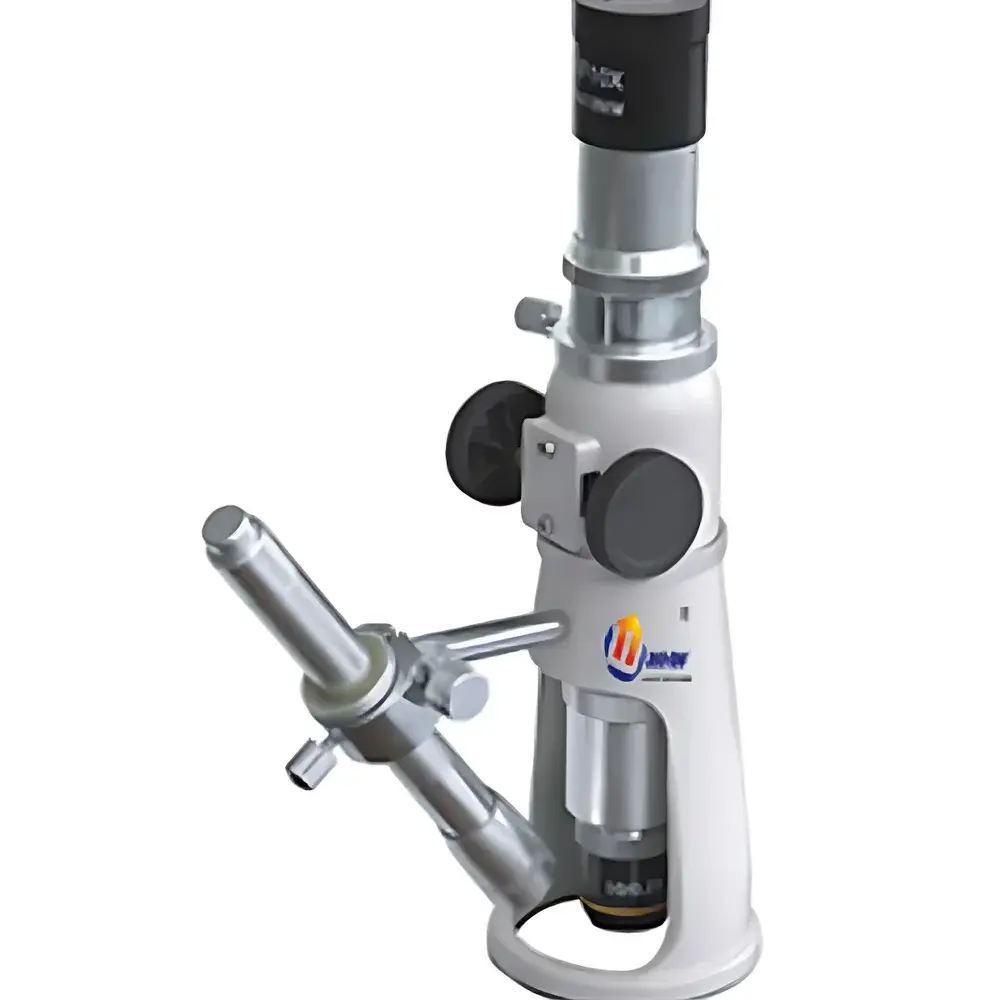
YANRUN HMM-200 Portable Measuring Microscope
| Brand | YANRUN |
|---|---|
| Origin | Shanghai, China |
| Manufacturer Type | Direct Manufacturer |
| Product Category | Domestic (PRC) |
| Model | HMM-200 Portable Measuring Microscope |
| Configuration | Upright |
| Image Analysis System | Not Integrated |
| Eyepiece | Widefield 10× reticle eyepiece (0.1 mm per division) |
| Objective Lenses | Single interchangeable objective — 10× (NA 0.25, WD 7 mm), 5× (NA 0.12, WD 18 mm), 4× (NA 0.10, WD 18 mm), or 2× (NA 0.05, WD 18 mm) |
| Optical Magnification | 20×, 40×, 50×, or 100× (objective-dependent) |
| Mechanical Tube Length | 160 mm |
| Focusing Travel | 30 mm |
| Field of View Diameter | 18 mm |
| Overall Height | 210 mm |
| Net Weight | 0.65 kg |
| Dimensions (L×W×H) | 143 × 63 × 210 mm |
| Illumination | Two AA batteries + integrated pen-type LED lamp |
Overview
The YANRUN HMM-200 Portable Measuring Microscope is a compact, upright optical instrument engineered for field-deployable and workshop-based dimensional inspection of metallic, ceramic, and polymer surfaces. Designed around classical finite-conjugate optics with a standardized 160 mm mechanical tube length, it operates on direct visual observation—without digital imaging hardware—making it ideal for rapid qualitative assessment and manual measurement tasks where portability, battery autonomy, and mechanical robustness are prioritized over automated metrology. Its optical path supports precise linear measurement via a calibrated reticle scale in the widefield 10× eyepiece (0.1 mm per division), enabling direct estimation of feature dimensions—such as grain size, scratch width, coating thickness, or machining marks—on opaque samples requiring reflected-light illumination. The instrument’s lightweight aluminum alloy chassis (0.65 kg), foldable column, and integrated pen-style LED illuminator powered by two AA batteries ensure reliable operation in environments lacking stable power infrastructure, including foundries, on-site quality audits, educational labs, and maintenance depots.
Key Features
- True portable architecture: Compact footprint (143 × 63 × 210 mm), sub-1 kg weight, and self-contained battery-powered illumination enable immediate deployment without external power or mounting fixtures.
- Interchangeable finite-conjugate objectives: Four standard options (2×, 4×, 5×, 10×) with matched numerical apertures (0.05–0.25) and working distances (7–18 mm) allow optimization for depth-of-field, resolution, and sample clearance requirements.
- Calibrated reticle eyepiece: Widefield 10× eyepiece with engraved 0.1 mm/division scale enables repeatable manual measurements under consistent viewing geometry; scale accuracy traceable to mechanical calibration standards.
- Mechanical focusing system: Coaxial coarse/fine focusing mechanism with 30 mm total travel provides stable vertical positioning across varying sample topographies.
- Dedicated metallurgical illumination: Integrated pen-type LED delivers uniform coaxial or oblique reflected light—critical for contrast enhancement on polished, etched, or as-machined metallographic specimens.
- No embedded electronics or software: Eliminates firmware dependencies, cybersecurity concerns, and compatibility constraints—ensuring long-term operational continuity and compliance with legacy QA workflows.
Sample Compatibility & Compliance
The HMM-200 accommodates solid, non-transparent specimens up to 18 mm in height (dictated by longest working distance objective) and unrestricted planar dimensions, provided they fit beneath the objective lens. It is routinely applied to polished metallographic mounts, fracture surfaces, solder joints, printed circuit board traces, and wear debris analysis substrates. While not certified to ISO/IEC 17025 or ASTM E3 for laboratory accreditation, its optical design conforms to fundamental principles outlined in ASTM E883 (Standard Guide for Reflected Light Photomicrography) and ISO 4287 (Geometrical Product Specifications — Surface texture). Its manual measurement methodology aligns with internal manufacturing work instructions compliant with IATF 16949 and ISO 9001 requirements for first-article and in-process inspection.
Software & Data Management
The HMM-200 does not incorporate onboard imaging sensors, data logging, or proprietary software. Measurement records are documented manually in controlled notebooks or electronic spreadsheets, supporting full auditability under GLP and GMP frameworks where handwritten entries with operator signature, date, and instrument ID are mandated. Users may integrate external USB microscopes or DSLR adapters (not supplied) for documentation purposes—though such configurations fall outside factory calibration scope and require independent validation per ISO/IEC 17025 Clause 5.9.
Applications
- On-site metallographic evaluation during heat treatment verification or casting inspection.
- Rapid verification of machined feature dimensions (e.g., thread root radius, chamfer width, burr height) in toolrooms and CNC shops.
- Educational demonstration of microstructural features (ferrite/pearlite ratios, dendritic segregation, inclusion morphology) in materials science laboratories.
- Field-level failure analysis of coated components, weld interfaces, or abrasive wear patterns.
- Calibration cross-checking of coordinate measuring machine (CMM) probe tip geometry using reference artifacts.
FAQ
Is the HMM-200 suitable for quantitative image analysis?
No. It lacks an integrated camera or digital capture interface. Quantitative analysis requires external imaging hardware and third-party metrology software.
Can the reticle scale be recalibrated?
Yes—using NIST-traceable stage micrometers or certified line-pair standards; recalibration must be performed by qualified personnel and documented per internal QA procedures.
What is the expected battery life under continuous use?
Approximately 12–15 hours with two fresh AA alkaline cells, depending on ambient temperature and LED drive current.
Does the microscope support Kohler illumination?
No. Its fixed LED configuration provides critical illumination but does not permit Köhler alignment; contrast optimization relies on objective selection and manual focus adjustment.
Is the instrument compliant with FDA 21 CFR Part 11?
Not applicable—no electronic records or signatures are generated. Manual logbooks remain the sole source of record and satisfy Part 11 requirements when maintained per SOP.





