
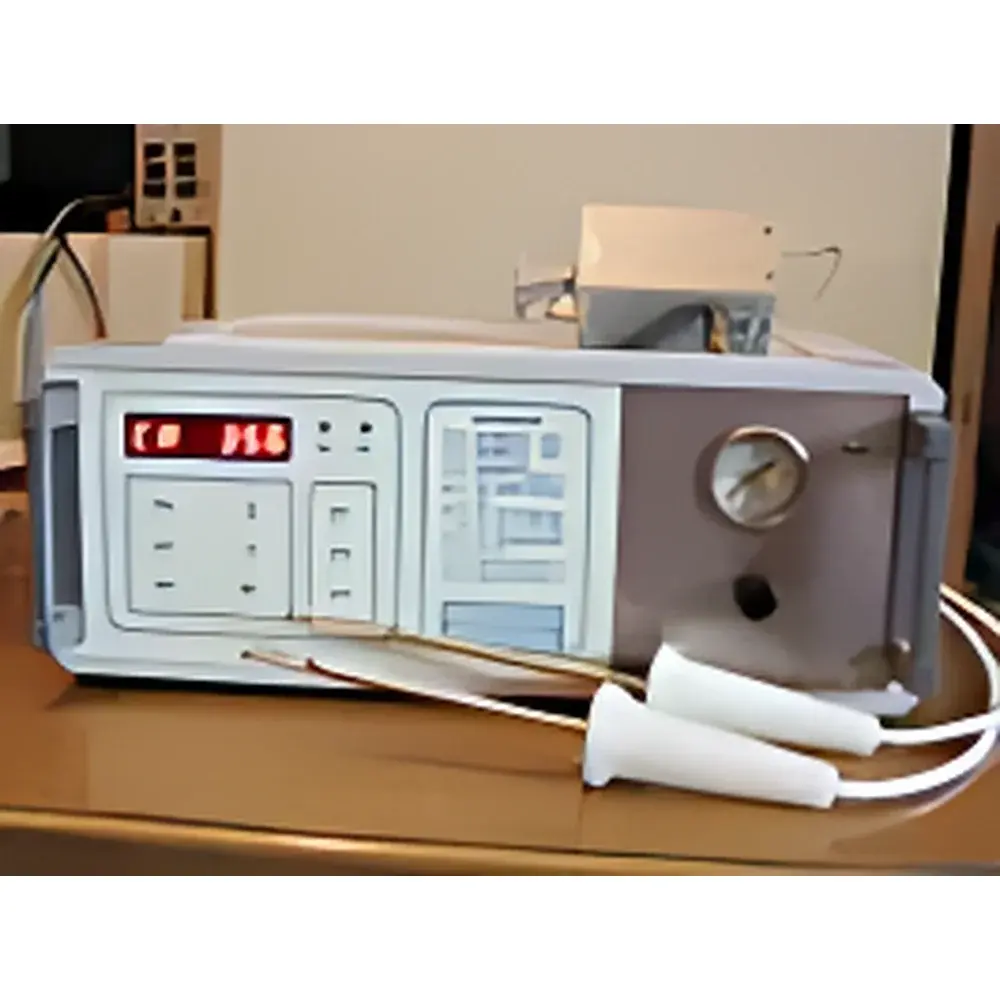
Pyrolyzer LJ-100 Microprocessor-Controlled Tube-Furnace Pyrolyzer
| Origin | Beijing, China |
|---|---|
| Manufacturer Type | Authorized Distributor |
| Origin Category | Domestic (China) |
| Model | LJ-100 |
| Instrument Type | Tube-Furnace Pyrolyzer |
| Pyrolysis Cell Temp Range | 5–400 °C (1 °C increment) |
| Probe Temp Range | 300–1200 °C (10 °C increment), 5-step programmable ramp |
| Probe Heating Rate | 0.01–20 °C/ms (11 selectable steps) |
| Probe Hold Time | 10 ms–99 s (10 ms increment) |
| Cleaning Temp | 1200 °C for 5 s |
| Dimensions | 387 × 245 × 130 mm (L×W×H) |
| Power | 250 W |
| Weight | 7 kg |
Overview
The Pyrolyzer LJ-100 is a microprocessor-controlled, tube-furnace-based pyrolysis system engineered for direct coupling with gas chromatography (GC) instruments. It operates on the principle of controlled thermal degradation—rapid, reproducible heating of solid or viscous polymeric samples under inert atmosphere to generate volatile fragment ions and low-molecular-weight characteristic markers. Unlike solvent-extraction or derivatization-dependent sample preparation methods, the LJ-100 enables flash pyrolysis directly at the GC inlet, minimizing analyte loss, contamination risk, and method development time. Its design adheres to fundamental requirements for trace-level structural elucidation of macromolecules—including synthetic polymers, biopolymers, rubbers, coatings, and environmental microplastics—where conventional GC injection is impractical due to thermal lability or non-volatility.
Key Features
- High-precision platinum-wire and platinum-foil pyrolysis probe offering exceptional thermal stability, oxidation resistance, and consistent heat transfer across repeated cycles.
- Five-stage programmable temperature ramping for probe heating, enabling multi-step thermal profiling (e.g., desorption → primary cleavage → secondary rearrangement) critical for mechanistic interpretation of decomposition pathways.
- Microsecond-level temporal resolution in heating control: adjustable heating rates from 0.01 to 20 °C/ms across 11 discrete settings, ensuring compatibility with both fast-pyrolysis screening and slow-ramp kinetic studies.
- Dedicated high-temperature cleaning cycle (1200 °C for 5 s) integrated into method sequencing to eliminate carbonaceous residue and maintain baseline integrity over extended operational periods.
- Onboard memory supporting up to 10 user-defined pyrolysis methods, each storing full temperature-time profiles, hold durations, and cooling parameters—facilitating rapid method recall and inter-laboratory protocol standardization.
- Compact benchtop footprint (387 × 245 × 130 mm) and low power consumption (250 W) enable seamless integration into regulated QC labs, academic research facilities, and forensic analysis suites without requiring dedicated utility infrastructure.
Sample Compatibility & Compliance
The LJ-100 accepts solid, gel, film, fiber, and particulate samples—ranging from mg-scale polymer pellets to µg-level forensic trace evidence—without pre-grinding or solvent dissolution. It supports ASTM D7216 (Standard Practice for Pyrolysis-GC Analysis of Polymers), ISO 17242 (Plastics — Determination of composition by pyrolysis–gas chromatography), and aligns with USP and ICH Q5C guidelines for polymer characterization in pharmaceutical excipient testing. All temperature setpoints, ramp profiles, and method executions are logged with timestamped audit trails, satisfying GLP/GMP documentation requirements per FDA 21 CFR Part 11 when used with compliant data acquisition software.
Software & Data Management
While the LJ-100 operates as a standalone hardware module, its digital interface supports RS-232 or USB communication with third-party GC control platforms (e.g., Agilent OpenLab, Thermo Chromeleon, Shimadzu GCsolution). Method parameters—including probe temperature ramp sequences, dwell times, and cleaning triggers—are configurable via ASCII command protocol or vendor-supplied configuration utilities. Raw event logs (start/stop timestamps, actual vs. setpoint deviations, fault codes) are exportable in CSV format for integration into LIMS environments and long-term trend analysis of instrument performance and method robustness.
Applications
- Polymer identification and compositional analysis in quality control of elastomers, thermoplastics, and composites.
- Microplastic source attribution in environmental water, sediment, and biota samples (per EPA Method 8270D adaptations).
- Forensic paint chip layer differentiation and adhesive binder profiling in criminalistics.
- Thermal stability assessment and degradation mechanism mapping for biomedical polymers (e.g., PLGA, PCL) under accelerated aging conditions.
- Residue analysis of catalysts, carbon blacks, and charred organic matter in petrochemical feedstock evaluation.
FAQ
Can the LJ-100 be interfaced with all major GC brands?
Yes—it features universal analog/digital trigger outputs and serial command compatibility with Agilent, Thermo Fisher, Shimadzu, PerkinElmer, and Bruker GC systems.
Is the platinum probe replaceable, and what is its typical service life?
The probe is field-replaceable using standard tools; under routine use (≤50 pyrolysis cycles/day), average service life exceeds 1,200 runs before calibration drift exceeds ±1.5 °C.
Does the system support inert gas purging during pyrolysis?
Yes—the unit includes a dedicated inlet for helium or nitrogen purge gas (flow rate 20–60 mL/min), configurable via external mass flow controller.
How is temperature accuracy validated and maintained?
Each unit undergoes NIST-traceable calibration at three points (300 °C, 700 °C, 1000 °C) prior to shipment; users may perform periodic verification using certified reference materials such as polystyrene dimer (RSD ≤2%).
What safety protections are built into the LJ-100?
Over-temperature cutoff (1250 °C hard limit), open-circuit detection for probe integrity monitoring, and automatic cooldown lockout until surface temperature falls below 60 °C.





