
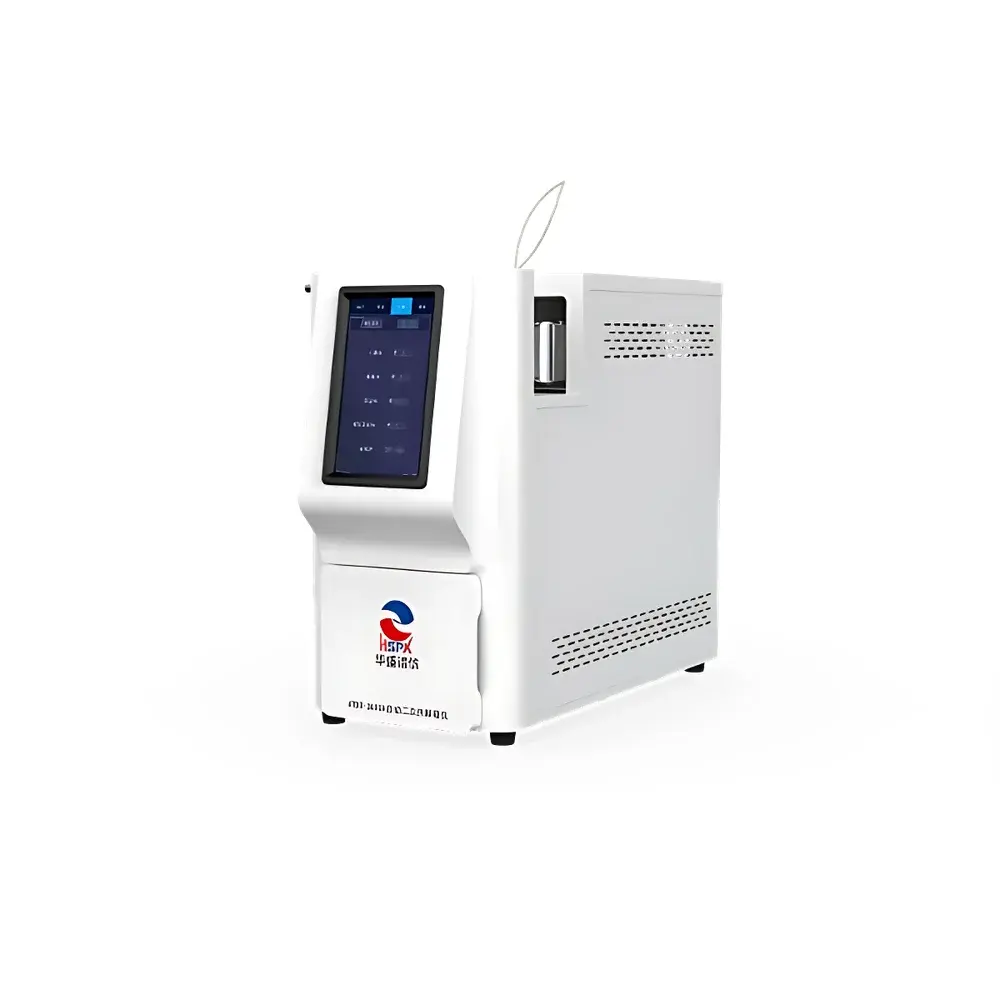
HuaShengPuXin ATDS-3600A Single-Position Automated Two-Stage Thermal Desorber
| Brand | HuaShengPuXin (HSPX) |
|---|---|
| Origin | Beijing, China |
| Manufacturer Type | Direct Manufacturer |
| Instrument Type | Two-Stage Thermal Desorber |
| Automation Level | Semi-Automatic |
| Primary Desorption Temp Range | Ambient to 350 °C |
| Valve Inlet Temp Range | Ambient to 220 °C |
| Transfer Line Temp Range | Ambient to 200 °C |
| Cryo-Focusing Trap Temp Range | −35 °C to 50 °C |
| Temperature Control Accuracy | ±1 °C |
| Desorption Recovery Rate | >98% |
| Sample Position Capacity | 1 |
Overview
The HuaShengPuXin ATDS-3600A is a single-position, semi-automated two-stage thermal desorber engineered for precise, reproducible pre-concentration and introduction of volatile organic compounds (VOCs) from sorbent tubes into gas chromatography (GC) or gas chromatography–mass spectrometry (GC–MS) systems. It operates on the principle of sequential thermal desorption: first-stage desorption releases analytes from the sorbent tube into a cryogenically focused trap; second-stage desorption rapidly injects the thermally refocused analytes as a narrow band into the GC column. This dual-stage architecture enhances sensitivity, improves peak shape, and minimizes breakthrough and carryover—critical for trace-level environmental, occupational health, and indoor air quality analysis. Designed for compliance-driven laboratories, the ATDS-3600A supports method-defined temperature ramping (up to 2500 °C/min for secondary desorption), electronic cryo-cooling (no liquid nitrogen required), and independent, digitally controlled heating zones for primary desorption, valve manifold, transfer line, and cold trap.
Key Features
- Electronic Peltier-based cryo-focusing trap with programmable temperature range from −35 °C to +50 °C, enabling robust, maintenance-free low-temperature trapping without cryogens.
- Independent PID-controlled heating zones: primary desorption furnace (ambient–350 °C), valve inlet (ambient–220 °C), transfer line (ambient–200 °C), and secondary desorption zone (ambient–350 °C).
- High-precision temperature control with ±1 °C accuracy and 1 °C incremental setpoint resolution across all zones.
- Optimized thermal desorption kinetics: secondary desorption rate up to 2500 °C/min ensures sharp, narrow analyte bands for superior chromatographic resolution.
- Proven desorption recovery >98% for C2–C12 VOCs—including benzene, toluene, xylenes (BTX), styrene, aldehydes, and halogenated hydrocarbons—validated per EPA TO-17 and ISO 16017-1 protocols.
- Compact benchtop footprint (220 × 400 × 500 mm) and low power consumption (650 W rated) suit space-constrained analytical labs.
Sample Compatibility & Compliance
The ATDS-3600A is fully compatible with standard 6-mm OD stainless steel or quartz sorbent tubes (e.g., Tenax TA, Carbopack B/C, Carboxen 1000, or multi-bed configurations) used in regulated air sampling. It meets instrumental requirements for all cited Chinese national and environmental standards—including HJ 583–2010, HJ 644–2013, HJ 734–2014, and GBZ/T 300 series—ensuring method-compliant data generation for regulatory reporting. Its thermal stability, low memory effect, and quantitative recovery performance align with ISO/IEC 17025 quality system expectations for accredited testing laboratories. While not inherently 21 CFR Part 11 compliant, its operation supports GLP/GMP workflows when integrated with validated LIMS or chromatography data systems (CDS) that provide audit trails and electronic signatures.
Software & Data Management
The ATDS-3600A operates via an embedded microprocessor with front-panel keypad and LCD interface, supporting full parameter programming (ramp rates, hold times, cooling cycles) and real-time temperature monitoring. All method parameters—including desorption profiles, trap conditioning sequences, and purge cycles—are stored locally and recallable per sample batch. For integration into automated lab environments, RS-232 or optional USB communication enables synchronization with GC/GC–MS instrument control software (e.g., Agilent OpenLab, Thermo Chromeleon, or Shimadzu GCsolution). Method files can be exported for documentation, and thermal event logs are timestamped for traceability—facilitating internal QA reviews and external audit readiness.
Applications
- Environmental monitoring: ambient air, stack emissions, and fugitive VOC source testing per HJ 734–2014 and HJ 644–2013.
- Indoor air quality (IAQ) assessment: formaldehyde, TVOC, and specific odorants in residential, commercial, and school buildings (GB 50325–2020, GB/T 18883–2022, GB 36246–2018).
- Occupational hygiene: time-weighted average (TWA) and short-term exposure limit (STEL) measurements of solvents and aromatics in workplace air (GBZ/T 300.62/66/68–2017).
- Automotive cabin air analysis: VOC and carbonyl compound profiling per HJ/T 400–2007.
- Public health surveillance: airborne chemical pollutants in hospitals, schools, and transportation hubs (GB/T 18204.2–2014).
FAQ
Does the ATDS-3600A require liquid nitrogen for cold trapping?
No—it uses solid-state Peltier cooling to achieve −35 °C, eliminating cryogen handling, storage, and associated safety protocols.
Can it be used with GC–MS systems?
Yes; its rapid secondary desorption and low-dead-volume transfer path ensure compatibility with both quadrupole and high-resolution GC–MS platforms.
Is method validation support available?
HuaShengPuXin provides application notes and baseline recovery data per ISO 16017-1; users are responsible for in-house system suitability testing per their SOPs and regulatory scope.
What maintenance is required for long-term reliability?
Routine checks include sorbent tube o-ring integrity, valve seal inspection, and periodic bake-out of the transfer line and trap; no scheduled calibration is mandated beyond annual temperature verification using NIST-traceable probes.
How is data integrity ensured during unattended runs?
All thermal events are logged with timestamps and parameter settings; when paired with compliant CDS software, full audit trail, user access control, and electronic signature capabilities are achievable.





