
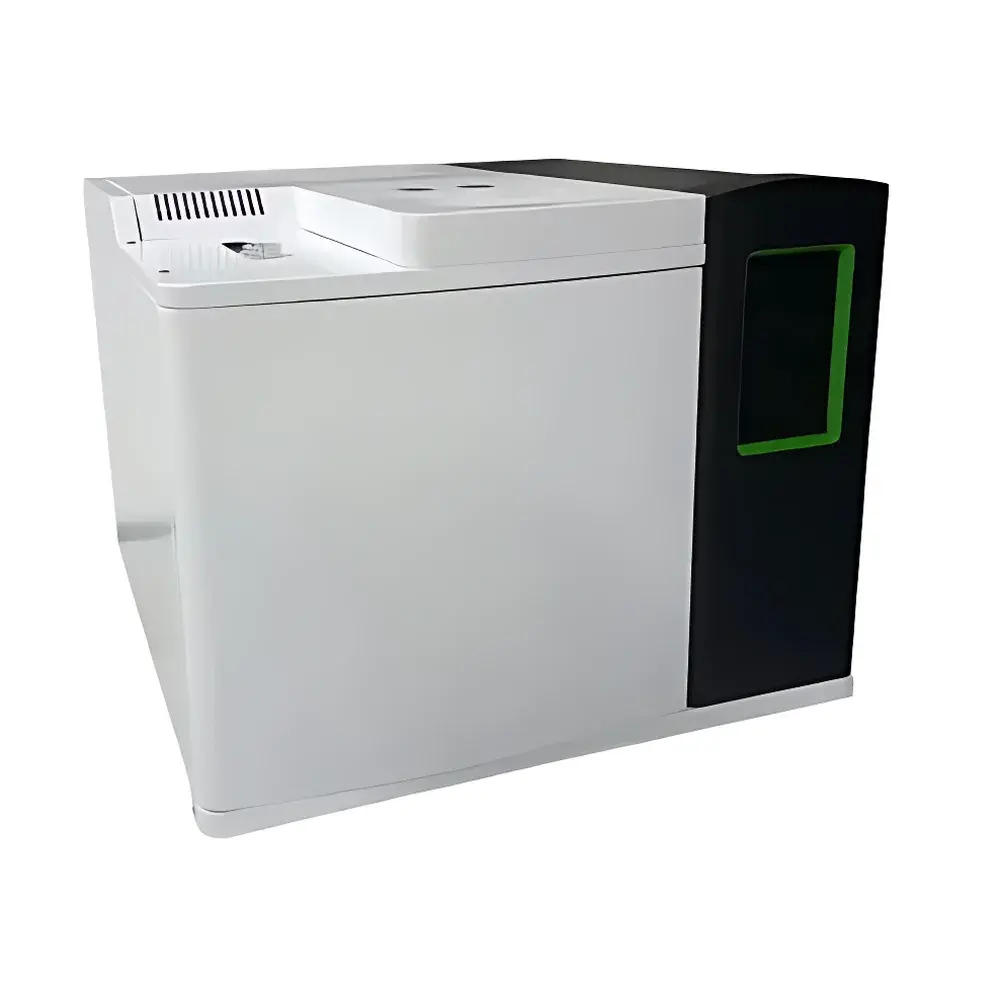
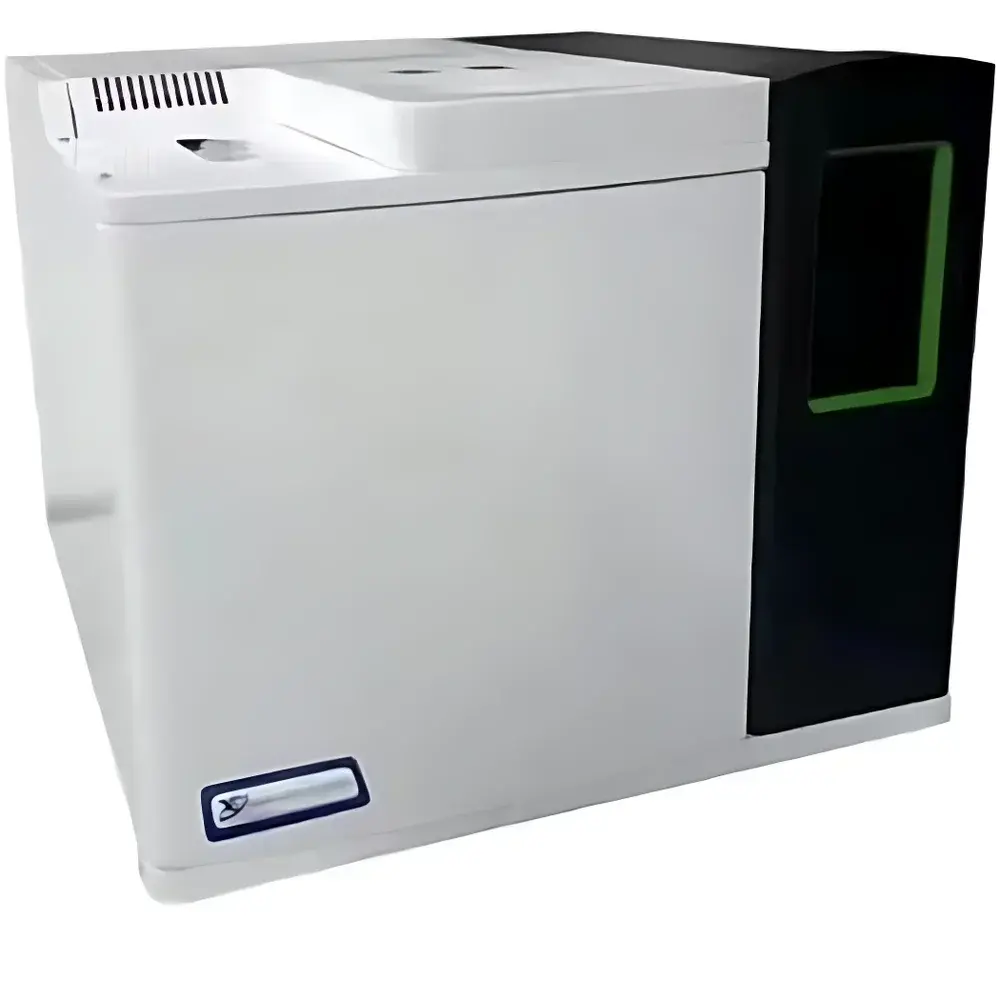
HuaShengPuXin HSPX-LPG-DME-Methanol Dedicated Gas Chromatograph
| Brand | HuaShengPuXin (HSPX) |
|---|---|
| Origin | Beijing, China |
| Manufacturer Type | Direct Manufacturer |
| Instrument Type | Laboratory Gas Chromatograph |
| Application Field | Petrochemical Industry |
| Oven Temperature Range | Ambient +5°C to 400°C |
| Temperature Ramp Rate | 0.1–40°C/min |
| Cooling Rate | 400°C → 50°C in ~6 min |
| Carrier Gas Flow Range & Control | 0–1200 mL/min |
| Carrier Gas Pressure Range & Control | 0–0.6 MPa |
| Injector Maximum Operating Temperature | 400°C |
| Injector Pressure Setting Range | 0–0.6 MPa |
| Injector Total Flow Setting Range | 0–1200 mL/min |
| Detector | Thermal Conductivity Detector (TCD) |
| TCD Sensitivity | ≥3000 mV·mL/mg (benzene) |
| TCD Baseline Drift | ≤3% of full scale per hour |
| Column | 3 mm ID × 6 m stainless steel packed column |
| Injection Mode | 6-port gas sampling valve |
| Display & Control | Microprocessor-controlled with backlit LCD and Chinese-language keypad |
Overview
The HuaShengPuXin HSPX-LPG-DME-Methanol Dedicated Gas Chromatograph is a purpose-engineered laboratory gas chromatograph designed for precise, routine quantification of dimethyl ether (DME), methanol, and hydrocarbon components in liquefied petroleum gas (LPG) matrices. It operates on the fundamental principle of gas-solid or gas-liquid partition chromatography, where sample components are volatilized, separated on a thermally stable stainless-steel packed column, and detected via a high-stability thermal conductivity detector (TCD). Unlike general-purpose GC systems, this instrument integrates application-specific hardware configuration—including a dedicated 3 mm × 6 m stainless-steel column optimized for C₁–C₄ hydrocarbons, DME, and methanol resolution—and firmware-level method templates aligned with ASTM D2158, GB/T 13290, and SH/T 0230 standards for LPG compositional analysis. Its microprocessor-based control architecture ensures reproducible temperature programming, robust carrier gas regulation, and real-time system diagnostics—critical for compliance-driven petrochemical QA/QC environments.
Key Features
- Integrated 6-port gas sampling valve with precise dead-volume minimization for repeatable gaseous injection of LPG samples
- Thermal conductivity detector (TCD) calibrated for high sensitivity (≥3000 mV·mL/mg using benzene) and low baseline drift (≤3% FS/h), enabling reliable detection of trace DME (down to 0.05 vol%) in propane/butane matrices
- Column oven with ±0.1°C temperature uniformity across ambient +5°C to 400°C range, supporting both isothermal and programmable ramp profiles (0.1–40°C/min)
- Dual independent gas control modules: digitally regulated carrier gas pressure (0–0.6 MPa) and mass flow (0–1200 mL/min), ensuring consistent retention time stability across multi-day analyses
- Injector zone rated to 400°C with pressure and total flow programmability—compatible with both liquid and vapor-phase introduction
- Real-time self-diagnostic system monitoring 36 operational parameters; displays fault codes and step-by-step remediation guidance on the backlit LCD interface
- Patented “gas-loss protection” function automatically halts analysis and alerts the operator upon carrier gas interruption, preventing column damage and data corruption
Sample Compatibility & Compliance
This GC is validated for direct analysis of commercial LPG (propane/butane blends), refinery-grade DME, and methanol-contaminated cylinder gas without derivatization or pre-concentration. Sample introduction uses standardized 1 mL gas-tight syringe injection or automated 6-port valve actuation per ISO 6974-1 and GB/T 12205. The system supports GLP-compliant operation through audit-trail-capable method storage, user-access-level permissions, and electronic signature-ready run logs. While not FDA 21 CFR Part 11-certified out-of-the-box, its firmware architecture allows integration with validated LIMS platforms meeting pharmaceutical and regulatory QA requirements. All thermal zones meet IEC 61010-1 safety standards for laboratory equipment.
Software & Data Management
The embedded firmware provides full method development, sequence scheduling, and peak integration via intuitive Chinese-language menu navigation. Raw chromatograms and processed reports (area %, corrected area %, external standard calibration curves) are exportable in CSV and PDF formats. Optional PC-based ChromaLink Pro software (sold separately) adds multi-instrument fleet management, spectral library matching, and automated report generation compliant with ISO/IEC 17025 documentation requirements. All calibration data—including TCD bridge current settings, column aging logs, and retention index tracking—are timestamped and user-annotatable.
Applications
- Quantitative determination of DME adulteration in LPG fuel per SH/T 0663 and EN 15376
- Simultaneous assay of propane, propylene, n-butane, isobutane, butylenes, DME, and methanol in refinery off-gas streams
- Batch release testing of commercial DME feedstock for purity specification (≥99.5% v/v)
- Monitoring methanol carryover in amine-treated LPG desulfurization units
- Educational training in hydrocarbon separation mechanics and TCD response characteristics
FAQ
What column is recommended for optimal DME/methanol resolution in LPG?
A 3 mm ID × 6 m stainless-steel column packed with GDX-502 or Porapak Q is factory-validated for baseline separation of DME from propane and methanol from butanes under specified isothermal conditions (45°C oven, 30 mL/min H₂ carrier).
Is hydrogen safe to use as carrier gas with this TCD system?
Yes—hydrogen is the preferred carrier for enhanced sensitivity and faster analysis times. The instrument includes leak-tested gas lines, pressure relief valves, and automatic shutoff logic compliant with CGA G-1.1 guidelines.
Can this GC be upgraded for FID detection?
No. This model is hardwired for TCD-only operation. For flame ionization detection, consider the HSPX-GC-FID series with dual-detector switching capability.
Does the system support unattended overnight operation?
Yes—scheduled sequences with auto-shutdown, cooling, and standby mode are fully supported. Internal battery-backed clock maintains time integrity during power interruptions.
What maintenance intervals are recommended for routine LPG analysis?
TCD filament cleaning every 200 injections; column bake-out at 250°C for 2 hours monthly; carrier gas filter replacement every 6 months or 1000 operating hours—whichever occurs first.



